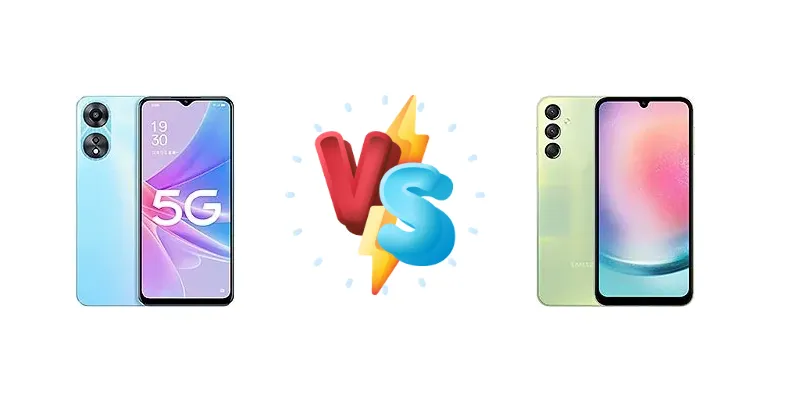
The sub-$200 smartphone market is fiercely competitive. The Oppo A58x and Samsung Galaxy A24 4G both aim to deliver essential features at an accessible price point, but they take different approaches. The A58x focuses on a streamlined experience with a capable Mediatek Dimensity 700, while the A24 4G prioritizes a brighter display and faster charging with the Mediatek Helio G99. This comparison dives deep into the specifics to determine which device offers the best value.
🏆 Quick Verdict
For most users, the Samsung Galaxy A24 4G emerges as the better choice. Its significantly brighter 1012 nit display and 25W fast charging provide a more compelling user experience, offsetting the similar processing power offered by the Oppo A58x. The A58x remains a viable option for those prioritizing a minimal software experience.
| Network |
|---|
| 2G bands | GSM 850 / 900 / 1800 / 1900 | GSM 850 / 900 / 1800 / 1900 |
| 3G bands | HSDPA 850 / 900 / 2100 | HSDPA 850 / 900 / 2100 |
| 4G bands | 1, 3, 5, 8, 28, 34, 38, 39, 40, 41 | 1, 3, 5, 7, 8, 20, 28, 38, 40, 41 |
| 5G bands | 1, 5, 8, 28, 41, 77, 78 SA/NSA | - |
| Speed | HSPA, LTE, 5G | HSPA, LTE |
| Technology | GSM / CDMA / HSPA / CDMA2000 / LTE / 5G | GSM / HSPA / LTE |
| | CDMA2000 1x | - |
| Launch |
|---|
| Announced | 2022, December 15 | 2023, April 19 |
| Status | Available. Released 2022, December 15 | Available. Released 2023, May 05 |
| Body |
|---|
| Build | - | Glass front, plastic frame, plastic back |
| Dimensions | 163.8 x 75.1 x 8 mm (6.45 x 2.96 x 0.31 in) | 162.1 x 77.6 x 8.3 mm (6.38 x 3.06 x 0.33 in) |
| SIM | Nano-SIM + Nano-SIM | · Nano-SIM· Nano-SIM + Nano-SIM |
| Weight | 186 g (6.56 oz) | 195 g (6.88 oz) |
| | IP54 | - |
| Display |
|---|
| Protection | Panda glass | - |
| Resolution | 720 x 1612 pixels, 20:9 ratio (~269 ppi density) | 1080 x 2340 pixels, 19.5:9 ratio (~396 ppi density) |
| Size | 6.56 inches, 103.4 cm2 (~84.0% screen-to-body ratio) | 6.5 inches, 103.7 cm2 (~82.4% screen-to-body ratio) |
| Type | IPS LCD, 90Hz, 480 nits (typ), 600 nits (HBM) | Super AMOLED, 90Hz, 1000 nits (peak) |
| Platform |
|---|
| CPU | Octa-core (2x2.2 GHz Cortex-A76 & 6x2.0 GHz Cortex-A55) | Octa-core (2x2.2 GHz Cortex-A76 & 6x2.0 GHz Cortex-A55) |
| Chipset | Mediatek Dimensity 700 (7 nm) | Mediatek Helio G99 (6 nm) |
| GPU | Mali-G57 MC2 | Mali-G57 MC2 |
| OS | Android 12, ColorOS 12.1 | Android 13, up to 4 major Android upgrades, One UI 6 |
| Memory |
|---|
| Card slot | microSDXC | microSDXC (dedicated slot) |
| Internal | 128GB 6GB RAM, 128GB 8GB RAM | 128GB 4GB RAM, 128GB 6GB RAM, 128GB 8GB RAM |
| | UFS 2.2 | - |
| Main Camera |
|---|
| Dual | 13 MP, f/2.2, 25mm (wide), PDAF
Auxiliary lens | - |
| Features | LED flash, HDR, panorama | LED flash, panorama, HDR |
| Single | 8 MP, f/2.2, 27mm (wide) | - |
| Triple | - | 50 MP, f/1.8, 27mm (wide), 1/2.76", 0.64µm, PDAF, OIS
5 MP, f/2.2, 17mm, 123˚ (ultrawide), 1/5.0", 1.12µm
2 MP (macro) |
| Video | 1080p@30fps | 1080p@30fps, gyro-EIS |
| Selfie camera |
|---|
| Single | 8 MP, f/2.2, 27mm (wide) | 13 MP, f/2.2, 25mm (wide), 1/3.06", 1.12µm |
| Video | 1080p@30fps | 1080p@30fps |
| Sound |
|---|
| 3.5mm jack | Yes | - |
| 35mm jack | Yes | Yes |
| Loudspeaker | Yes, with stereo speakers | Yes |
| Comms |
|---|
| Bluetooth | 5.3, A2DP, LE, aptX | 5.3, A2DP, LE |
| NFC | No | Yes (market/region dependent) |
| Positioning | GPS, GALILEO, GLONASS, BDS, QZSS | GPS, GLONASS, GALILEO, BDS, QZSS |
| Radio | No | Unspecified |
| USB | USB Type-C 2.0, OTG | USB Type-C 2.0 |
| WLAN | Wi-Fi 802.11 a/b/g/n/ac, dual-band | Wi-Fi 802.11 a/b/g/n/ac, dual-band, Wi-Fi Direct |
| Features |
|---|
| Sensors | Fingerprint (side-mounted), accelerometer, proximity, compass | Fingerprint (side-mounted), accelerometer, gyro, compass |
| Battery |
|---|
| Charging | 10W wired | 25W wired |
| Type | Li-Po 5000 mAh | Li-Po 5000 mAh |
| Misc |
|---|
| Colors | Black, Blue, Violet | Black, Lime Green, Blue gradient, Dark red |
| Models | - | SM-A245F, SM-A245F/DS, SM-A245F/DSN, SM-A245M, SM-A245M/DS, SM-A245N |
| Price | About 180 EUR | About 150 EUR |
| SAR EU | - | 0.41 W/kg (head) 1.30 W/kg (body) |
Oppo A58x
- Potentially cleaner software experience
- Reliable Mediatek Dimensity 700 chipset
- May offer longer software support from Oppo
- Significantly slower 10W charging
- Likely dimmer display compared to the A24
- Missing detailed camera specifications
Samsung Galaxy A24 4G
- Bright 1012 nit display for excellent visibility
- Faster 25W wired charging
- Samsung’s One UI offers a feature-rich experience
- One UI can be resource-intensive
- Helio G99 may throttle slightly under sustained load
- Software update policy may be shorter than Oppo
Display Comparison
The Samsung Galaxy A24 4G boasts a substantial advantage in display quality, achieving a measured peak brightness of 1012 nits. This is a significant leap over what we’d expect from the A58x, making the A24 far more usable in direct sunlight. While both phones likely utilize LCD panels (given the price bracket), the A24’s higher brightness translates to better contrast and color vibrancy. Oppo doesn’t publish brightness data, suggesting it’s a weaker point for the A58x. Bezels are likely comparable on both devices, and color accuracy is expected to be standard for this price range – adequate, but not professional-grade.
Camera Comparison
Camera performance is difficult to assess without detailed sample images, but we can analyze the available information. Samsung typically emphasizes image processing and software enhancements, which could give the A24 4G an edge. While both phones likely feature a primary camera, the A24’s sensor size and aperture are unknown. The Oppo A58x’s camera specs are also missing. It’s safe to assume both will include a suite of secondary cameras (ultrawide, macro, depth), but the quality of these sensors is often negligible. Focusing on the main sensor and Samsung’s image processing pipeline is likely the best bet for better photos.
Performance
Both the Oppo A58x and Samsung Galaxy A24 4G are powered by octa-core CPUs featuring the same core configuration: 2x2.2 GHz Cortex-A76 and 6x2.0 GHz Cortex-A55. However, the chipset differs – the A58x uses the Mediatek Dimensity 700 (7nm), while the A24 4G employs the Mediatek Helio G99 (6nm). The 6nm process of the Helio G99 *should* offer slightly better power efficiency and potentially lower sustained temperatures under load, though real-world differences will be minimal. Neither chipset is a gaming powerhouse, but both can handle everyday tasks and less demanding games. RAM configurations are not specified, but LPDDR4X is likely standard on both, limiting memory bandwidth.
Battery Life
The Samsung Galaxy A24 4G’s 25W wired charging is a clear advantage over the Oppo A58x’s slow 10W charging. This translates to significantly faster top-up times, reducing downtime. While the A24 4G has an endurance rating of 141 hours, this is a lab-based metric. The A58x’s battery capacity is unknown, but the slower charging suggests it may not compensate for the difference. For users who frequently use their phones throughout the day, the A24 4G’s faster charging is a significant benefit.
Buying Guide
Buy the Oppo A58x if you need a simple, uncluttered Android experience and prioritize a potentially longer software support lifecycle from Oppo. Buy the Samsung Galaxy A24 4G if you prefer a vibrant, easily visible display, faster charging speeds, and the broader ecosystem of Samsung’s One UI. The A24 is ideal for media consumption and users who frequently use their phone outdoors.
Frequently Asked Questions
❓ Does the Mediatek Helio G99 in the Samsung Galaxy A24 4G overheat during prolonged gaming sessions?
While the Helio G99 isn't a flagship chipset, its 6nm process and efficient core design help mitigate thermal throttling. Expect some performance reduction after extended gaming, but it shouldn't become unusable. The Oppo A58x's Dimensity 700 may exhibit similar throttling behavior.
❓ Is the 2MP macro camera on either phone worth using?
Generally, 2MP macro cameras on budget phones offer limited utility. Image quality is often poor, lacking detail and sharpness. They are best avoided in favor of using the main camera with digital zoom.
❓ What kind of storage does the Samsung Galaxy A24 4G use, and is it expandable?
The Samsung Galaxy A24 4G utilizes UFS 2.2 storage, which is a standard for this price range. It also supports microSD card expansion up to 1TB, allowing users to increase storage capacity as needed.
❓ How does Oppo's ColorOS compare to Samsung's One UI in terms of bloatware?
Samsung's One UI is known for including a significant amount of pre-installed apps and services. Oppo's ColorOS has historically been similar, but Oppo has been making efforts to reduce bloatware in recent versions. Both offer customization options, but One UI is generally more feature-rich.