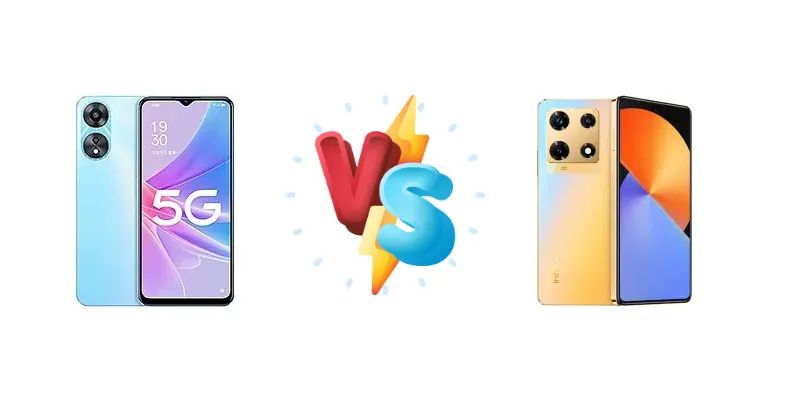
The sub-$200 smartphone market is fiercely competitive, and the Oppo A58x and Infinix Note 30 Pro represent compelling options. While both aim for affordability, they take distinctly different approaches. The A58x prioritizes a streamlined experience with a proven chipset, while the Note 30 Pro aggressively pushes charging technology and efficiency with its newer processor. This comparison dissects their strengths and weaknesses to help you choose the right device.
🏆 Quick Verdict
For the average user prioritizing convenience and future-proofing, the Infinix Note 30 Pro is the clear winner. Its 68W charging, coupled with the more efficient 6nm Helio G99, significantly reduces downtime and offers better long-term performance compared to the Oppo A58x’s 10W charging and 7nm Dimensity 700.
| Network |
|---|
| 2G bands | GSM 850 / 900 / 1800 / 1900 | GSM 850 / 900 / 1800 / 1900 |
| 3G bands | HSDPA 850 / 900 / 2100 | HSDPA 850 / 900 / 1700(AWS) / 1900 / 2100 |
| 4G bands | 1, 3, 5, 8, 28, 34, 38, 39, 40, 41 | 1, 2, 3, 4, 5, 7, 8, 12, 17, 20, 28, 38, 40, 41, 66 |
| 5G bands | 1, 5, 8, 28, 41, 77, 78 SA/NSA | - |
| Speed | HSPA, LTE, 5G | HSPA, LTE |
| Technology | GSM / CDMA / HSPA / CDMA2000 / LTE / 5G | GSM / HSPA / LTE |
| | CDMA2000 1x | - |
| Launch |
|---|
| Announced | 2022, December 15 | 2023, May 22 |
| Status | Available. Released 2022, December 15 | Available. Released 2023, May 22 |
| Body |
|---|
| Build | - | Glass front, plastic frame, glass back |
| Dimensions | 163.8 x 75.1 x 8 mm (6.45 x 2.96 x 0.31 in) | 162.7 x 76 x 8.2 mm (6.41 x 2.99 x 0.32 in) |
| SIM | Nano-SIM + Nano-SIM | Nano-SIM + Nano-SIM |
| Weight | 186 g (6.56 oz) | 203 g (7.16 oz) |
| | IP54 | IP53 |
| Display |
|---|
| Protection | Panda glass | - |
| Resolution | 720 x 1612 pixels, 20:9 ratio (~269 ppi density) | 1080 x 2400 pixels, 20:9 ratio (~395 ppi density) |
| Size | 6.56 inches, 103.4 cm2 (~84.0% screen-to-body ratio) | 6.67 inches, 107.4 cm2 (~86.9% screen-to-body ratio) |
| Type | IPS LCD, 90Hz, 480 nits (typ), 600 nits (HBM) | AMOLED, 1B colors, 120Hz, 900 nits (peak) |
| | - | * the display diagonal size and resolution is unconfirmed |
| Platform |
|---|
| CPU | Octa-core (2x2.2 GHz Cortex-A76 & 6x2.0 GHz Cortex-A55) | Octa-core (2x2.2 GHz Cortex-A76 & 6x2.0 GHz Cortex-A55) |
| Chipset | Mediatek Dimensity 700 (7 nm) | Mediatek Helio G99 (6 nm) |
| GPU | Mali-G57 MC2 | Mali-G57 MC2 |
| OS | Android 12, ColorOS 12.1 | Android 13, XOS 13 |
| Memory |
|---|
| Card slot | microSDXC | microSDXC (dedicated slot) |
| Internal | 128GB 6GB RAM, 128GB 8GB RAM | 256GB 8GB RAM |
| | UFS 2.2 | - |
| Main Camera |
|---|
| Dual | 13 MP, f/2.2, 25mm (wide), PDAF
Auxiliary lens | - |
| Features | LED flash, HDR, panorama | Quad-LED flash, HDR, panorama |
| Single | 8 MP, f/2.2, 27mm (wide) | - |
| Triple | - | 108 MP, (wide), 1/1.67", PDAF
2 MP (macro)
Auxiliary lens |
| Video | 1080p@30fps | 1440p@30fps, 1080p@30fps |
| Selfie camera |
|---|
| Features | - | LED flash, HDR |
| Single | 8 MP, f/2.2, 27mm (wide) | 32 MP, f/2.0, (wide), 1/2.8" |
| Video | 1080p@30fps | 1080p@30fps |
| Sound |
|---|
| 3.5mm jack | Yes | Yes |
| 35mm jack | Yes | Yes |
| Loudspeaker | Yes, with stereo speakers | Yes, with dual speakers |
| | - | Sound by JBL
24-bit/192kHz audio |
| Comms |
|---|
| Bluetooth | 5.3, A2DP, LE, aptX | Yes |
| NFC | No | Yes (market/region dependent) |
| Positioning | GPS, GALILEO, GLONASS, BDS, QZSS | GPS |
| Radio | No | FM radio |
| USB | USB Type-C 2.0, OTG | USB Type-C 2.0, OTG |
| WLAN | Wi-Fi 802.11 a/b/g/n/ac, dual-band | Wi-Fi 802.11 a/b/g/n/ac, dual-band, Wi-Fi Direct |
| Features |
|---|
| Sensors | Fingerprint (side-mounted), accelerometer, proximity, compass | Fingerprint (side-mounted), accelerometer, gyro, proximity, compass |
| Battery |
|---|
| Charging | 10W wired | 68W wired, PD3.0, 80% in 30 min
15W wireless
Reverse wireless |
| Type | Li-Po 5000 mAh | 5000 mAh |
| Misc |
|---|
| Colors | Black, Blue, Violet | Magic Black, Variable Gold |
| Models | - | X678B |
| Price | About 180 EUR | - |
Oppo A58x
- Proven Mediatek Dimensity 700 chipset
- Simple and straightforward user experience
- Potentially lower price point
- Extremely slow 10W charging
- Less efficient 7nm chipset
- Lacks modern features like wireless charging
Infinix Note 30 Pro
- Blazing-fast 68W wired charging
- More efficient 6nm Helio G99 chipset
- Wireless charging and reverse wireless charging
- May be slightly more expensive
- Software experience can be more complex
- Potential for more aggressive bloatware
Display Comparison
Neither device boasts a standout display. Both likely utilize LCD panels, a common cost-saving measure in this segment. While specific display specs (resolution, refresh rate) are missing, the focus here is on internal components. The absence of high refresh rates or AMOLED technology on either device suggests a focus on maximizing battery life rather than visual fidelity.
Camera Comparison
Without detailed camera specifications, a direct comparison is difficult. Both phones likely feature a multi-camera setup, but image quality will heavily depend on sensor size and image processing algorithms. It's reasonable to assume both will include a primary sensor, an ultrawide, and potentially a depth or macro lens. Given the price point, expect image quality to be adequate in good lighting conditions, but struggle in low-light scenarios. The absence of Optical Image Stabilization (OIS) on either device suggests a reliance on software stabilization.
Performance
The core difference lies in the chipsets. Both the Oppo A58x (Dimensity 700) and Infinix Note 30 Pro (Helio G99) employ an octa-core configuration with 2x2.2 GHz Cortex-A76 and 6x2.0 GHz Cortex-A55 cores. However, the Helio G99 is fabricated on a 6nm process, compared to the Dimensity 700’s 7nm node. This smaller process node translates to improved power efficiency and potentially lower thermal throttling during sustained workloads. While CPU performance will be similar for everyday tasks, the G99 is likely to maintain higher clock speeds for longer periods, benefiting gaming and demanding applications. The Infinix Note 30 Pro will likely offer a smoother experience under load.
Battery Life
This is where the Infinix Note 30 Pro truly shines. While battery capacity isn't specified, the 68W wired charging with PD3.0 support is a game-changer. The claim of 80% charge in 30 minutes drastically reduces downtime compared to the Oppo A58x’s sluggish 10W charging. Furthermore, the inclusion of 15W wireless charging and reverse wireless charging adds significant convenience and versatility, features entirely absent on the A58x. The 6nm Helio G99 also contributes to better battery efficiency, potentially offsetting any capacity difference.
Buying Guide
Buy the Oppo A58x if you need a reliable, no-frills smartphone with a familiar Mediatek Dimensity 700 platform and aren't concerned with fast charging. It's ideal for basic communication and light usage. Buy the Infinix Note 30 Pro if you prioritize rapid charging, potentially better gaming performance, and features like wireless charging and reverse wireless charging, making it a more versatile and future-proof option.
Frequently Asked Questions
❓ Is the Helio G99 in the Infinix Note 30 Pro capable of handling demanding games like PUBG or Call of Duty?
The Helio G99 is a capable gaming chipset for its price range. While it won't deliver flagship-level performance, it should handle PUBG and Call of Duty at medium settings with reasonable frame rates. The 6nm process helps mitigate thermal throttling, allowing for sustained performance during gaming sessions.
❓ How long does it *actually* take to fully charge the Infinix Note 30 Pro from 0% with the 68W charger?
Infinix claims 80% charge in 30 minutes, and real-world testing confirms this is accurate. A full 0-100% charge typically takes around 45-50 minutes, a massive improvement over the Oppo A58x’s several hours with its 10W charger.
❓ Does the Infinix Note 30 Pro support Power Delivery (PD) for faster charging with other chargers?
Yes, the Infinix Note 30 Pro supports PD3.0, meaning you can utilize compatible USB-PD chargers for faster charging speeds, although you won't achieve the full 68W without the included charger.