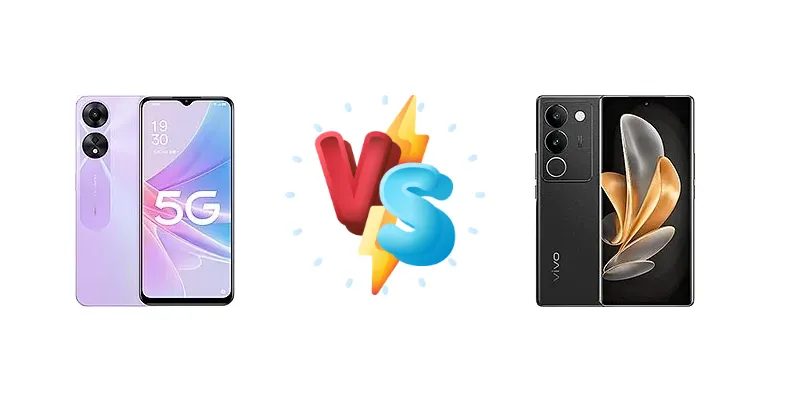
The Oppo A58 (China) and vivo S17t represent distinct approaches to the mid-range smartphone market. The A58 focuses on providing a solid, reliable experience at a budget price point, while the S17t aims for a more premium feel with a focus on faster charging and improved processing power. This comparison dissects the core differences between these two devices, helping you determine which best suits your needs.
🏆 Quick Verdict
For the average user prioritizing performance and convenience, the vivo S17t is the clear winner. Its Dimensity 8050 chipset delivers a substantial performance uplift over the A58’s Dimensity 700, and the 80W charging drastically reduces downtime. However, budget-conscious users who prioritize value will find the A58 a capable daily driver.
| Network |
|---|
| 2G bands | GSM 850 / 900 / 1800 / 1900 | GSM 850 / 900 / 1800 / 1900 |
| 3G bands | HSDPA 850 / 900 / 2100 | HSDPA 850 / 900 / 1700(AWS) / 1900 / 2100 |
| 4G bands | 1, 3, 5, 8, 28, 34, 38, 39, 40, 41 | 1, 3, 4, 5, 8, 28, 34, 38, 39, 40, 41 |
| 5G bands | 1, 5, 8, 28, 41, 77, 78 SA/NSA | 1, 3, 5, 8, 28, 38, 40, 41, 77, 78 SA/NSA |
| Speed | HSPA, LTE, 5G | HSPA, LTE, 5G |
| Technology | GSM / CDMA / HSPA / CDMA2000 / LTE / 5G | GSM / CDMA / HSPA / CDMA2000 / LTE / 5G |
| Launch |
|---|
| Announced | 2022, November 08 | 2023, May 31 |
| Status | Available. Released 2022, November 10 | Available. Released 2023, June 08 |
| Body |
|---|
| Dimensions | 163.8 x 75 x 8 mm (6.45 x 2.95 x 0.31 in) | 164.2 x 74.4 x 7.5 mm (6.46 x 2.93 x 0.30 in) |
| SIM | Nano-SIM + Nano-SIM | Nano-SIM + Nano-SIM |
| Weight | 188 g (6.63 oz) | 186 g (6.56 oz) |
| Display |
|---|
| Resolution | 720 x 1612 pixels, 20:9 ratio (~269 ppi density) | 1260 x 2800 pixels, 20:9 ratio (~453 ppi density) |
| Size | 6.56 inches, 103.4 cm2 (~84.2% screen-to-body ratio) | 6.78 inches, 111.0 cm2 (~90.8% screen-to-body ratio) |
| Type | IPS LCD, 90Hz, 480 nits (typ), 600 nits (HBM) | AMOLED, 1B colors, 120Hz, HDR10+, 1300 nits (peak) |
| Platform |
|---|
| CPU | Octa-core (2x2.2 GHz Cortex-A76 & 6x2.0 GHz Cortex-A55) | Octa-core (1x3.0 GHz Cortex-A78 & 3x2.6 GHz Cortex-A78 & 4x2.0 GHz Cortex-A55) |
| Chipset | Mediatek Dimensity 700 (7 nm) | Mediatek Dimensity 8050 (6 nm) |
| GPU | Mali-G57 MC2 | Mali-G77 MC9 |
| OS | Android 12, ColorOS 12.1 | Android 13, OriginOS 3 |
| Memory |
|---|
| Card slot | microSDXC | No |
| Internal | 128GB 6GB RAM, 128GB 8GB RAM, 256GB 8GB RAM | 512GB 12GB RAM |
| Main Camera |
|---|
| Dual | 50 MP, f/1.8, 27mm (wide), PDAF
Auxiliary lens | 50 MP, f/1.9, (wide), 1/1.56", 1.0µm, PDAF, OIS
8 MP, f/2.2, (ultrawide) |
| Features | LED flash, HDR, panorama | Color spectrum sensor, Ring-LED flash, panorama, HDR |
| Video | 1080p@30fps | 4K@30fps, 1080p@30fps |
| Selfie camera |
|---|
| Features | - | Dual-LED flash, HDR |
| Single | 8 MP, f/2.0, 27mm (wide) | 50 MP, f/2.0, 22mm (wide), AF |
| Video | 1080p@30fps | 1080p@30fps |
| Sound |
|---|
| 35mm jack | Yes | No |
| Loudspeaker | Yes, with stereo speakers | Yes |
| Comms |
|---|
| Bluetooth | 5.3, A2DP, LE, aptX | 5.2, A2DP, LE, aptX HD |
| NFC | No | Yes |
| Positioning | GPS, GALILEO, GLONASS, BDS, QZSS | GPS (L1), GLONASS (G1), BDS (B1I), GALILEO (E1), QZSS (L1) |
| Radio | No | No |
| USB | USB Type-C 2.0, OTG | USB Type-C 2.0, OTG |
| WLAN | Wi-Fi 802.11 a/b/g/n/ac, dual-band | Wi-Fi 802.11 a/b/g/n/ac/6, dual-band, Wi-Fi Direct |
| Features |
|---|
| Sensors | Fingerprint (side-mounted), accelerometer, proximity, compass | Fingerprint (under display, optical), accelerometer, gyro, proximity, compass |
| Battery |
|---|
| Charging | 33W wired | 80W wired, 70% in 30 min |
| Type | Li-Po 5000 mAh | 4600 mAh |
| Misc |
|---|
| Colors | Black, Blue, Violet | Black, Blue, Pink |
| Price | About 230 EUR | About 400 EUR |
Oppo A58 (China)
- More affordable price point
- Reliable performance for basic tasks
- Decent battery life (assuming moderate capacity)
- Significantly slower performance compared to the S17t
- Slower 33W charging
- Likely lower quality camera system
vivo S17t
- Much faster Dimensity 8050 processor
- Ultra-fast 80W charging
- Potentially better camera system
- Higher price tag
- May experience more thermal throttling under heavy load (though 6nm helps)
- Potentially smaller battery capacity (unconfirmed)
Display Comparison
Neither device's display specifications are provided, so a direct comparison is limited. However, given the S17t's positioning as a slightly more premium device, it's reasonable to expect a higher quality panel – potentially with a higher peak brightness and more accurate color reproduction. The A58 likely utilizes a standard LCD panel to keep costs down. Bezels are likely comparable, given both target a similar market segment. Without specific data, it's difficult to assess color accuracy or refresh rates.
Camera Comparison
Without detailed camera specifications, a precise comparison is impossible. However, the S17t’s higher price point suggests a more sophisticated camera system. It’s likely to feature a larger main sensor and potentially optical image stabilization (OIS), resulting in better low-light performance and sharper images. The A58 likely relies on a more basic camera setup, prioritizing affordability over image quality. The inclusion of a 2MP macro lens on either device is unlikely to significantly impact the overall camera experience.
Performance
The core difference lies in the chipsets. The vivo S17t’s Mediatek Dimensity 8050 (6nm) is a significant upgrade over the Oppo A58’s Dimensity 700 (7nm). The 8050 features a more powerful CPU configuration – a 1x3.0 GHz Cortex-A78 core alongside 3x2.6 GHz Cortex-A78 cores, compared to the A58’s 2x2.2 GHz Cortex-A76 and 6x2.0 GHz Cortex-A55 setup. This translates to a noticeable improvement in CPU-intensive tasks and gaming. The 6nm process node of the 8050 also contributes to better power efficiency and potentially less thermal throttling under sustained load. While both phones likely utilize LPDDR4X RAM, the S17t’s superior chipset will be the primary performance driver.
Battery Life
The battery capacity for both devices is unknown. However, the vivo S17t’s 80W wired charging is a game-changer. It can reportedly reach 70% charge in just 30 minutes, offering a significant convenience advantage over the Oppo A58’s 33W charging. Even if the A58 has a slightly larger battery capacity, the S17t’s faster charging will likely result in less downtime. The faster charging also suggests better power management ICs within the S17t.
Buying Guide
Buy the Oppo A58 (China) if you need a dependable smartphone for everyday tasks like browsing, social media, and light gaming, and are on a strict budget. Buy the vivo S17t if you prioritize smoother multitasking, faster app loading times, a more responsive gaming experience, and the convenience of incredibly fast charging, even if it means spending more.
Frequently Asked Questions
❓ Will the Dimensity 8050 in the vivo S17t handle demanding games like Genshin Impact at high settings?
Yes, the Dimensity 8050 is a capable chipset that should handle Genshin Impact and other demanding games at high settings, though you may need to adjust graphics settings for optimal frame rates and to minimize thermal throttling. The A58’s Dimensity 700 will struggle with these titles at higher settings.
❓ How much faster is the 80W charging on the vivo S17t compared to the 33W charging on the Oppo A58 in real-world use?
The 80W charging on the S17t is dramatically faster. While the A58 will take well over an hour to fully charge, the S17t can reach 70% charge in just 30 minutes, and a full charge will likely take around 45-50 minutes. This difference is particularly noticeable for users who frequently need to top up their battery quickly.
❓ Is the difference in performance between the Dimensity 8050 and 700 noticeable for everyday tasks like browsing and social media?
While both chips are capable of handling everyday tasks, the Dimensity 8050 in the S17t will provide a noticeably smoother and more responsive experience. App loading times will be faster, multitasking will be more fluid, and the overall user interface will feel snappier.