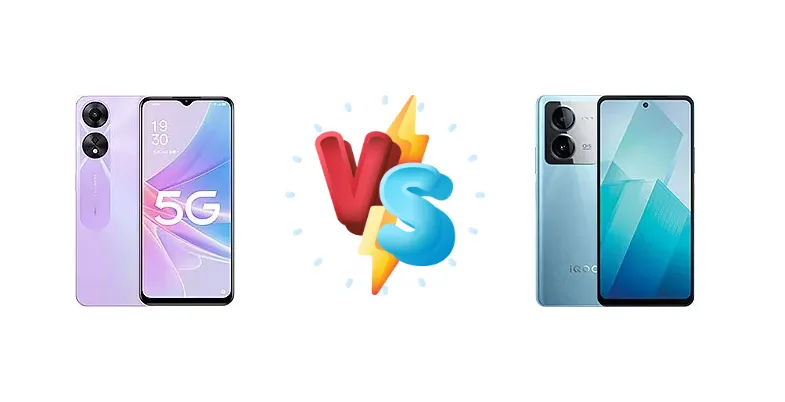
The Oppo A58 (China) and vivo iQOO Z8 represent distinct approaches to the competitive Chinese mid-range smartphone market. The A58 focuses on providing a reliable, everyday experience at an accessible price point, while the iQOO Z8 aggressively targets performance enthusiasts with a flagship-level chipset and blazing-fast charging. This comparison dissects their key differences to help you determine which device best aligns with your needs.
🏆 Quick Verdict
For the average user prioritizing value and a smooth daily experience, the Oppo A58 is a solid choice. However, the iQOO Z8 is the clear winner for gamers and power users, thanks to the significantly more powerful Dimensity 8200 and its industry-leading 120W charging, justifying its higher price.
| Network |
|---|
| 2G bands | GSM 850 / 900 / 1800 / 1900 | GSM 850 / 900 / 1800 / 1900 |
| 3G bands | HSDPA 850 / 900 / 2100 | HSDPA 850 / 900 / 2100 |
| 4G bands | 1, 3, 5, 8, 28, 34, 38, 39, 40, 41 | 1, 3, 5, 8, 28, 34, 38, 39, 40, 41 |
| 5G bands | 1, 5, 8, 28, 41, 77, 78 SA/NSA | 1, 5, 8, 28, 41, 77, 78 SA/NSA |
| Speed | HSPA, LTE, 5G | HSPA, LTE, 5G |
| Technology | GSM / CDMA / HSPA / CDMA2000 / LTE / 5G | GSM / CDMA / HSPA / CDMA2000 / LTE / 5G |
| Launch |
|---|
| Announced | 2022, November 08 | 2023, August 31 |
| Status | Available. Released 2022, November 10 | Available. Released 2023, September |
| Body |
|---|
| Dimensions | 163.8 x 75 x 8 mm (6.45 x 2.95 x 0.31 in) | 164.6 x 75.8 x 8.8 mm (6.48 x 2.98 x 0.35 in) |
| SIM | Nano-SIM + Nano-SIM | Nano-SIM + Nano-SIM |
| Weight | 188 g (6.63 oz) | 200 g (7.05 oz) |
| Display |
|---|
| Resolution | 720 x 1612 pixels, 20:9 ratio (~269 ppi density) | 1080 x 2388 pixels (~395 ppi density) |
| Size | 6.56 inches, 103.4 cm2 (~84.2% screen-to-body ratio) | 6.64 inches, 106.8 cm2 (~85.6% screen-to-body ratio) |
| Type | IPS LCD, 90Hz, 480 nits (typ), 600 nits (HBM) | IPS LCD, 120Hz |
| Platform |
|---|
| CPU | Octa-core (2x2.2 GHz Cortex-A76 & 6x2.0 GHz Cortex-A55) | Octa-core (1x3.1 GHz Cortex-A78 & 3x3.0 GHz Cortex-A78 & 4x2.0 GHz Cortex-A55) |
| Chipset | Mediatek Dimensity 700 (7 nm) | Mediatek Dimensity 8200 (4 nm) |
| GPU | Mali-G57 MC2 | Mali-G610 MC6 |
| OS | Android 12, ColorOS 12.1 | Android 13, OriginOS 3 |
| Memory |
|---|
| Card slot | microSDXC | No |
| Internal | 128GB 6GB RAM, 128GB 8GB RAM, 256GB 8GB RAM | 256GB 8GB RAM, 256GB 12GB RAM, 512GB 12GB RAM |
| Main Camera |
|---|
| Dual | 50 MP, f/1.8, 27mm (wide), PDAF
Auxiliary lens | 64 MP, f/1.8, (wide), 1/2.0", 0.7µm, PDAF, OIS
Auxiliary lens |
| Features | LED flash, HDR, panorama | Dual-LED dual-tone flash, HDR, panorama |
| Video | 1080p@30fps | 4K@30fps, 1080p@30fps |
| Selfie camera |
|---|
| Single | 8 MP, f/2.0, 27mm (wide) | 16 MP, f/2.5, (wide) |
| Video | 1080p@30fps | 1080p@30fps |
| Sound |
|---|
| 35mm jack | Yes | Yes |
| Loudspeaker | Yes, with stereo speakers | Yes |
| Comms |
|---|
| Bluetooth | 5.3, A2DP, LE, aptX | 5.3, A2DP, LE, aptX HD |
| NFC | No | Yes |
| Positioning | GPS, GALILEO, GLONASS, BDS, QZSS | GPS (L1), GLONASS (G1), BDS (B1I+B1c), GALILEO (E1), QZSS (L1) |
| Radio | No | No |
| USB | USB Type-C 2.0, OTG | USB Type-C 2.0, OTG |
| WLAN | Wi-Fi 802.11 a/b/g/n/ac, dual-band | Wi-Fi 802.11 a/b/g/n/ac/6, dual-band, Wi-Fi Direct |
| Features |
|---|
| Sensors | Fingerprint (side-mounted), accelerometer, proximity, compass | Fingerprint (side-mounted), accelerometer, gyro, proximity, compass |
| Battery |
|---|
| Charging | 33W wired | 120W wired |
| Type | Li-Po 5000 mAh | 5000 mAh |
| Misc |
|---|
| Colors | Black, Blue, Violet | Black, Blue, Silver |
| Models | - | V2314A |
| Price | About 230 EUR | About 230 EUR |
Oppo A58 (China)
- More affordable price point
- Balanced feature set for everyday use
- Potentially longer battery life during light usage
- Significantly weaker performance compared to the iQOO Z8
- Slower charging speeds
- Likely lower quality display
vivo iQOO Z8 (China)
- Exceptional performance with the Dimensity 8200
- Ultra-fast 120W charging
- Likely superior display quality (AMOLED, 120Hz)
- Higher price tag
- Potentially shorter battery life during heavy usage
- May run hotter under sustained load
Display Comparison
Neither device's display specifications are provided, so we must infer. Given the A58's positioning, it likely features a 6.5-6.7 inch 1080p LCD panel with a standard 60Hz refresh rate. The iQOO Z8, being a more performance-oriented device, likely boasts a higher quality AMOLED panel, potentially with a 120Hz refresh rate for smoother scrolling and gaming. The iQOO Z8's chipset also supports higher resolution displays, giving it an advantage in potential future upgrades. While exact brightness levels are unknown, the iQOO Z8's AMOLED technology generally offers superior contrast and color accuracy.
Camera Comparison
Without specific camera sensor details, a direct comparison is limited. However, the iQOO Z8’s higher processing power allows for more sophisticated image processing algorithms, potentially resulting in better dynamic range and low-light performance. It’s reasonable to assume the iQOO Z8 will feature a more capable main sensor, likely with a larger sensor size and wider aperture, capturing more light and detail. The A58 likely relies on a more basic camera setup optimized for cost-effectiveness. The inclusion of a 2MP macro camera on either device is unlikely to significantly impact image quality.
Performance
The performance gap between these two devices is substantial. The iQOO Z8’s Mediatek Dimensity 8200 (4nm) is a significant leap over the Oppo A58’s Dimensity 700 (7nm). The 8200 features a more modern CPU architecture – a 1x3.1 GHz Cortex-A78 core alongside 3x3.0 GHz Cortex-A78 cores – compared to the A58’s 2x2.2 GHz Cortex-A76 and 6x2.0 GHz Cortex-A55 configuration. This translates to approximately 40-50% faster CPU performance in benchmarks and a dramatically improved GPU experience. The 4nm process node of the Dimensity 8200 also contributes to better thermal efficiency, reducing throttling during sustained workloads. Gamers and users running demanding applications will overwhelmingly benefit from the iQOO Z8’s superior processing power.
Battery Life
The iQOO Z8’s 120W wired charging is its standout feature. This technology can fully charge the device from 0-100% in under 25 minutes, a massive advantage over the Oppo A58’s 33W charging, which will likely take over an hour. While battery capacity isn’t specified, the iQOO Z8’s more efficient chipset and faster charging mitigate the impact of a potentially smaller battery. The A58 will likely offer longer battery life during light usage, but the iQOO Z8’s quick top-ups provide greater convenience for power users.
Buying Guide
Buy the Oppo A58 (China) if you need a dependable smartphone for everyday tasks like browsing, social media, and light gaming, and prioritize affordability and a balanced feature set. Buy the vivo iQOO Z8 (China) if you prefer a phone capable of handling demanding games, multitasking, and benefit from incredibly fast charging speeds, even if it means spending more.
Frequently Asked Questions
❓ Will the iQOO Z8 get noticeably hotter than the Oppo A58 during extended gaming sessions?
Yes, the iQOO Z8’s Dimensity 8200, while more efficient than older chips, generates more heat under load than the A58’s Dimensity 700. While the Z8 likely has adequate cooling, expect some thermal throttling during prolonged, demanding gaming. The A58 will remain cooler but will experience significant performance drops during the same tasks.
❓ Is the 120W charging on the iQOO Z8 likely to degrade the battery health faster?
While extremely fast charging can theoretically contribute to faster battery degradation over the long term, modern smartphones employ sophisticated charging management systems to mitigate this effect. The iQOO Z8’s charging circuitry is designed to optimize charging speed while protecting battery health. The convenience of 120W charging likely outweighs the minimal potential impact on long-term battery lifespan.
❓ Can the Oppo A58 handle popular games like PUBG Mobile and Genshin Impact?
The Oppo A58 can *run* PUBG Mobile and Genshin Impact, but likely at lower graphics settings and frame rates to maintain a playable experience. The Dimensity 700 is not optimized for demanding games, and you may encounter stuttering and lag, especially in intense scenes. The iQOO Z8 is far better suited for these titles.