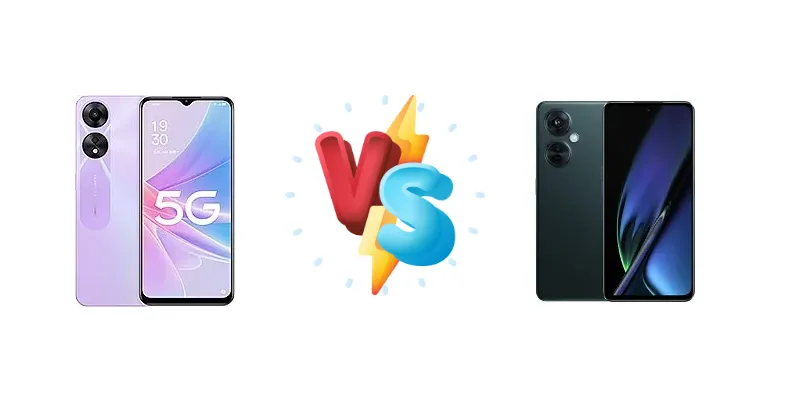
Oppo’s mid-range offerings, the K11x and A58 (China), cater to the growing demand for affordable 5G smartphones. While both aim to deliver connectivity and essential features, they diverge in core components like the chipset and charging technology. This comparison dissects these differences to determine which device provides the best experience for your needs.
🏆 Quick Verdict
For most users, the Oppo K11x emerges as the superior choice. Its Snapdragon 695, built on a more efficient 6nm process, offers a slight performance edge and better thermal management, coupled with significantly faster 67W charging. While the A58 is still a capable device, the K11x’s advantages justify the potential price difference.
| Network |
|---|
| 2G bands | GSM 850 / 900 / 1800 / 1900 | GSM 850 / 900 / 1800 / 1900 |
| 3G bands | HSDPA 850 / 900 / 2100 | HSDPA 850 / 900 / 1700(AWS) / 2100 |
| 4G bands | 1, 3, 5, 8, 28, 34, 38, 39, 40, 41 | 1, 3, 4, 5, 8, 28, 34, 38, 39, 40, 41 |
| 5G bands | 1, 5, 8, 28, 41, 77, 78 SA/NSA | 1, 5, 8, 28, 41, 77, 78 SA/NSA |
| Speed | HSPA, LTE, 5G | HSPA, LTE, 5G |
| Technology | GSM / CDMA / HSPA / CDMA2000 / LTE / 5G | GSM / HSPA / LTE / 5G |
| Launch |
|---|
| Announced | 2022, November 08 | 2023, May 25 |
| Status | Available. Released 2022, November 10 | Available. Released 2023, May 25 |
| Body |
|---|
| Build | - | Glass front, plastic frame, plastic back |
| Dimensions | 163.8 x 75 x 8 mm (6.45 x 2.95 x 0.31 in) | 165.5 x 76 x 8.3 mm (6.52 x 2.99 x 0.33 in) |
| SIM | Nano-SIM + Nano-SIM | Nano-SIM + Nano-SIM |
| Weight | 188 g (6.63 oz) | 195 g (6.88 oz) |
| Display |
|---|
| Protection | - | Corning Gorilla Glass |
| Resolution | 720 x 1612 pixels, 20:9 ratio (~269 ppi density) | 1080 x 2400 pixels, 20:9 ratio (~392 ppi density) |
| Size | 6.56 inches, 103.4 cm2 (~84.2% screen-to-body ratio) | 6.72 inches, 109.0 cm2 (~86.7% screen-to-body ratio) |
| Type | IPS LCD, 90Hz, 480 nits (typ), 600 nits (HBM) | IPS LCD, 120Hz, 550 nits (typ), 680 nits (peak) |
| Platform |
|---|
| CPU | Octa-core (2x2.2 GHz Cortex-A76 & 6x2.0 GHz Cortex-A55) | Octa-core (2x2.2 GHz Kryo 660 Gold & 6x1.7 GHz Kryo 660 Silver) |
| Chipset | Mediatek Dimensity 700 (7 nm) | Qualcomm SM6375 Snapdragon 695 5G (6 nm) |
| GPU | Mali-G57 MC2 | Adreno 619 |
| OS | Android 12, ColorOS 12.1 | Android 13, ColorOS 13.1 |
| Memory |
|---|
| Card slot | microSDXC | microSDXC (uses shared SIM slot) |
| Internal | 128GB 6GB RAM, 128GB 8GB RAM, 256GB 8GB RAM | 128GB 8GB RAM, 256GB 8GB RAM, 256GB 12GB RAM |
| Main Camera |
|---|
| Dual | 50 MP, f/1.8, 27mm (wide), PDAF
Auxiliary lens | 108 MP, f/1.8, 24mm (wide), 1/1.67", 0.64µm, PDAF
Auxiliary lens |
| Features | LED flash, HDR, panorama | LED flash, HDR, panorama |
| Video | 1080p@30fps | 1080p@30fps |
| Selfie camera |
|---|
| Features | - | HDR, panorama |
| Single | 8 MP, f/2.0, 27mm (wide) | 16 MP, f/2.4, (wide), 1.0µm |
| Video | 1080p@30fps | 1080p@30fps |
| Sound |
|---|
| 35mm jack | Yes | Yes |
| Loudspeaker | Yes, with stereo speakers | Yes, with stereo speakers |
| Comms |
|---|
| Bluetooth | 5.3, A2DP, LE, aptX | 5.1, A2DP, LE, aptX HD |
| NFC | No | No |
| Positioning | GPS, GALILEO, GLONASS, BDS, QZSS | GPS, GALILEO, GLONASS, BDS, QZSS |
| Radio | No | No |
| USB | USB Type-C 2.0, OTG | USB Type-C 2.0, OTG |
| WLAN | Wi-Fi 802.11 a/b/g/n/ac, dual-band | Wi-Fi 802.11 a/b/g/n/ac, dual-band |
| Features |
|---|
| Sensors | Fingerprint (side-mounted), accelerometer, proximity, compass | Fingerprint (side-mounted), accelerometer, gyro, proximity, compass |
| Battery |
|---|
| Charging | 33W wired | 67W wired, 80% in 33 min |
| Type | Li-Po 5000 mAh | Li-Po 5000 mAh |
| Misc |
|---|
| Colors | Black, Blue, Violet | Jade Black, Pearl Blue |
| Price | About 230 EUR | About 250 EUR |
Oppo A58 (China)
- Potentially lower price point
- Reliable MediaTek Dimensity 700 chipset for everyday tasks
- Acceptable battery life for moderate usage
- Slower 33W charging
- Less efficient 7nm chipset compared to Snapdragon 695
Oppo K11x
- Faster 67W charging with quick top-up times
- More efficient Snapdragon 695 5G chipset (6nm)
- Potentially better thermal management
- Likely a slightly higher price tag
- Battery capacity may be similar or slightly smaller than A58
Display Comparison
Neither Oppo provides display specifications beyond resolution in their marketing materials. However, given their price points, both likely utilize LCD panels. The absence of high refresh rates is expected. The key difference lies in the underlying processing power impacting UI smoothness, not the display itself. Bezels are likely comparable, typical of this segment. Color accuracy will likely be standard for budget devices, prioritizing power efficiency over color gamut coverage.
Camera Comparison
Without detailed sensor information, a direct camera comparison is difficult. However, it’s safe to assume both phones feature a primary camera supplemented by depth and macro sensors (the latter often being of limited utility). The aperture and sensor size of the main sensor will be the determining factors in low-light performance. Given Oppo’s image processing expertise, both phones will likely produce acceptable results in good lighting conditions. The K11x’s slightly more powerful ISP (Image Signal Processor) within the Snapdragon 695 could offer a marginal improvement in image processing speed and quality.
Performance
The Oppo K11x’s Qualcomm Snapdragon 695 5G (6nm) represents a clear architectural advantage over the A58’s MediaTek Dimensity 700 (7nm). The 6nm process node inherently offers better power efficiency, translating to potentially lower temperatures during sustained loads. While both CPUs feature a 2x2.2 GHz core configuration, the Snapdragon 695 utilizes Kryo 660 Gold cores, generally considered more efficient than the Cortex-A76 cores in the Dimensity 700. This difference, combined with the process node, suggests the K11x will exhibit less thermal throttling during gaming or intensive multitasking. The K11x’s GPU will also benefit from the more modern architecture.
Battery Life
The Oppo K11x’s 67W wired charging is a significant advantage over the A58’s 33W charging. Oppo claims an 80% charge in 33 minutes with the K11x, a substantial time saving compared to the A58. While battery capacity isn’t specified, the faster charging mitigates the impact of a potentially smaller battery in the K11x. Users who frequently top up their phones or require quick boosts will greatly benefit from the K11x’s charging speed.
Buying Guide
Buy the Oppo A58 (China) if you prioritize a lower initial cost and are comfortable with slower charging speeds. It’s a solid option for basic smartphone tasks and casual 5G usage. Buy the Oppo K11x if you value faster charging, potentially smoother performance in demanding apps, and a more modern chipset architecture, even if it means spending a bit more upfront.
Frequently Asked Questions
❓ Will the Snapdragon 695 in the Oppo K11x handle demanding games like PUBG Mobile smoothly?
The Snapdragon 695 is capable of running PUBG Mobile, but expect to use medium graphics settings for a consistently smooth experience. The 6nm process and improved GPU architecture compared to the Dimensity 700 will help maintain stable frame rates for longer periods.
❓ How much faster is the 67W charging on the Oppo K11x compared to the 33W charging on the A58 in real-world use?
Oppo claims 80% charge in 33 minutes with the K11x. The A58, with 33W charging, will likely take over an hour to reach the same charge level. This difference is particularly noticeable for users who frequently need to quickly top up their battery.
❓ Does the Oppo K11x get noticeably warmer than the A58 during extended gaming sessions?
The Snapdragon 695’s 6nm process is more thermally efficient than the Dimensity 700’s 7nm process. This means the K11x is likely to run cooler and experience less performance throttling during prolonged gaming or intensive tasks.
❓ Is the difference in chipset performance between the K11x and A58 noticeable for everyday tasks like browsing and social media?
For basic tasks, the difference will be minimal. Both phones are capable of handling everyday usage smoothly. However, the K11x will feel more responsive when switching between apps or multitasking due to its more powerful processor and efficient architecture.