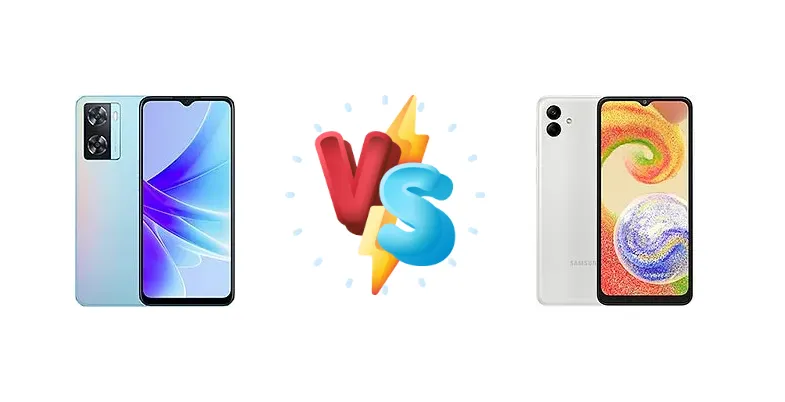
The budget smartphone market is fiercely competitive, offering incredible value for money. Two contenders vying for your attention are the Oppo A57s and the Samsung Galaxy A04. But which one delivers the best experience for your hard-earned cash? Let's dive into a comprehensive comparison.
🏆 Quick Verdict
The Oppo A57s edges out the Samsung Galaxy A04 thanks to its significantly faster charging and slightly more powerful chipset. While both offer basic functionality, the Oppo provides a noticeably smoother experience and quicker top-ups, making it the better overall choice for most users.
| Network |
|---|
| 2G bands | GSM 850 / 900 / 1800 / 1900 | GSM 850 / 900 / 1800 / 1900 |
| 3G bands | HSDPA 850 / 900 / 2100 | HSDPA 850 / 900 / 2100 |
| 4G bands | 1, 3, 5, 7, 8, 20, 28, 38, 40, 41 | 1, 3, 5, 7, 8, 20, 28, 38, 40, 41 |
| Speed | HSPA, LTE | HSPA 42.2/5.76 Mbps, LTE Cat4 150/50 Mbps |
| Technology | GSM / HSPA / LTE | GSM / HSPA / LTE |
| Launch |
|---|
| Announced | 2022, August 31 | 2022, August 24 |
| Status | Available. Released 2022, September 12 | Available. Released 2022, October 10 |
| Body |
|---|
| Build | Glass front (Panda Glass), plastic frame, plastic back | Glass front, plastic back, plastic frame |
| Dimensions | 163.8 x 75 x 8 mm (6.45 x 2.95 x 0.31 in) | 164.4 x 76.3 x 9.1 mm (6.47 x 3.00 x 0.36 in) |
| SIM | Nano-SIM + Nano-SIM | · Nano-SIM· Nano-SIM + Nano-SIM |
| Weight | 187 g (6.60 oz) | 192 g (6.77 oz) |
| | IP5X (dust), IPX4 (water) resistance | - |
| Display |
|---|
| Protection | Panda Glass | - |
| Resolution | 720 x 1612 pixels, 20:9 ratio (~269 ppi density) | 720 x 1600 pixels, 20:9 ratio (~270 ppi density) |
| Size | 6.56 inches, 103.4 cm2 (~84.2% screen-to-body ratio) | 6.5 inches, 102.0 cm2 (~81.3% screen-to-body ratio) |
| Type | IPS LCD, 480 nits (typ), 600 nits (HBM) | PLS LCD |
| Platform |
|---|
| CPU | Octa-core (4x2.3 GHz Cortex-A53 & 4x1.8 GHz Cortex-A53) | Octa-core (4x2.3 GHz Cortex-A53 & 4x1.8 GHz Cortex-A53) |
| Chipset | Mediatek MT6765G Helio G35 (12 nm) | Mediatek MT6765 Helio P35 (12 nm) |
| GPU | PowerVR GE8320 | PowerVR GE8320 |
| OS | Android 12, ColorOS 12.1 | Android 12, upgradable to Android 13, One UI Core 5.0 |
| Memory |
|---|
| Card slot | microSDXC | microSDXC (dedicated slot) |
| Internal | 64GB 4GB RAM, 128GB 4GB RAM | 32GB 3GB RAM, 32GB 4GB RAM, 64GB 3GB RAM, 64GB 4GB RAM, 64GB 6GB RAM, 128GB 4GB RAM, 128GB 8GB RAM |
| | eMMC 5.1 | eMMC 5.1 |
| Main Camera |
|---|
| Dual | 50 MP, f/1.8, 27mm (wide), PDAF
Auxiliary lens | 50 MP, f/1.8, 25mm (wide), 1/2.51", 0.7µm, AF
Auxiliary lens |
| Features | LED flash, HDR, panorama | LED flash |
| Single | 8 MP, f/2.0, 26mm (wide) | 5 MP, f/2.2 |
| Video | 1080p@30fps | 1080p@30fps |
| Selfie camera |
|---|
| Features | Panorama | - |
| Single | 8 MP, f/2.0, 26mm (wide) | 5 MP, f/2.2, 28mm (wide), 1/5", 1.12µm |
| Video | 1080p@30fps | Yes |
| Sound |
|---|
| 3.5mm jack | Yes | Yes |
| 35mm jack | Yes | Yes |
| Loudspeaker | Yes, with stereo speakers | Yes |
| Comms |
|---|
| Bluetooth | 5.3, A2DP, LE, aptX HD | 5.0, A2DP, LE |
| NFC | Yes | No |
| Positioning | GPS, GLONASS, BDS, GALILEO, QZSS | GPS, GLONASS, GALILEO, BDS |
| Radio | No | Unspecified |
| USB | USB Type-C 2.0, OTG | USB Type-C 2.0 |
| WLAN | Wi-Fi 802.11 a/b/g/n/ac, dual-band, Wi-Fi Direct | Wi-Fi 802.11 a/b/g/n/ac, dual-band, Wi-Fi Direct |
| Features |
|---|
| Sensors | Fingerprint (side-mounted), accelerometer, proximity, compass | Accelerometer, proximity |
| Battery |
|---|
| Charging | 33W wired, 100% in 69 min | - |
| Type | Li-Po 5000 mAh | Li-Po 5000 mAh |
| Misc |
|---|
| Colors | Starry Black, Sky Blue | Black, Green, White, Copper |
| Models | CPH2385 | SM-A045F, SM-A045F/DS, SM-A045M |
| Price | - | About 70 EUR |
| SAR EU | - | 0.32 W/kg (head) 1.10 W/kg (body) |
Oppo A57s
- Faster 33W Charging
- Slightly Better Performance (Helio G35)
- Decent Battery Life
- Modern Design
- Entry-Level Chipset (Limited Gaming)
- Basic Camera Capabilities
- Plastic Build
Samsung Galaxy A04
- Samsung Brand Recognition
- Affordable Price
- Large Display
- Reliable Basic Functionality
- Slower Charging
- Less Powerful Chipset (Helio P35)
- Average Camera Quality
- Less Responsive
Display Comparison
Both phones feature a 6.5-inch display, likely with an HD+ resolution. While the Oppo A57s might have a slightly better panel (potentially with slightly better color accuracy or brightness), the difference is unlikely to be substantial. Expect similar viewing experiences for general use.
Camera Comparison
Camera specs are often similar in this price range. Both likely feature a primary 13MP camera and a depth sensor. Image quality will be adequate in good lighting conditions, but expect noise and limited detail in low light. The Oppo might have slightly better image processing, but it's a marginal difference.
Performance
The Oppo A57s holds a clear advantage here. Its Helio G35 chipset, while still entry-level, is generally considered a step up from the Galaxy A04's Helio P35. This translates to slightly smoother multitasking, app loading, and overall responsiveness. Don't expect high-end gaming performance from either, but the Oppo will handle basic games better.
Battery Life
The Oppo A57s shines in this category. Its 33W fast charging is a game-changer compared to the Galaxy A04's standard charging. While both likely have a similar battery capacity (around 5000mAh), the Oppo will charge significantly faster, reducing downtime.
Buying Guide
The Oppo A57s is ideal for users who prioritize faster charging and a slightly more responsive performance for everyday tasks. The Samsung Galaxy A04 is a good option for those on a very tight budget who primarily need a basic phone for calls, texts, and light usage, and value the Samsung brand.
Frequently Asked Questions
❓ Which phone has better battery life?
Both have similar battery capacities, but the Oppo A57s's faster charging means it spends less time plugged in.
❓ Can I play demanding games on either of these phones?
Neither phone is designed for demanding games. The Oppo A57s will handle lighter games slightly better due to its marginally more powerful chipset.