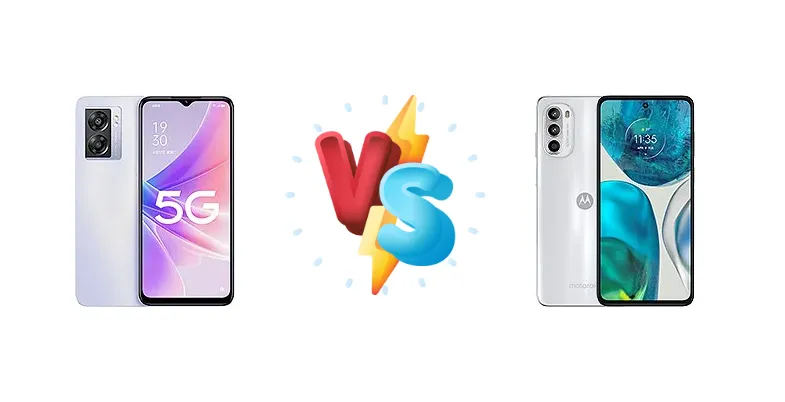
The Oppo A57 and Motorola Moto G52 represent compelling options in the crowded budget smartphone space. While both aim for affordability, they take different approaches to achieving it. The A57 prioritizes raw processing power with its Mediatek Dimensity 810, while the Moto G52 focuses on a balanced experience with the Qualcomm Snapdragon 680 and a faster charging solution. This comparison dives deep into the specifics to determine which phone delivers the best value for your money.
🏆 Quick Verdict
For users prioritizing demanding tasks like gaming or frequent multitasking, the Oppo A57’s Dimensity 810 chipset offers a noticeable performance edge. However, the Motorola Moto G52 wins for everyday users who value efficient power consumption and significantly faster 30W charging, making it the better all-rounder for most.
| Network |
|---|
| 2G bands | GSM 850 / 900 / 1800 / 1900 | GSM 850 / 900 / 1800 / 1900 |
| 3G bands | HSDPA 800 / 850 / 900 / 1900 / 2100 | HSDPA 850 / 900 / 1700(AWS) / 1900 / 2100 |
| 4G bands | 1, 3, 5, 7, 8, 28, 34, 38, 39, 40, 41 | LTE |
| 5G bands | 1, 5, 8, 28, 41, 77, 78 SA/NSA | - |
| Speed | HSPA, LTE, 5G | HSPA, LTE |
| Technology | GSM / CDMA / HSPA / CDMA2000 / LTE / 5G | GSM / HSPA / LTE |
| Launch |
|---|
| Announced | 2022, April 14 | 2022, April 12 |
| Status | Available. Released 2022, April 15 | Available. Released 2022, April 20 |
| Body |
|---|
| Build | Glass front, plastic frame, plastic back | - |
| Dimensions | 163.8 x 75.1 x 8 mm (6.45 x 2.96 x 0.31 in) | 160.1 x 74.5 x 8 mm (6.30 x 2.93 x 0.31 in) |
| SIM | Nano-SIM + Nano-SIM | Nano-SIM + Nano-SIM |
| Weight | 186 g (6.56 oz) | 169 g (5.96 oz) |
| | - | Water-repellent design |
| Display |
|---|
| Resolution | 720 x 1612 pixels, 20:9 ratio (~269 ppi density) | 1080 x 2400 pixels, 20:9 ratio (~402 ppi density) |
| Size | 6.56 inches, 103.4 cm2 (~84.0% screen-to-body ratio) | 6.6 inches, 103.6 cm2 (~86.9% screen-to-body ratio) |
| Type | IPS LCD, 90Hz, 480 nits (typ), 600 nits (HBM) | AMOLED, 90Hz |
| Platform |
|---|
| CPU | Octa-core (2x2.4 GHz Cortex-A76 & 6x2.0 GHz Cortex-A55) | Octa-core (4x2.4 GHz Kryo 265 Gold & 4x1.9 GHz Kryo 265 Silver) |
| Chipset | Mediatek Dimensity 810 (6 nm) | Qualcomm SM6225 Snapdragon 680 4G (6 nm) |
| GPU | Mali-G57 MC2 | Adreno 610 |
| OS | Android 12, ColorOS 12.1 | Android 12, planned upgrade to Android 13 |
| Memory |
|---|
| Card slot | microSDXC | microSDXC (uses shared SIM slot) |
| Internal | 128GB 6GB RAM, 128GB 8GB RAM, 256GB 8GB RAM | 64GB 4GB RAM, 128GB 4GB RAM, 128GB 6GB RAM, 256GB 6GB RAM |
| Main Camera |
|---|
| Dual | 13 MP, f/2.2, 26mm (wide), 1/3.06", 1.12µm, AF
Auxiliary lens | - |
| Features | LED flash, HDR, panorama | LED flash, HDR, panorama |
| Triple | - | 50 MP, f/1.8 (wide), 1/2.76", 0.64µm, PDAF
8 MP, f/2.2, 118˚ (ultrawide), 1/4.0", 1.12µm
2 MP (macro) |
| Video | 1080p@30fps | 1080p@30fps |
| Selfie camera |
|---|
| Single | 8 MP, f/2.0, 26mm (wide) | 16 MP, f/2.5, (wide), 1.0µm |
| Video | 1080p@30fps | 1080p@30fps |
| Sound |
|---|
| 3.5mm jack | - | Yes |
| 35mm jack | Yes | Yes |
| Loudspeaker | Yes, with stereo speakers | Yes, with stereo speakers |
| Comms |
|---|
| Bluetooth | 5.2, A2DP, LE, aptX HD | 5.0, A2DP, LE |
| NFC | No | Yes (market/region dependent) |
| Positioning | GPS, GLONASS, GALILEO, BDS, QZSS | GPS, GLONASS, GALILEO |
| Radio | No | Unspecified |
| USB | USB Type-C 2.0, OTG | USB Type-C 2.0 |
| WLAN | Wi-Fi 802.11 a/b/g/n/ac, dual-band, Wi-Fi Direct | Wi-Fi 802.11 a/b/g/n/ac, dual-band, Wi-Fi Direct |
| Features |
|---|
| Sensors | Fingerprint (side-mounted), accelerometer, gyro, proximity, compass | Fingerprint (side-mounted), accelerometer, gyro, proximity, compass |
| Battery |
|---|
| Charging | 10W wired | 30W wired |
| Type | Li-Po 5000 mAh | Li-Po 5000 mAh |
| Misc |
|---|
| Colors | Black, Blue, Lilac | Charcoal Gray, Porcelain White |
| Models | PFTM20 | XT2221-1, XT2221-2 |
| Price | About 200 EUR | About 470 EUR |
Oppo A57
- More powerful CPU for demanding tasks
- Higher peak display brightness for outdoor use
- Potentially better image processing with Dimensity 810 ISP
- Significantly slower 10W charging
- Potentially lower battery life due to higher power consumption
Motorola Moto G52
- Faster 30W wired charging
- More efficient Snapdragon 680 chipset
- Likely better battery life for typical usage
- Less powerful CPU for gaming and multitasking
- Potentially lower display brightness
Display Comparison
The Oppo A57 boasts a measured peak brightness of 761 nits, a strong figure for outdoor visibility. While the Moto G52’s display specifications aren’t provided, Motorola typically uses IPS LCD panels in this price range, likely with lower peak brightness. The A57’s higher brightness will translate to a more usable experience in direct sunlight. Without knowing the Moto G52’s panel technology, it’s difficult to assess color accuracy or viewing angles, but the A57’s brightness is a clear advantage.
Camera Comparison
Without detailed camera specifications beyond the chipsets, a direct comparison is limited. Both phones likely feature a multi-camera setup geared towards social media sharing. The image signal processor (ISP) within the Dimensity 810 and Snapdragon 680 will handle image processing, but the quality will depend heavily on the sensor sizes and lens apertures, which are currently unknown. It’s reasonable to assume both phones will perform adequately in good lighting conditions, but low-light performance will be a key differentiator, dependent on sensor capabilities.
Performance
The core difference lies in the chipsets. The Oppo A57’s Mediatek Dimensity 810 (6nm) features a more powerful CPU configuration – 2x2.4 GHz Cortex-A76 cores and 6x2.0 GHz Cortex-A55 cores – compared to the Motorola Moto G52’s Qualcomm Snapdragon 680 (6nm) with 4x2.4 GHz Kryo 265 Gold and 4x1.9 GHz Kryo 265 Silver. This suggests the A57 will handle CPU-intensive tasks more efficiently. Both are built on a 6nm process, offering good efficiency, but the A57’s CPU architecture gives it a theoretical edge in sustained performance. The Snapdragon 680 is known for its efficiency, potentially leading to better battery life during lighter use.
Battery Life
The Motorola Moto G52’s 30W wired charging is a significant advantage over the Oppo A57’s 10W charging. This means the Moto G52 can replenish its battery much faster, reducing downtime. While battery capacity isn’t specified for either device, the faster charging speed of the Moto G52 effectively mitigates any potential disadvantage from a smaller battery size. The A57’s 10W charging will require considerably longer to reach a full charge.
Buying Guide
Buy the Oppo A57 if you frequently play mobile games, edit videos, or run multiple apps simultaneously and need the extra processing power of the Dimensity 810. Buy the Motorola Moto G52 if you prioritize battery life, quick top-ups with 30W charging, and a smooth, responsive experience for everyday tasks like browsing, social media, and communication.
Frequently Asked Questions
❓ Will the Oppo A57’s Dimensity 810 overheat during extended gaming sessions?
The Dimensity 810 is a 6nm chip, which helps with thermal efficiency. However, sustained high loads like gaming can still generate heat. While we haven't tested thermal throttling specifically on the A57, the 6nm process and the phone's design will play a role in managing temperatures. Expect some performance throttling after prolonged gaming, but it shouldn't be severe.
❓ Is the 30W charging on the Moto G52 truly faster in real-world use?
Yes, 30W charging is substantially faster than 10W. While the exact 0-100% time depends on battery capacity (which isn't specified), you can expect the Moto G52 to charge from near empty to full in approximately 60-90 minutes, compared to potentially 2+ hours for the Oppo A57. This makes a significant difference in daily usability.
❓ Does the Snapdragon 680 in the Moto G52 support VoLTE and VoWiFi?
The Qualcomm Snapdragon 680 generally supports VoLTE (Voice over LTE) and VoWiFi (Voice over Wi-Fi), but carrier compatibility is crucial. You'll need to check with your specific mobile carrier to ensure they support these features on the Moto G52.