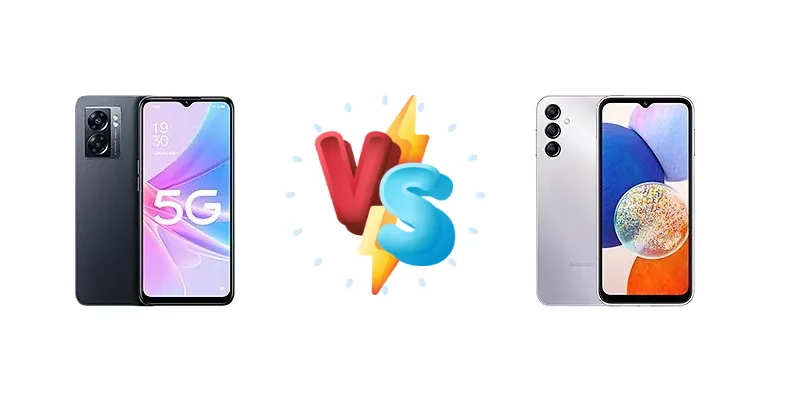
The budget smartphone market is fiercely competitive, and the Oppo A56s and Samsung Galaxy A14 5G are two strong contenders. Both offer compelling features at an affordable price, but which one reigns supreme? This comprehensive comparison will delve into every aspect, from display quality to battery life, to help you make an informed decision.
🏆 Quick Verdict
The Samsung Galaxy A14 5G edges out the Oppo A56s thanks to its brighter display, faster charging, and the potential for 5G connectivity (depending on the variant). While the Oppo A56s boasts a slightly more powerful chipset, the A14 5G's overall package provides better value.
| Network |
|---|
| 2G bands | GSM 850 / 900 / 1800 / 1900 | GSM 850 / 900 / 1800 / 1900 |
| 3G bands | HSDPA 800 / 850 / 900 / 1900 / 2100 | HSDPA 850 / 900 / 1700(AWS) / 1900 / 2100 |
| 4G bands | 1, 3, 5, 7, 8, 28, 34, 38, 39, 40, 41 | 1, 2, 3, 4, 5, 7, 8, 12, 17, 20, 26, 28, 38, 40, 41, 66 - International |
| 5G bands | 1, 5, 8, 28, 41, 77, 78 SA/NSA | 2, 5, 66, 77 Sub6/mmWave - USA |
| Speed | HSPA, LTE, 5G | HSPA, LTE, 5G |
| Technology | GSM / CDMA / HSPA / CDMA2000 / LTE / 5G | GSM / HSPA / LTE / 5G |
| | CDMA2000 1x | 1, 3, 5, 7, 8, 20, 28, 40, 41, 78 SA/NSA/Sub6 - India |
| Launch |
|---|
| Announced | 2023, January 05 | 2023, January 04 |
| Status | Available. Released 2023, January 09 | Available. Released 2023, January 12 |
| Body |
|---|
| Build | Glass front, plastic frame, plastic back | Glass front, plastic back, plastic frame |
| Dimensions | 163.8 x 75.1 x 8 mm (6.45 x 2.96 x 0.31 in) | 167.7 x 78 x 9.1 mm (6.60 x 3.07 x 0.36 in) |
| SIM | Nano-SIM + Nano-SIM | · Nano-SIM· Nano-SIM + Nano-SIM |
| Weight | 186 g (6.56 oz) | 202 g (7.13 oz) |
| Display |
|---|
| Resolution | 720 x 1612 pixels, 20:9 ratio (~269 ppi density) | 1080 x 2408 pixels, 20:9 ratio (~400 ppi density) |
| Size | 6.56 inches, 103.4 cm2 (~84.0% screen-to-body ratio) | 6.6 inches, 104.9 cm2 (~80.2% screen-to-body ratio) |
| Type | IPS LCD, 90Hz, 480 nits (typ), 600 nits (HBM) | PLS LCD, 90Hz |
| Platform |
|---|
| CPU | Octa-core (2x2.4 GHz Cortex-A76 & 6x2.0 GHz Cortex-A55) | Octa-core (2x2.4 GHz Cortex-A78 & 6x2.0 GHz Cortex-A55) - SM-A146BOcta-core (2x2.2 GHz Cortex-A76 & 6x2.0 GHz Cortex-A55) - SM-A146P |
| Chipset | Mediatek Dimensity 810 (6 nm) | Exynos 1330 (5 nm) - SM-A146BMediatek Dimensity 700 (7 nm) - SM-A146P |
| GPU | Mali-G57 MC2 | Mali-G68 MP2 - SM-A146BMali-G57 MC2 - SM-A146P |
| OS | Android 12, ColorOS 12.1 | Android 13, upgradable to Android 15, One UI Core 7 |
| Memory |
|---|
| Card slot | microSDXC | microSDXC (uses shared SIM slot) - USA onlymicroSDXC (dedicated slot) - International |
| Internal | 128GB 8GB RAM, 256GB 8GB RAM | 64GB 4GB RAM, 128GB 4GB RAM, 128GB 6GB RAM, 128GB 8GB RAM |
| Main Camera |
|---|
| Dual | 13 MP, f/2.2, 26mm (wide), 1/3.06", 1.12µm, AF
Auxiliary lens | - |
| Features | LED flash, HDR, panorama | LED flash, panorama, HDR |
| Single | 8 MP, f/2.0, 26mm (wide) | 13 MP, f/2.0, (wide) |
| Triple | - | 50 MP, f/1.8, 26mm (wide), 1/2.76", 0.64µm, PDAF
2 MP (macro)
Auxiliary lens |
| Video | 1080p@30fps | 1080p@30fps |
| Selfie camera |
|---|
| Single | 8 MP, f/2.0, 26mm (wide) | 13 MP, f/2.0, 26mm (wide), 1.12µm |
| Video | 1080p@30fps | 1080p@30fps |
| Sound |
|---|
| 3.5mm jack | Yes | Yes |
| 35mm jack | Yes | Yes |
| Loudspeaker | Yes, with stereo speakers | Yes |
| Comms |
|---|
| Bluetooth | 5.2, A2DP, LE, aptX HD | 5.2, A2DP, LE |
| NFC | No | Yes |
| Positioning | GPS, GLONASS, GALILEO, BDS, QZSS | GPS, GLONASS, GALILEO |
| Radio | No | FM radio (Exynos 1330 chipset only), recording |
| USB | USB Type-C 2.0, OTG | USB Type-C 2.0 |
| WLAN | Wi-Fi 802.11 a/b/g/n/ac, dual-band, Wi-Fi Direct | Wi-Fi 802.11 a/b/g/n/ac, dual-band, Wi-Fi Direct |
| Features |
|---|
| Sensors | Fingerprint (side-mounted), accelerometer, proximity, compass | Fingerprint (side-mounted), accelerometer, gyro, proximity, compass, barometer (USA only) |
| Battery |
|---|
| Charging | 10W wired | 15W wired |
| Type | Li-Po 5000 mAh | Li-Po 5000 mAh |
| Misc |
|---|
| Colors | Black, Blue | Black, Light Green, Dark Red, Silver |
| Models | PFTM20 | SM-A146B, SM-A146B/DS, SM-A146P, SM-A146P/DS, SM-A146U, SM-A146U1, SM-A146U1/DS, SM-A146W, SM-A146P/N, SM-A146P/DSN, SM-S146VL, SM-A146M |
| Price | About 150 EUR | $ 77.63 / C$ 151.00 / £ 97.00 / € 159.79 / ₹ 14,990 |
| SAR | - | 1.00 W/kg (head) 1.00 W/kg (body) |
| SAR EU | - | 0.56 W/kg (head) 1.28 W/kg (body) |
| Tests |
|---|
| Battery life | - |
Endurance rating 130h
|
| Camera | - |
Photo / Video |
| Display | - |
Contrast ratio: 1334:1 (nominal) |
| Loudspeaker | - |
-26.8 LUFS (Good)
|
| Performance | - |
AnTuTu: 307886 (v9)
GeekBench: 1727 (v5.1)
GFXBench: 12fps (ES 3.1 onscreen) |
Oppo A56s
- Slightly more powerful chipset
- Good value for money
- Slow 10W charging
- Lower display brightness
- Potentially shorter battery life
Samsung Galaxy A14 5G
- Brighter display
- Faster 15W charging
- Excellent battery life
- Potential 5G connectivity (variant dependent)
- Chipset performance slightly behind the Oppo A56s
- Samsung's One UI can be polarizing
Display Comparison
The Samsung Galaxy A14 5G takes the lead here. While both offer a nominal contrast ratio of 1334:1, the A14 5G's measured peak brightness of 519 nits is noticeably higher than the A56s, resulting in better visibility in outdoor conditions. Both likely use similar LCD panels, but the A14 5G's brightness advantage is significant.
Camera Comparison
Camera performance is difficult to definitively declare a winner without detailed testing. Both phones feature capable camera systems, but the A14 5G likely benefits from Samsung's image processing expertise. Expect decent photo and video quality from both, but don't anticipate flagship-level results.
Performance
The Oppo A56s holds a slight advantage in raw processing power thanks to its Mediatek Dimensity 810 chipset built on a 6nm process. The Exynos 1330 (in some A14 5G variants) and Dimensity 700 (in others) are both capable, but the Dimensity 810 generally offers a bit more headroom for demanding tasks. However, real-world performance differences may be minimal for everyday use.
Battery Life
The Samsung Galaxy A14 5G shines in battery life. Its endurance rating of 130 hours is impressive, suggesting significantly longer usage times compared to the Oppo A56s. The A56s' 10W charging is also a significant disadvantage compared to the A14 5G's 15W charging, meaning longer recharge times.
Buying Guide
The Oppo A56s is a good choice for users prioritizing raw processing power for gaming or demanding apps. The Samsung Galaxy A14 5G is ideal for those seeking a vibrant display, longer battery life, and the future-proofing of 5G connectivity, especially if the variant you choose supports it.
Frequently Asked Questions
❓ Does the Samsung Galaxy A14 5G support 5G on all variants?
No, the 5G support depends on the specific variant (SM-A146B vs. SM-A146P). Check the specifications of the model you're considering.
❓ Which phone is better for gaming?
The Oppo A56s likely offers slightly better gaming performance due to its more powerful chipset, but both phones are suitable for casual gaming.