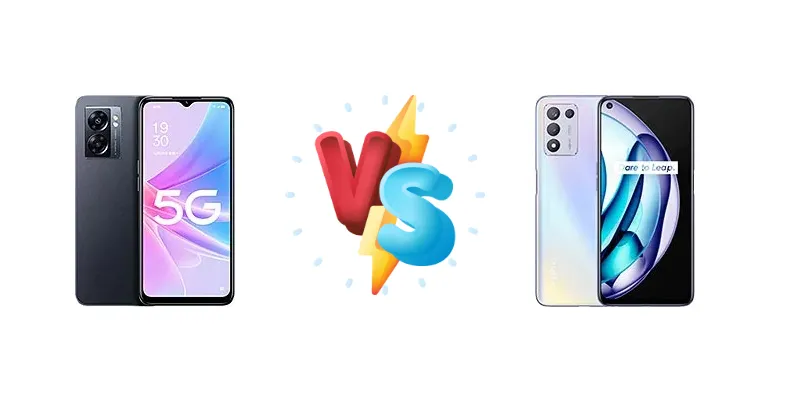
The Oppo A56s and Realme Q3s represent compelling options in the increasingly competitive budget 5G smartphone market. Both aim to deliver 5G connectivity without breaking the bank, but they achieve this through different approaches – the Oppo leveraging MediaTek’s Dimensity 810, while the Realme opts for Qualcomm’s Snapdragon 778G. This comparison dissects their key differences to determine which device offers the best value.
🏆 Quick Verdict
For most users, the Realme Q3s emerges as the superior choice. Its Snapdragon 778G chipset provides a noticeable performance advantage over the Dimensity 810 in the Oppo A56s, and the significantly faster 30W charging is a game-changer for convenience. While the Oppo offers a slightly lower price point, the Realme’s benefits justify the small premium.
| Network |
|---|
| 2G bands | GSM 850 / 900 / 1800 / 1900 | GSM 850 / 900 / 1800 / 1900 |
| 3G bands | HSDPA 800 / 850 / 900 / 1900 / 2100 | HSDPA 850 / 900 / 1700(AWS) / 1900 / 2100 |
| 4G bands | 1, 3, 5, 7, 8, 28, 34, 38, 39, 40, 41 | 1, 3, 4, 5, 7, 8, 19, 28, 34, 38, 39, 40, 41 |
| 5G bands | 1, 5, 8, 28, 41, 77, 78 SA/NSA | 1, 28, 41, 77, 78 SA/NSA |
| Speed | HSPA, LTE, 5G | HSPA, LTE, 5G |
| Technology | GSM / CDMA / HSPA / CDMA2000 / LTE / 5G | GSM / CDMA / HSPA / EVDO / LTE / 5G |
| | CDMA2000 1x | CDMA2000 1xEV-DO |
| Launch |
|---|
| Announced | 2023, January 05 | 2021, October 19 |
| Status | Available. Released 2023, January 09 | Available. Released 2021, November 01 |
| Body |
|---|
| Build | Glass front, plastic frame, plastic back | - |
| Dimensions | 163.8 x 75.1 x 8 mm (6.45 x 2.96 x 0.31 in) | 164.4 x 75.8 x 8.5 mm (6.47 x 2.98 x 0.33 in) |
| SIM | Nano-SIM + Nano-SIM | Nano-SIM + Nano-SIM |
| Weight | 186 g (6.56 oz) | 199 g (7.02 oz) |
| Display |
|---|
| Resolution | 720 x 1612 pixels, 20:9 ratio (~269 ppi density) | 1080 x 2412 pixels, 20:9 ratio (~401 ppi density) |
| Size | 6.56 inches, 103.4 cm2 (~84.0% screen-to-body ratio) | 6.6 inches, 104.3 cm2 (~83.7% screen-to-body ratio) |
| Type | IPS LCD, 90Hz, 480 nits (typ), 600 nits (HBM) | IPS LCD, 144Hz, 600 nits |
| Platform |
|---|
| CPU | Octa-core (2x2.4 GHz Cortex-A76 & 6x2.0 GHz Cortex-A55) | Octa-core (1x2.4 GHz Cortex-A78 & 3x2.2 GHz Cortex-A78 & 4x1.9 GHz Cortex-A55) |
| Chipset | Mediatek Dimensity 810 (6 nm) | Qualcomm SM7325 Snapdragon 778G 5G (6 nm) |
| GPU | Mali-G57 MC2 | Adreno 642L |
| OS | Android 12, ColorOS 12.1 | Android 11, Realme UI 2.0 |
| Memory |
|---|
| Card slot | microSDXC | microSDXC (dedicated slot) |
| Internal | 128GB 8GB RAM, 256GB 8GB RAM | 128GB 6GB RAM, 128GB 8GB RAM, 256GB 8GB RAM |
| Main Camera |
|---|
| Dual | 13 MP, f/2.2, 26mm (wide), 1/3.06", 1.12µm, AF
Auxiliary lens | - |
| Features | LED flash, HDR, panorama | LED flash, HDR, panorama |
| Single | 8 MP, f/2.0, 26mm (wide) | 16 MP, f/2.1, 26mm (wide) |
| Triple | - | 48 MP, f/1.8, 26mm (wide), PDAF
2 MP (macro)
Auxiliary lens |
| Video | 1080p@30fps | 4K@30fps, 1080p@30/60fps |
| Selfie camera |
|---|
| Features | - | HDR, panorama |
| Single | 8 MP, f/2.0, 26mm (wide) | 16 MP, f/2.1, 26mm (wide) |
| Video | 1080p@30fps | 1080p@30fps |
| Sound |
|---|
| 3.5mm jack | Yes | Yes |
| 35mm jack | Yes | Yes |
| Loudspeaker | Yes, with stereo speakers | Yes |
| | - | 24-bit/192kHz audio |
| Comms |
|---|
| Bluetooth | 5.2, A2DP, LE, aptX HD | 5.2, A2DP, LE |
| NFC | No | No |
| Positioning | GPS, GLONASS, GALILEO, BDS, QZSS | GPS, GLONASS, BDS, GALILEO, QZSS |
| Radio | No | No |
| USB | USB Type-C 2.0, OTG | USB Type-C 2.0, OTG |
| WLAN | Wi-Fi 802.11 a/b/g/n/ac, dual-band, Wi-Fi Direct | Wi-Fi 802.11 a/b/g/n/ac/6, dual-band, Wi-Fi Direct |
| Features |
|---|
| Sensors | Fingerprint (side-mounted), accelerometer, proximity, compass | Fingerprint (side-mounted), accelerometer, gyro, proximity, compass |
| Battery |
|---|
| Charging | 10W wired | 30W wired, 50% in 25 min |
| Type | Li-Po 5000 mAh | 5000 mAh |
| Misc |
|---|
| Colors | Black, Blue | Aurora, Dark Blue |
| Models | PFTM20 | - |
| Price | About 150 EUR | About 200 EUR |
Oppo A56s
- Potentially lower price point
- Decent performance for basic tasks
- Reliable MediaTek chipset
- Slow 10W charging
- Less powerful chipset compared to Snapdragon 778G
- Likely inferior camera performance
Realme Q3s
- Superior Snapdragon 778G performance
- Significantly faster 30W charging
- Better image processing capabilities
- Slightly higher price
- May not have a dramatically larger battery capacity
- LCD display (likely)
Display Comparison
Neither device boasts a standout display. Both likely utilize LCD panels, a common cost-saving measure in this segment. While specific display specs (resolution, brightness) are missing, the focus here is on processing power. The absence of high refresh rates on either device suggests a prioritization of battery life over visual fluidity.
Camera Comparison
Without detailed camera specifications, a direct comparison is difficult. However, given the price bracket, both phones likely feature a primary sensor paired with depth and macro lenses. The Realme Q3s, benefiting from its more powerful ISP within the Snapdragon 778G, is likely to deliver better image processing, particularly in low-light conditions. The Dimensity 810’s ISP is capable, but generally lags behind Qualcomm’s offerings in terms of dynamic range and noise reduction.
Performance
The core difference lies in the chipsets. The Realme Q3s’ Snapdragon 778G 5G (6nm) is architecturally superior to the Oppo A56s’ Dimensity 810 (6nm). The Snapdragon 778G features a single Cortex-A78 prime core clocked at 2.4GHz, alongside three additional A78 cores at 2.2GHz, offering a significant advantage in single-core and multi-core performance compared to the Dimensity 810’s two Cortex-A76 cores at 2.4GHz. This translates to snappier app launches, smoother multitasking, and better gaming performance on the Realme. The Snapdragon’s Adreno 642L GPU also outperforms the Dimensity 810’s Mali-G57 MC2. While both are 6nm chips, Qualcomm’s architecture is more efficient.
Battery Life
The Realme Q3s’ 30W wired charging is a substantial advantage over the Oppo A56s’ slow 10W charging. The ability to reach 50% charge in just 25 minutes significantly reduces downtime. While battery capacity isn’t specified, the faster charging speed effectively mitigates any potential capacity difference. The Snapdragon 778G’s efficiency also contributes to potentially better battery life under load compared to the Dimensity 810.
Buying Guide
Buy the Oppo A56s if your primary concern is absolute cost and you prioritize basic smartphone functionality over demanding tasks. It’s a suitable option for users who primarily browse the web, use social media, and make occasional calls. Buy the Realme Q3s if you value performance, faster charging, and a more responsive user experience. This phone is ideal for mobile gamers, content creators, and anyone who wants a phone that can keep up with their fast-paced lifestyle.
Frequently Asked Questions
❓ Will the Snapdragon 778G in the Realme Q3s handle demanding games like PUBG or Call of Duty Mobile smoothly?
Yes, the Snapdragon 778G is a capable chipset for gaming. It can comfortably run PUBG and Call of Duty Mobile at medium to high settings with stable frame rates. While it’s not a flagship-level gaming experience, it provides a significantly better experience than the Dimensity 810.
❓ How much faster is the 30W charging on the Realme Q3s compared to the 10W charging on the Oppo A56s in real-world use?
The difference is substantial. The Realme Q3s can reach 50% charge in approximately 25 minutes, while the Oppo A56s will take well over an hour to achieve the same level. This means you can quickly top up the Realme Q3s during short breaks, whereas the Oppo A56s requires a much longer charging period.
❓ Is the camera on the Realme Q3s noticeably better for low-light photography?
Likely, yes. The Snapdragon 778G’s image signal processor (ISP) is more advanced than the one found in the Dimensity 810. This translates to better noise reduction, improved dynamic range, and more detailed images in low-light conditions. While sensor size is unknown, the ISP advantage is significant.