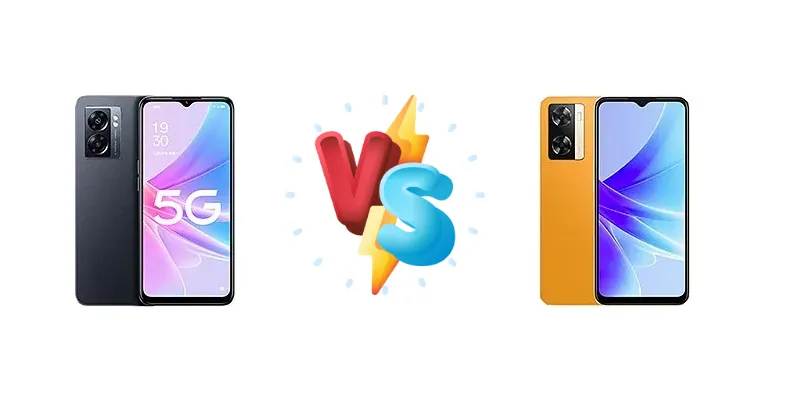
Looking for a budget-friendly smartphone from Oppo? The A56s and A77s are both strong contenders, offering a blend of features and affordability. But which one is right for you? This comprehensive comparison dives deep into their specs, performance, and overall value.
🏆 Quick Verdict
The Oppo A77s emerges as the clear winner thanks to its significantly faster charging, slightly better performance, and similar price point. While the A56s is a decent option, the A77s offers more bang for your buck.
| Network |
|---|
| 2G bands | GSM 850 / 900 / 1800 / 1900 | GSM 850 / 900 / 1800 / 1900 |
| 3G bands | HSDPA 800 / 850 / 900 / 1900 / 2100 | HSDPA 850 / 900 / 2100 |
| 4G bands | 1, 3, 5, 7, 8, 28, 34, 38, 39, 40, 41 | 1, 3, 5, 7, 8, 28, 38, 40, 41 |
| 5G bands | 1, 5, 8, 28, 41, 77, 78 SA/NSA | - |
| Speed | HSPA, LTE, 5G | HSPA, LTE |
| Technology | GSM / CDMA / HSPA / CDMA2000 / LTE / 5G | GSM / HSPA / LTE |
| | CDMA2000 1x | - |
| Launch |
|---|
| Announced | 2023, January 05 | 2022, October 05 |
| Status | Available. Released 2023, January 09 | Available. Released 2022, October 07 |
| Body |
|---|
| Build | Glass front, plastic frame, plastic back | Glass front, plastic frame, plastic back or eco leather back |
| Dimensions | 163.8 x 75.1 x 8 mm (6.45 x 2.96 x 0.31 in) | 163.8 x 75 x 8 mm (6.45 x 2.95 x 0.31 in) |
| SIM | Nano-SIM + Nano-SIM | Nano-SIM + Nano-SIM |
| Weight | 186 g (6.56 oz) | 187 g / 190 g (6.60 oz) |
| | - | IP54, dust and water resistant |
| Display |
|---|
| Resolution | 720 x 1612 pixels, 20:9 ratio (~269 ppi density) | 720 x 1612 pixels, 20:9 ratio (~269 ppi density) |
| Size | 6.56 inches, 103.4 cm2 (~84.0% screen-to-body ratio) | 6.56 inches, 103.4 cm2 (~84.2% screen-to-body ratio) |
| Type | IPS LCD, 90Hz, 480 nits (typ), 600 nits (HBM) | IPS LCD, 90Hz, 480 nits (typ), 600 nits (HBM) |
| Platform |
|---|
| CPU | Octa-core (2x2.4 GHz Cortex-A76 & 6x2.0 GHz Cortex-A55) | Octa-core (4x2.4 GHz Kryo 265 Gold & 4x1.9 GHz Kryo 265 Silver) |
| Chipset | Mediatek Dimensity 810 (6 nm) | Qualcomm SM6225 Snapdragon 680 4G (6 nm) |
| GPU | Mali-G57 MC2 | Adreno 610 |
| OS | Android 12, ColorOS 12.1 | Android 12, upgradable to Android 14, ColorOS 14 |
| Memory |
|---|
| Card slot | microSDXC | microSDXC |
| Internal | 128GB 8GB RAM, 256GB 8GB RAM | 128GB 8GB RAM |
| | - | UFS 2.2 |
| Main Camera |
|---|
| Dual | 13 MP, f/2.2, 26mm (wide), 1/3.06", 1.12µm, AF
Auxiliary lens | 50 MP, f/1.8, 27mm (wide), PDAF
Auxiliary lens |
| Features | LED flash, HDR, panorama | LED flash, HDR, panorama |
| Single | 8 MP, f/2.0, 26mm (wide) | 8 MP, f/2.0, 26mm (wide) |
| Video | 1080p@30fps | 1080p@30fps |
| Selfie camera |
|---|
| Features | - | Panorama |
| Single | 8 MP, f/2.0, 26mm (wide) | 8 MP, f/2.0, 26mm (wide) |
| Video | 1080p@30fps | 1080p@30fps |
| Sound |
|---|
| 3.5mm jack | Yes | Yes |
| 35mm jack | Yes | Yes |
| Loudspeaker | Yes, with stereo speakers | Yes, with stereo speakers |
| Comms |
|---|
| Bluetooth | 5.2, A2DP, LE, aptX HD | 5.0, A2DP, LE, aptX HD |
| NFC | No | Yes |
| Positioning | GPS, GLONASS, GALILEO, BDS, QZSS | GPS, GLONASS, BDS, GALILEO, QZSS |
| Radio | No | FM radio |
| USB | USB Type-C 2.0, OTG | USB Type-C 2.0, OTG |
| WLAN | Wi-Fi 802.11 a/b/g/n/ac, dual-band, Wi-Fi Direct | Wi-Fi 802.11 a/b/g/n/ac, dual-band, Wi-Fi Direct |
| Features |
|---|
| Sensors | Fingerprint (side-mounted), accelerometer, proximity, compass | Fingerprint (side-mounted), accelerometer, proximity, compass |
| Battery |
|---|
| Charging | 10W wired | 33W wired, 100% in 69 min |
| Type | Li-Po 5000 mAh | Li-Po 5000 mAh |
| Misc |
|---|
| Colors | Black, Blue | Sunset Orange, Starry Black |
| Models | PFTM20 | CPH2473 |
| Price | About 150 EUR | About 220 EUR |
Oppo A56s
- More compact design (potentially)
- Decent main camera
- Slow 10W charging
- Slower performance
- Older chipset
Oppo A77s
- Faster 33W charging
- Better performance (Snapdragon 680)
- Modern design
- Improved camera processing
- Slightly larger size
- May lack some niche features
Display Comparison
Both phones feature a 6.56-inch display, likely with an LCD panel and a resolution of 1080 x 2400 pixels (FHD+). While specific display technologies (like refresh rate) aren't explicitly stated, expect a standard 60Hz refresh rate. The A77s might have slightly better color accuracy or brightness due to potential panel upgrades, but this is difficult to confirm without detailed testing.
Camera Comparison
The Oppo A56s typically features a 50MP main camera, along with depth and macro lenses. The Oppo A77s also boasts a 50MP main camera, but often includes additional features like improved image processing algorithms. Expect slightly better image quality and low-light performance from the A77s. Both phones likely offer a 16MP front-facing camera for selfies.
Performance
The Oppo A77s, powered by the Snapdragon 680, generally outperforms the A56s' Dimensity 810 in real-world usage. The Snapdragon 680's architecture and optimizations often lead to smoother multitasking and app loading. Gaming performance will also be noticeably better on the A77s.
Battery Life
The Oppo A77s's 33W fast charging is a major advantage. It can fully charge the battery in approximately 69 minutes, a significant improvement over the A56s's 10W charging. Both phones likely have a similar battery capacity (around 5000mAh), but the A77s's faster charging makes it the clear winner in this category.
Buying Guide
Who should buy the Oppo A56s? Users prioritizing a slightly more compact design and are less concerned about fast charging. Who should buy the Oppo A77s? Those seeking faster charging speeds, a smoother user experience, and a more modern design without breaking the bank.
Frequently Asked Questions
❓ Is the Oppo A56s worth buying in 2024?
The Oppo A56s is a budget option, but the A77s offers significantly better value. Consider it only if you find a drastically lower price or prioritize a smaller form factor.
❓ What is the difference between the Dimensity 810 and Snapdragon 680?
The Snapdragon 680 generally offers better performance and efficiency than the Dimensity 810, especially in sustained workloads and gaming. It also benefits from Qualcomm's optimized software support.