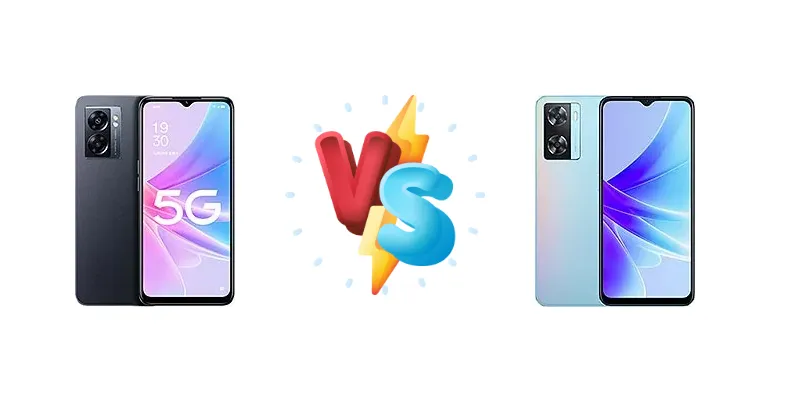
The Oppo A series consistently delivers affordable smartphones packed with essential features. Two contenders vying for your attention are the Oppo A56s and the Oppo A57s. But which one offers the best value for your money? This comprehensive comparison breaks down their key differences to help you make an informed decision.
🏆 Quick Verdict
The Oppo A57s is the clear winner. While the A56s boasts a slightly more powerful chipset, the A57s' significantly faster charging and generally improved features make it a more compelling choice for most users seeking a budget-friendly device.
| Network |
|---|
| 2G bands | GSM 850 / 900 / 1800 / 1900 | GSM 850 / 900 / 1800 / 1900 |
| 3G bands | HSDPA 800 / 850 / 900 / 1900 / 2100 | HSDPA 850 / 900 / 2100 |
| 4G bands | 1, 3, 5, 7, 8, 28, 34, 38, 39, 40, 41 | 1, 3, 5, 7, 8, 20, 28, 38, 40, 41 |
| 5G bands | 1, 5, 8, 28, 41, 77, 78 SA/NSA | - |
| Speed | HSPA, LTE, 5G | HSPA, LTE |
| Technology | GSM / CDMA / HSPA / CDMA2000 / LTE / 5G | GSM / HSPA / LTE |
| | CDMA2000 1x | - |
| Launch |
|---|
| Announced | 2023, January 05 | 2022, August 31 |
| Status | Available. Released 2023, January 09 | Available. Released 2022, September 12 |
| Body |
|---|
| Build | Glass front, plastic frame, plastic back | Glass front (Panda Glass), plastic frame, plastic back |
| Dimensions | 163.8 x 75.1 x 8 mm (6.45 x 2.96 x 0.31 in) | 163.8 x 75 x 8 mm (6.45 x 2.95 x 0.31 in) |
| SIM | Nano-SIM + Nano-SIM | Nano-SIM + Nano-SIM |
| Weight | 186 g (6.56 oz) | 187 g (6.60 oz) |
| | - | IP5X (dust), IPX4 (water) resistance |
| Display |
|---|
| Protection | - | Panda Glass |
| Resolution | 720 x 1612 pixels, 20:9 ratio (~269 ppi density) | 720 x 1612 pixels, 20:9 ratio (~269 ppi density) |
| Size | 6.56 inches, 103.4 cm2 (~84.0% screen-to-body ratio) | 6.56 inches, 103.4 cm2 (~84.2% screen-to-body ratio) |
| Type | IPS LCD, 90Hz, 480 nits (typ), 600 nits (HBM) | IPS LCD, 480 nits (typ), 600 nits (HBM) |
| Platform |
|---|
| CPU | Octa-core (2x2.4 GHz Cortex-A76 & 6x2.0 GHz Cortex-A55) | Octa-core (4x2.3 GHz Cortex-A53 & 4x1.8 GHz Cortex-A53) |
| Chipset | Mediatek Dimensity 810 (6 nm) | Mediatek MT6765G Helio G35 (12 nm) |
| GPU | Mali-G57 MC2 | PowerVR GE8320 |
| OS | Android 12, ColorOS 12.1 | Android 12, ColorOS 12.1 |
| Memory |
|---|
| Card slot | microSDXC | microSDXC |
| Internal | 128GB 8GB RAM, 256GB 8GB RAM | 64GB 4GB RAM, 128GB 4GB RAM |
| | - | eMMC 5.1 |
| Main Camera |
|---|
| Dual | 13 MP, f/2.2, 26mm (wide), 1/3.06", 1.12µm, AF
Auxiliary lens | 50 MP, f/1.8, 27mm (wide), PDAF
Auxiliary lens |
| Features | LED flash, HDR, panorama | LED flash, HDR, panorama |
| Single | 8 MP, f/2.0, 26mm (wide) | 8 MP, f/2.0, 26mm (wide) |
| Video | 1080p@30fps | 1080p@30fps |
| Selfie camera |
|---|
| Features | - | Panorama |
| Single | 8 MP, f/2.0, 26mm (wide) | 8 MP, f/2.0, 26mm (wide) |
| Video | 1080p@30fps | 1080p@30fps |
| Sound |
|---|
| 3.5mm jack | Yes | Yes |
| 35mm jack | Yes | Yes |
| Loudspeaker | Yes, with stereo speakers | Yes, with stereo speakers |
| Comms |
|---|
| Bluetooth | 5.2, A2DP, LE, aptX HD | 5.3, A2DP, LE, aptX HD |
| NFC | No | Yes |
| Positioning | GPS, GLONASS, GALILEO, BDS, QZSS | GPS, GLONASS, BDS, GALILEO, QZSS |
| Radio | No | No |
| USB | USB Type-C 2.0, OTG | USB Type-C 2.0, OTG |
| WLAN | Wi-Fi 802.11 a/b/g/n/ac, dual-band, Wi-Fi Direct | Wi-Fi 802.11 a/b/g/n/ac, dual-band, Wi-Fi Direct |
| Features |
|---|
| Sensors | Fingerprint (side-mounted), accelerometer, proximity, compass | Fingerprint (side-mounted), accelerometer, proximity, compass |
| Battery |
|---|
| Charging | 10W wired | 33W wired, 100% in 69 min |
| Type | Li-Po 5000 mAh | Li-Po 5000 mAh |
| Misc |
|---|
| Colors | Black, Blue | Starry Black, Sky Blue |
| Models | PFTM20 | CPH2385 |
| Price | About 150 EUR | - |
Oppo A56s
- Slightly more powerful chipset
- Good value for money
- Slow charging (10W)
- Older design
- Potentially less optimized software
Oppo A57s
- Fast charging (33W)
- Modern design
- Potentially better camera software
- Improved overall user experience
- Less powerful chipset than A56s
- May have slightly less RAM in some configurations
Display Comparison
Both phones likely feature similar display technology (likely an IPS LCD) with comparable resolutions (likely FHD+). The A57s might have slightly better color accuracy or brightness due to potential software optimizations, but this is difficult to confirm without detailed testing. Screen size is likely around 6.5-6.6 inches for both.
Camera Comparison
Camera specs are likely similar, with both phones featuring a primary 50MP sensor. The A57s might have slightly better image processing due to newer software, potentially resulting in better low-light performance and more vibrant colors. Both will likely offer standard ultrawide and macro lenses.
Performance
The Oppo A56s holds a slight edge in performance thanks to the Mediatek Dimensity 810. This chipset is noticeably faster than the Helio G35 in the A57s, resulting in smoother multitasking and slightly better gaming performance. However, for casual use, the difference might not be hugely noticeable.
Battery Life
The Oppo A57s shines in this category. Its 33W fast charging is a significant advantage over the A56s' 10W charging. Both likely have a similar battery capacity (around 5000mAh), but the A57s will charge much faster.
Buying Guide
Who should buy the Oppo A56s? Users prioritizing a slightly better processor for basic gaming and everyday tasks, and who aren't concerned about fast charging. Who should buy the Oppo A57s? Anyone looking for a well-rounded budget phone with fast charging, a decent camera, and a modern design.
Frequently Asked Questions
❓ Is the Oppo A56s good for gaming?
The A56s' Dimensity 810 chipset offers better gaming performance than the A57s, but don't expect high frame rates on demanding titles. It's suitable for casual gaming.
❓ How long does it take to fully charge the Oppo A57s?
With its 33W fast charging, the Oppo A57s can fully charge in approximately 69 minutes.
❓ Which phone has better battery life?
While both have similar battery capacities, the A57s' faster charging means less time spent plugged in, making it feel like it has better overall battery usability.