
Oppo A56s vs OnePlus Nord CE 2 Lite 5G: A Detailed Comparison of Budget 5G Contenders
| Phones Images | |||||
|---|---|---|---|---|---|
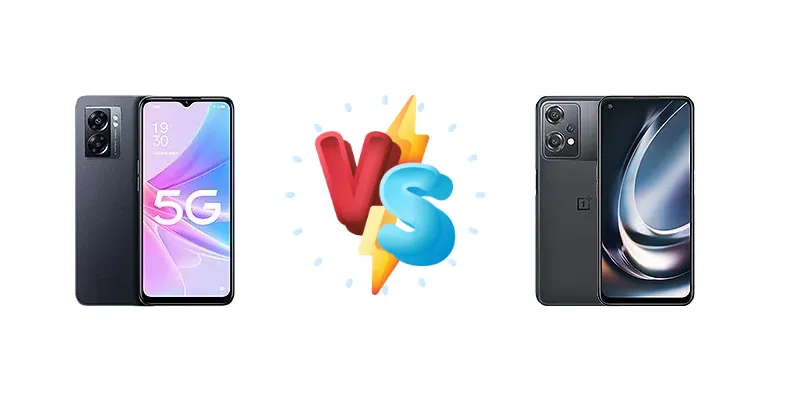
|
🏆 Quick Verdict
For most users, the OnePlus Nord CE 2 Lite 5G emerges as the better choice. Its Snapdragon 695 chipset, coupled with significantly faster 33W charging, provides a smoother overall experience and reduces downtime. While the A56s is more affordable, the Nord CE 2 Lite’s performance and convenience justify the price difference.
| PHONES | ||
|---|---|---|
| Phone Names | Oppo A56s | OnePlus Nord CE 2 Lite 5G |
| Network | ||
|---|---|---|
| 2G bands | GSM 850 / 900 / 1800 / 1900 | GSM 850 / 900 / 1800 / 1900 |
| 3G bands | HSDPA 800 / 850 / 900 / 1900 / 2100 | HSDPA 800 / 850 / 900 / 1700(AWS) / 1900 / 2100 |
| 4G bands | 1, 3, 5, 7, 8, 28, 34, 38, 39, 40, 41 | 1, 2, 3, 4, 5, 7, 8, 12, 13, 17, 18, 19, 20, 26, 28, 38, 39, 40, 41, 66 - Europe |
| 5G bands | 1, 5, 8, 28, 41, 77, 78 SA/NSA | 1, 3, 5, 7, 8, 20, 28, 38, 40, 41, 66, 77, 78 SA/NSA - Europe |
| Speed | HSPA, LTE, 5G | HSPA, LTE, 5G |
| Technology | GSM / CDMA / HSPA / CDMA2000 / LTE / 5G | GSM / HSPA / LTE / 5G |
| CDMA2000 1x | - | |
| Launch | ||
|---|---|---|
| Announced | 2023, January 05 | 2022, April 28 |
| Status | Available. Released 2023, January 09 | Available. Released 2022, April 30 |
| Body | ||
|---|---|---|
| Build | Glass front, plastic frame, plastic back | Glass front, plastic frame, plastic back |
| Dimensions | 163.8 x 75.1 x 8 mm (6.45 x 2.96 x 0.31 in) | 164.3 x 75.6 x 8.5 mm (6.47 x 2.98 x 0.33 in) |
| SIM | Nano-SIM + Nano-SIM | Nano-SIM + Nano-SIM |
| Weight | 186 g (6.56 oz) | 195 g (6.88 oz) |
| Display | ||
|---|---|---|
| Resolution | 720 x 1612 pixels, 20:9 ratio (~269 ppi density) | 1080 x 2412 pixels, 20:9 ratio (~401 ppi density) |
| Size | 6.56 inches, 103.4 cm2 (~84.0% screen-to-body ratio) | 6.59 inches, 104.5 cm2 (~84.1% screen-to-body ratio) |
| Type | IPS LCD, 90Hz, 480 nits (typ), 600 nits (HBM) | IPS LCD, 120Hz |
| Platform | ||
|---|---|---|
| CPU | Octa-core (2x2.4 GHz Cortex-A76 & 6x2.0 GHz Cortex-A55) | Octa-core (2x2.2 GHz Kryo 660 Gold & 6x1.7 GHz Kryo 660 Silver) |
| Chipset | Mediatek Dimensity 810 (6 nm) | Qualcomm SM6375 Snapdragon 695 5G (6 nm) |
| GPU | Mali-G57 MC2 | Adreno 619 |
| OS | Android 12, ColorOS 12.1 | Android 12, upgradable to Android 13, OxygenOS 13 |
| Memory | ||
|---|---|---|
| Card slot | microSDXC | microSDXC (uses shared SIM slot) |
| Internal | 128GB 8GB RAM, 256GB 8GB RAM | 128GB 6GB RAM, 128GB 8GB RAM |
| Main Camera | ||
|---|---|---|
| Dual | 13 MP, f/2.2, 26mm (wide), 1/3.06", 1.12µm, AF Auxiliary lens | - |
| Features | LED flash, HDR, panorama | LED flash, HDR, panorama |
| Single | 8 MP, f/2.0, 26mm (wide) | - |
| Triple | - | 64 MP, f/1.7, 26mm (wide), 0.7µm, PDAF 2 MP (macro) Auxiliary lens |
| Video | 1080p@30fps | 1080p@30fps |
| Selfie camera | ||
|---|---|---|
| Features | - | HDR |
| Single | 8 MP, f/2.0, 26mm (wide) | 16 MP, f/2.0, (wide), 1/3.0", 1.0µm |
| Video | 1080p@30fps | 1080p@30fps |
| Sound | ||
|---|---|---|
| 3.5mm jack | Yes | Yes |
| 35mm jack | Yes | Yes |
| Loudspeaker | Yes, with stereo speakers | Yes |
| Comms | ||
|---|---|---|
| Bluetooth | 5.2, A2DP, LE, aptX HD | 5.2, A2DP, LE, aptX HD |
| NFC | No | Yes (market/region dependent) |
| Positioning | GPS, GLONASS, GALILEO, BDS, QZSS | GPS, GLONASS, GALILEO, BDS, QZSS |
| Radio | No | Unspecified |
| USB | USB Type-C 2.0, OTG | USB Type-C 2.0, OTG |
| WLAN | Wi-Fi 802.11 a/b/g/n/ac, dual-band, Wi-Fi Direct | Wi-Fi 802.11 a/b/g/n/ac, dual-band, Wi-Fi Direct |
| Features | ||
|---|---|---|
| Sensors | Fingerprint (side-mounted), accelerometer, proximity, compass | Fingerprint (side-mounted), accelerometer, gyro, proximity, compass |
| Battery | ||
|---|---|---|
| Charging | 10W wired | 33W wired |
| Type | Li-Po 5000 mAh | Li-Po 5000 mAh |
| Misc | ||
|---|---|---|
| Colors | Black, Blue | Black Dusk, Blue Tide |
| Models | PFTM20 | CPH2381, CPH2409 |
| Price | About 150 EUR | About 220 EUR |
| SAR | - | 1.19 W/kg (head) 0.71 W/kg (body) |
Oppo A56s
- Lower price point makes it accessible to budget-conscious buyers.
- Dimensity 810 is capable of handling everyday tasks efficiently.
- Likely a lightweight and comfortable design.
- Extremely slow 10W charging is a significant drawback.
- Performance may struggle with demanding games or apps.
- Camera quality likely limited by the chipset and lack of OIS.
OnePlus Nord CE 2 Lite 5G
- Faster Snapdragon 695 chipset offers smoother performance.
- 33W fast charging significantly reduces downtime.
- OnePlus’s software experience is generally cleaner and more refined.
- Slightly higher price compared to the Oppo A56s.
- May not offer a dramatically better camera experience.
- Still lacks high-end features like a high refresh rate display.
Display Comparison
Neither device boasts a standout display. Both likely utilize LCD panels, a common cost-saving measure in this segment. The focus here isn't on visual fidelity, but on functionality. Without specific display specs, we can infer that both will offer adequate viewing angles and color reproduction for everyday use. The absence of high refresh rates on either device suggests a focus on power efficiency rather than a fluid visual experience.
Camera Comparison
Without detailed camera specs, a direct comparison is difficult. However, given the price point, both phones likely feature a primary sensor paired with depth and macro lenses. The quality of image processing will be a key differentiator. OnePlus generally prioritizes natural-looking images, while Oppo often leans towards more saturated colors. The absence of Optical Image Stabilization (OIS) on either device suggests that low-light performance will be a challenge, relying heavily on software algorithms. The usefulness of the typical 2MP macro lens found in this segment is questionable, offering limited detail and often serving as a marketing feature rather than a practical tool.
Performance
The core difference lies in the chipsets. The Oppo A56s features the Mediatek Dimensity 810 (6nm), with a CPU configuration of 2x2.4 GHz Cortex-A76 and 6x2.0 GHz Cortex-A55 cores. The OnePlus Nord CE 2 Lite 5G utilizes the Qualcomm Snapdragon 695 5G (6nm), employing 2x2.2 GHz Kryo 660 Gold and 6x1.7 GHz Kryo 660 Silver cores. While both are 6nm chips, Qualcomm’s Snapdragon typically exhibits better sustained performance and GPU efficiency. The slightly lower clock speeds on the Snapdragon 695 are offset by architectural advantages, resulting in a smoother experience during multitasking and gaming. The A56s will handle everyday tasks adequately, but the Nord CE 2 Lite 5G will likely show a noticeable advantage in more demanding scenarios.
Battery Life
The battery capacity is not specified, but both phones likely house batteries in the 4500-5000 mAh range. The critical difference is charging speed. The Oppo A56s is limited to a slow 10W wired charging, meaning a full charge will take well over two hours. The OnePlus Nord CE 2 Lite 5G, with its 33W wired charging, can significantly reduce charging times, potentially reaching 100% in under an hour. This faster charging capability is a major convenience factor, especially for users who frequently find themselves needing to top up their battery throughout the day.
Buying Guide
Buy the Oppo A56s if your absolute priority is minimizing upfront cost and you primarily use your phone for basic tasks like calls, messaging, and light social media. You’ll need to be patient with charging times. Buy the OnePlus Nord CE 2 Lite 5G if you value a more responsive user experience, faster charging, and are willing to spend a little more for improved performance, especially if you occasionally game or use demanding apps.