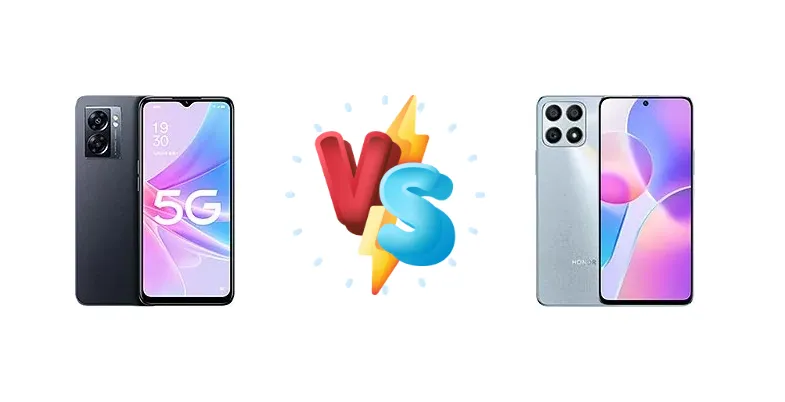
The Oppo A56s and Honor X30i represent a competitive segment of the smartphone market, both leveraging the Mediatek Dimensity 810 chipset. This comparison focuses on discerning the practical differences between these two devices, particularly concerning charging speed and overall user experience, as they often target similar budget-conscious consumers.
🏆 Quick Verdict
For the average user prioritizing convenience, the Honor X30i emerges as the better choice. While both phones share the same Dimensity 810 chipset, the X30i’s 22.5W charging significantly reduces downtime compared to the A56s’ sluggish 10W charging, making it more practical for daily use.
| Network |
|---|
| 2G bands | GSM 850 / 900 / 1800 / 1900 | GSM 850 / 900 / 1800 / 1900 |
| 3G bands | HSDPA 800 / 850 / 900 / 1900 / 2100 | HSDPA 850 / 900 / 1700(AWS) / 1900 / 2100 |
| 4G bands | 1, 3, 5, 7, 8, 28, 34, 38, 39, 40, 41 | LTE |
| 5G bands | 1, 5, 8, 28, 41, 77, 78 SA/NSA | SA/NSA |
| Speed | HSPA, LTE, 5G | HSPA, LTE, 5G |
| Technology | GSM / CDMA / HSPA / CDMA2000 / LTE / 5G | GSM / CDMA / HSPA / CDMA2000 / LTE / 5G |
| | CDMA2000 1x | CDMA2000 1x |
| Launch |
|---|
| Announced | 2023, January 05 | 2021, October 28 |
| Status | Available. Released 2023, January 09 | Available. Released 2021, November 02 |
| Body |
|---|
| Build | Glass front, plastic frame, plastic back | Glass front, plastic frame, plastic back |
| Dimensions | 163.8 x 75.1 x 8 mm (6.45 x 2.96 x 0.31 in) | 163.4 x 74.7 x 7.5 mm (6.43 x 2.94 x 0.30 in) |
| SIM | Nano-SIM + Nano-SIM | Nano-SIM + Nano-SIM |
| Weight | 186 g (6.56 oz) | 175 g (6.17 oz) |
| Display |
|---|
| Resolution | 720 x 1612 pixels, 20:9 ratio (~269 ppi density) | 1080 x 2388 pixels (~391 ppi density) |
| Size | 6.56 inches, 103.4 cm2 (~84.0% screen-to-body ratio) | 6.7 inches, 108.7 cm2 (~89.1% screen-to-body ratio) |
| Type | IPS LCD, 90Hz, 480 nits (typ), 600 nits (HBM) | IPS LCD, 90Hz |
| Platform |
|---|
| CPU | Octa-core (2x2.4 GHz Cortex-A76 & 6x2.0 GHz Cortex-A55) | Octa-core (2x2.4 GHz Cortex-A76 & 6x2.0 GHz Cortex-A55) |
| Chipset | Mediatek Dimensity 810 (6 nm) | Mediatek Dimensity 810 (6 nm) |
| GPU | Mali-G57 MC2 | Mali-G57 MC2 |
| OS | Android 12, ColorOS 12.1 | Android 11, Magic UI 5.0 |
| Memory |
|---|
| Card slot | microSDXC | No |
| Internal | 128GB 8GB RAM, 256GB 8GB RAM | 128GB 6GB RAM, 128GB 8GB RAM, 256GB 8GB RAM |
| Main Camera |
|---|
| Dual | 13 MP, f/2.2, 26mm (wide), 1/3.06", 1.12µm, AF
Auxiliary lens | - |
| Features | LED flash, HDR, panorama | LED flash, panorama, HDR |
| Single | 8 MP, f/2.0, 26mm (wide) | 8 MP, f/2.0 |
| Triple | - | 48 MP, f/1.8, 26mm (wide), PDAF
2 MP (macro)
Auxiliary lens |
| Video | 1080p@30fps | 1080p@30fps |
| Selfie camera |
|---|
| Single | 8 MP, f/2.0, 26mm (wide) | 8 MP, f/2.0 |
| Video | 1080p@30fps | 1080p@30fps |
| Sound |
|---|
| 3.5mm jack | Yes | Yes |
| 35mm jack | Yes | Yes |
| Loudspeaker | Yes, with stereo speakers | Yes, with dual speakers |
| Comms |
|---|
| Bluetooth | 5.2, A2DP, LE, aptX HD | 5.1, A2DP, LE |
| NFC | No | No |
| Positioning | GPS, GLONASS, GALILEO, BDS, QZSS | GPS, GLONASS, BDS |
| Radio | No | No |
| USB | USB Type-C 2.0, OTG | USB Type-C 2.0, OTG |
| WLAN | Wi-Fi 802.11 a/b/g/n/ac, dual-band, Wi-Fi Direct | Wi-Fi 802.11 a/b/g/n/ac, dual-band, Wi-Fi Direct |
| Features |
|---|
| Sensors | Fingerprint (side-mounted), accelerometer, proximity, compass | Fingerprint (side-mounted), accelerometer, compass |
| Battery |
|---|
| Charging | 10W wired | 22.5W wired |
| Type | Li-Po 5000 mAh | Li-Po 4000 mAh |
| Misc |
|---|
| Colors | Black, Blue | Black, Blue, Silver, Rose Gold |
| Models | PFTM20 | TFY-AN00 |
| Price | About 150 EUR | About 190 EUR |
Oppo A56s
- Potentially lower price point
- Mediatek Dimensity 810 chipset offers solid performance
- Reliable brand reputation (Oppo)
- Extremely slow 10W charging
- Likely basic display technology
- Camera performance may be limited
Honor X30i
- Significantly faster 22.5W charging
- Mediatek Dimensity 810 chipset offers solid performance
- Modern design aesthetic (Honor)
- May be slightly more expensive than the Oppo A56s
- Software experience may differ from Oppo's ColorOS
- Camera performance details are unknown
Display Comparison
Both the Oppo A56s and Honor X30i likely feature LCD panels, common in this price bracket. Specific details like resolution and refresh rate are missing, but the focus here is on charging. Display quality will likely be similar, with neither phone expected to offer high peak brightness or advanced features like LTPO. Bezels are also likely comparable, contributing minimally to differentiating the user experience.
Camera Comparison
Without detailed camera specifications, a direct comparison is difficult. Both phones likely feature a multi-camera setup, but the quality will depend on sensor size, lens aperture, and image processing algorithms. It’s reasonable to assume both will include a primary sensor and potentially depth or macro lenses, though the usefulness of a 2MP macro lens is questionable. Image processing style will likely differ, with Oppo historically favoring more vibrant colors and Honor leaning towards a more natural look.
Performance
Both devices are powered by the Mediatek Dimensity 810 (6nm), featuring an octa-core CPU configuration with 2x2.4 GHz Cortex-A76 and 6x2.0 GHz Cortex-A55 cores. This means performance will be virtually identical in most tasks, including everyday usage and moderate gaming. The 6nm process node offers a good balance of power efficiency, but thermal management will depend on the phone’s internal design, a detail not provided. RAM configurations are also unknown, but will impact multitasking capabilities.
Battery Life
The battery capacity of both devices is unknown. However, the critical difference lies in charging speed. The Honor X30i’s 22.5W wired charging is a significant advantage over the Oppo A56s’ 10W charging. This translates to a much faster 0-100% charge time for the X30i, potentially reducing charging time by over an hour. Even with a similar battery capacity, the faster charging of the X30i provides a more convenient user experience.
Buying Guide
Buy the Oppo A56s if you prioritize a potentially lower initial purchase price and are willing to tolerate significantly slower charging speeds. It’s a viable option for users who primarily charge their phones overnight and aren’t concerned with quick top-ups. Buy the Honor X30i if you value faster charging and a more convenient user experience. The 22.5W charging is a substantial advantage for those who need to quickly replenish their battery throughout the day, even if it means a slightly higher upfront cost.
Frequently Asked Questions
❓ How much faster is the Honor X30i's charging compared to the Oppo A56s in real-world use?
The Honor X30i's 22.5W charging will likely reduce charging time by at least 60-90 minutes for a full 0-100% charge. This is a significant difference, allowing for quick top-ups throughout the day, whereas the Oppo A56s' 10W charging requires a much longer commitment to reach full capacity.
❓ Will the Dimensity 810 in either phone struggle with demanding games like PUBG or Call of Duty?
The Dimensity 810 is capable of running PUBG and Call of Duty, but you'll likely need to lower graphics settings to achieve a consistently smooth frame rate. Thermal throttling could also become a factor during extended gaming sessions, though the extent of this will depend on the phone's cooling system, which is not specified.
❓ Are there any significant differences in the software experience between Oppo's ColorOS and Honor's Magic UI?
Oppo's ColorOS is known for its customization options and feature-rich interface, while Honor's Magic UI aims for a cleaner, more streamlined experience. Both are based on Android, but offer distinct visual styles and pre-installed apps. User preference will largely dictate which software experience is preferred.