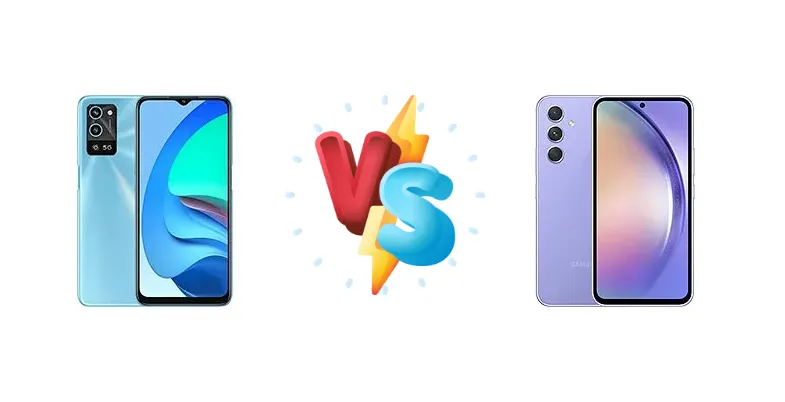
The mid-range smartphone market is packed with options, making it tough to choose. Today, we're pitting the Oppo A56 5G against the Samsung Galaxy A54, two popular contenders offering 5G connectivity and a range of features. Let's dive into a comprehensive comparison to see which phone reigns supreme.
🏆 Quick Verdict
The Samsung Galaxy A54 is the clear winner. While the Oppo A56 5G offers a budget-friendly entry point, the A54’s superior display, significantly faster chipset, better camera system, and faster charging make it the more compelling choice for most users.
| Network |
|---|
| 2G bands | GSM 850 / 900 / 1800 / 1900 | GSM 850 / 900 / 1800 / 1900 |
| 3G bands | HSDPA 800 / 850 / 900 / 1900 / 2100 | HSDPA 850 / 900 / 1700(AWS) / 1900 / 2100 |
| 4G bands | 1, 3, 5, 7, 8, 34, 38, 39, 40, 41 | 1, 2, 3, 4, 5, 7, 8, 12, 17, 20, 26, 28, 32, 38, 40, 41, 66 - International |
| 5G bands | 1, 28, 41, 77, 78 | 1, 3, 7, 8, 20, 28, 38, 40, 41, 77, 78 SA/NSA/Sub6 - International |
| Speed | HSPA, LTE | HSPA, LTE, 5G |
| Technology | GSM / CDMA / HSPA / CDMA2000 / LTE / 5G | GSM / HSPA / LTE / 5G |
| | CDMA2000 1x | 25, 41, 66, 71 SA/NSA/Sub6/mmWave - USA |
| Launch |
|---|
| Announced | 2021, October 25 | 2023, March 15 |
| Status | Available. Released 2021, November 16 | Available. Released 2023, March 24 |
| Body |
|---|
| Build | - | Glass front (Gorilla Glass 5), glass back (Gorilla Glass 5), plastic frame |
| Dimensions | 163.8 x 75.6 x 8.4 mm (6.45 x 2.98 x 0.33 in) | 158.2 x 76.7 x 8.2 mm (6.23 x 3.02 x 0.32 in) |
| SIM | Nano-SIM + Nano-SIM | · Nano-SIM + eSIM· Nano-SIM + Nano-SIM |
| Weight | 189.5 g (6.70 oz) | 202 g (7.13 oz) |
| | - | IP67 dust/water resistant (up to 1m for 30 min) |
| Display |
|---|
| Protection | Panda / Corning Gorilla Glass 3 | Corning Gorilla Glass 5 |
| Resolution | 720 x 1600 pixels, 20:9 ratio (~270 ppi density) | 1080 x 2340 pixels, 19.5:9 ratio (~403 ppi density) |
| Size | 6.5 inches, 102.0 cm2 (~82.4% screen-to-body ratio) | 6.4 inches, 100.5 cm2 (~82.9% screen-to-body ratio) |
| Type | IPS LCD, 480 nits (typ) | Super AMOLED, 120Hz, HDR10+, 1000 nits (HBM) |
| Platform |
|---|
| CPU | Octa-core (2x2.2 GHz Cortex-A76 & 6x2.0 GHz Cortex-A55) | Octa-core (4x2.4 GHz Cortex-A78 & 4x2.0 GHz Cortex-A55) |
| Chipset | Mediatek Dimensity 700 (7 nm) | Exynos 1380 (5 nm) |
| GPU | Mali-G57 MC2 | Mali-G68 MP5 |
| OS | Android 11, ColorOS 11.1 | Android 13, up to 4 major Android upgrades, One UI 7 |
| Memory |
|---|
| Card slot | microSDXC | microSDXC (uses shared SIM slot) |
| Internal | 128GB 4GB RAM, 128GB 6GB RAM | 128GB 4GB RAM, 128GB 6GB RAM, 128GB 8GB RAM, 256GB 6GB RAM, 256GB 8GB RAM |
| | UFS 2.1 / UFS 2.2 | - |
| Main Camera |
|---|
| Dual | 13 MP, f/2.2, 25mm (wide), 1/3.06", 1.12µm, PDAF
Auxiliary lens | - |
| Features | LED flash, HDR, panorama | LED flash, panorama, HDR |
| Single | 8 MP, f/2.0, (wide) | 32 MP, f/2.2, 26mm (wide), 1/2.8", 0.8µm |
| Triple | - | 50 MP, f/1.8, 23mm (wide), 1/1.56", 1.0µm, PDAF, OIS
12 MP, f/2.2, 13mm, 123˚ (ultrawide), 1/3.X", 1.12µm
5 MP (macro) |
| Video | 1080p@30fps | 4K@30fps, 1080p@30/60fps, 720p@480fps, gyro-EIS |
| Selfie camera |
|---|
| Features | HDR | - |
| Single | 8 MP, f/2.0, (wide) | 32 MP, f/2.2, 26mm (wide), 1/2.8", 0.8µm |
| Video | 1080p@30fps | 4K@30fps, 1080p@30/60fps |
| Sound |
|---|
| 3.5mm jack | Yes | No |
| 35mm jack | Yes | No |
| Loudspeaker | Yes | Yes, with stereo speakers |
| Comms |
|---|
| Bluetooth | 5.1, A2DP, LE, aptX | 5.3, A2DP, LE |
| NFC | No | Yes (market/region dependent) |
| Positioning | GPS, GLONASS, GALILEO, BDS, QZSS | GPS, GLONASS, GALILEO, BDS |
| Radio | No | No |
| USB | USB Type-C 2.0, OTG | USB Type-C 2.0, OTG |
| WLAN | Wi-Fi 802.11 a/b/g/n/ac, dual-band, Wi-Fi Direct | Wi-Fi 802.11 a/b/g/n/ac/6, dual-band, Wi-Fi Direct |
| Features |
|---|
| Sensors | Fingerprint (side-mounted), accelerometer, proximity, compass | Fingerprint (under display, optical), accelerometer, gyro, compass, barometer (USA only) |
| | - | Virtual proximity sensing |
| Battery |
|---|
| Charging | 10W wired | 25W wired |
| Type | Li-Po 5000 mAh | 5000 mAh |
| Misc |
|---|
| Colors | Black, Blue, Violet | Lime, Graphite, Violet, White |
| Models | PFVM10 | SM-A546V, SM-A546U, SM-A546U1, SM-A546B, SM-A546B/DS, SM-A546E, SM-A546E/DS, SM-A5460, SM-A546M, SM-A546M/DS, SM-A546W |
| Price | About 220 EUR | € 210.00 / $ 119.11 / £ 169.95 / ₹ 28,999 |
| SAR | - | 0.81 W/kg (head) 0.67 W/kg (body) |
| SAR EU | - | 0.69 W/kg (head) 1.34 W/kg (body) |
| Tests |
|---|
| Battery life | - |
Endurance rating 119h
|
| Camera | - |
Photo / Video |
| Display | - |
Contrast ratio: Infinite (nominal) |
| Loudspeaker | - |
-26.6 LUFS (Good)
|
| Performance | - |
AnTuTu: 506678 (v9)
GeekBench: 2703 (v5.1), 2797 (v6)
GFXBench: 25fps (ES 3.1 onscreen) |
Oppo A56 5G
- Affordable
- 5G Connectivity
- Decent Battery Life
- Slow Performance
- Mediocre Camera
- Slow Charging
- Less Bright Display
Samsung Galaxy A54
- Excellent Display
- Fast Performance
- Great Camera
- Long Battery Life
- Fast Charging
- Durable Build (likely Gorilla Glass)
- Higher Price
- Exynos Chipset (can be less efficient than Snapdragon in some cases)
Display Comparison
The Samsung Galaxy A54 boasts a significantly brighter display (980 nits peak) with an 'infinite' contrast ratio, offering richer colors and deeper blacks. The Oppo A56 5G's display is adequate but lacks the vibrancy and outdoor visibility of the A54. The A54 also likely has Gorilla Glass protection, adding durability.
Camera Comparison
The Galaxy A54’s camera system is expected to be superior, offering better image quality, dynamic range, and low-light performance. While the Oppo A56 5G has a usable camera, it doesn't match the A54's capabilities. The A54 likely offers more advanced features like optical image stabilization (OIS).
Performance
The Exynos 1380 in the Galaxy A54 is a substantial upgrade over the Mediatek Dimensity 700 in the Oppo A56 5G. The A54's 5nm process and Cortex-A78 cores provide noticeably faster performance for gaming, multitasking, and demanding apps. The Oppo A56 5G will handle basic tasks, but struggles with heavier workloads.
Battery Life
Both phones offer good battery life, but the Galaxy A54 shines with an endurance rating of 119 hours and active use lasting 11 hours and 15 minutes. The Oppo A56 5G's battery life is respectable, but falls short of the A54's longevity. The A54 also supports faster 25W charging compared to the Oppo's 10W.
Buying Guide
Who should buy the Oppo A56 5G? Those on a very tight budget who prioritize 5G connectivity above all else. Who should buy the Samsung Galaxy A54? Anyone seeking a well-rounded mid-range phone with a vibrant display, strong performance, a capable camera, and excellent battery life.
Frequently Asked Questions
❓ Is the Oppo A56 5G worth buying?
It's a budget option for basic 5G usage, but the performance limitations and slower charging make it less appealing than alternatives.
❓ Which phone has better software support?
Samsung typically offers longer software update support than Oppo, making the Galaxy A54 a better long-term investment.
❓ Can the Oppo A56 5G handle gaming?
It can handle light gaming, but demanding titles will likely suffer from lag and reduced frame rates.
❓ What is the difference between the Exynos 1380 and Dimensity 700?
The Exynos 1380 is significantly more powerful and efficient, offering better performance and graphics capabilities compared to the Dimensity 700.