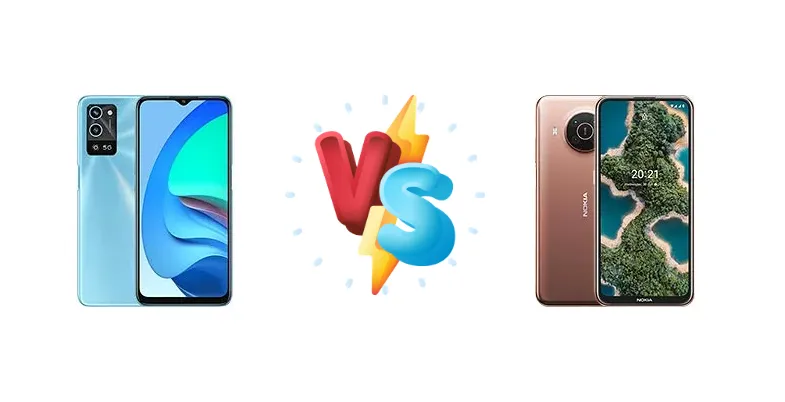
The Oppo A56 5G and Nokia X20 represent compelling options in the increasingly crowded budget 5G smartphone market. Both aim to deliver 5G connectivity without breaking the bank, but they take different approaches to achieving this. The Oppo prioritizes a newer chipset architecture, while the Nokia focuses on a more streamlined software experience and faster charging.
🏆 Quick Verdict
For the average user prioritizing faster charging and a cleaner software experience, the Nokia X20 is the better choice. While the Oppo A56 5G boasts a slightly more modern CPU architecture, the Nokia’s 18W charging and Qualcomm’s generally efficient power management provide a more convenient daily experience.
| Network |
|---|
| 2G bands | GSM 850 / 900 / 1800 / 1900 | GSM 850 / 900 / 1800 / 1900 |
| 3G bands | HSDPA 800 / 850 / 900 / 1900 / 2100 | HSDPA 850 / 900 / 1700(AWS) / 1900 / 2100 |
| 4G bands | 1, 3, 5, 7, 8, 34, 38, 39, 40, 41 | 1, 2, 3, 4, 5, 7, 8, 12, 20, 28, 66, 38, 39, 40, 41 |
| 5G bands | 1, 28, 41, 77, 78 | 1, 2, 3, 5, 7, 28, 38, 41, 66, 78 SA/NSA/Sub6 |
| Speed | HSPA, LTE | HSPA, LTE, 5G |
| Technology | GSM / CDMA / HSPA / CDMA2000 / LTE / 5G | GSM / HSPA / LTE / 5G |
| | CDMA2000 1x | - |
| Launch |
|---|
| Announced | 2021, October 25 | 2021, April 08 |
| Status | Available. Released 2021, November 16 | Available. Released 2021, May 12 |
| Body |
|---|
| Dimensions | 163.8 x 75.6 x 8.4 mm (6.45 x 2.98 x 0.33 in) | 168.9 x 79.7 x 9.1 mm (6.65 x 3.14 x 0.36 in) |
| SIM | Nano-SIM + Nano-SIM | · Nano-SIM· Nano-SIM + Nano-SIM |
| Weight | 189.5 g (6.70 oz) | 220 g (7.76 oz) |
| Display |
|---|
| Protection | Panda / Corning Gorilla Glass 3 | Corning Gorilla Glass 5 |
| Resolution | 720 x 1600 pixels, 20:9 ratio (~270 ppi density) | 1080 x 2400 pixels, 20:9 ratio (~395 ppi density) |
| Size | 6.5 inches, 102.0 cm2 (~82.4% screen-to-body ratio) | 6.67 inches, 107.4 cm2 (~79.8% screen-to-body ratio) |
| Type | IPS LCD, 480 nits (typ) | IPS LCD, 450 nits (typ) |
| Platform |
|---|
| CPU | Octa-core (2x2.2 GHz Cortex-A76 & 6x2.0 GHz Cortex-A55) | Octa-core (2x2.0 GHz Kryo 460 & 6x1.8 GHz Kryo 460) |
| Chipset | Mediatek Dimensity 700 (7 nm) | Qualcomm SM4350 Snapdragon 480 5G (8 nm) |
| GPU | Mali-G57 MC2 | Adreno 619 |
| OS | Android 11, ColorOS 11.1 | Android 11, upgradable to Android 14 |
| Memory |
|---|
| Card slot | microSDXC | microSDXC (uses shared SIM slot) |
| Internal | 128GB 4GB RAM, 128GB 6GB RAM | 128GB 6GB RAM, 128GB 8GB RAM |
| | UFS 2.1 / UFS 2.2 | - |
| Main Camera |
|---|
| Dual | 13 MP, f/2.2, 25mm (wide), 1/3.06", 1.12µm, PDAF
Auxiliary lens | - |
| Features | LED flash, HDR, panorama | Zeiss optics, LED flash, HDR, panorama |
| Quad | - | 64 MP, (wide), PDAF
5 MP, (ultrawide)
2 MP (macro)
Auxiliary lens |
| Single | 8 MP, f/2.0, (wide) | 32 MP, (wide) |
| Video | 1080p@30fps | 1080p@30/60fps |
| Selfie camera |
|---|
| Features | HDR | - |
| Single | 8 MP, f/2.0, (wide) | 32 MP, (wide) |
| Video | 1080p@30fps | 1080p@30fps |
| Sound |
|---|
| 3.5mm jack | Yes | Yes |
| 35mm jack | Yes | Yes |
| Loudspeaker | Yes | Yes |
| Comms |
|---|
| Bluetooth | 5.1, A2DP, LE, aptX | 5.0, A2DP, LE, aptX HD |
| NFC | No | Yes |
| Positioning | GPS, GLONASS, GALILEO, BDS, QZSS | GPS, GLONASS, GALILEO |
| Radio | No | FM radio |
| USB | USB Type-C 2.0, OTG | USB Type-C 2.0, OTG |
| WLAN | Wi-Fi 802.11 a/b/g/n/ac, dual-band, Wi-Fi Direct | Wi-Fi 802.11 a/b/g/n/ac, dual-band, Wi-Fi Direct |
| Features |
|---|
| Sensors | Fingerprint (side-mounted), accelerometer, proximity, compass | Fingerprint (side-mounted), accelerometer, gyro, proximity |
| Battery |
|---|
| Charging | 10W wired | 18W wired |
| Type | Li-Po 5000 mAh | Li-Po 4470 mAh |
| Misc |
|---|
| Colors | Black, Blue, Violet | Midnight Sun, Nordic Blue |
| Models | PFVM10 | TA-1341, TA-1344 |
| Price | About 220 EUR | About 130 EUR |
| SAR | - | 1.04 W/kg (head) 0.62 W/kg (body) |
| SAR EU | - | 0.51 W/kg (head) 1.29 W/kg (body) |
Oppo A56 5G
- Potentially faster CPU performance due to Cortex-A76 cores
- Modern 7nm chipset fabrication
- Competitive 5G connectivity
- Slow 10W charging
- Likely less efficient power consumption
- Oppo’s ColorOS may not appeal to all users
Nokia X20
- Faster 18W wired charging
- Potentially better power efficiency with Snapdragon 480
- Clean Android experience
- Slightly older CPU architecture
- Snapdragon 480 may struggle with demanding games
- Potentially less vibrant display
Display Comparison
Neither device boasts a standout display. Details regarding panel type, resolution, and refresh rate are missing, suggesting both utilize standard LCD panels common in this price bracket. The focus here is on functionality rather than visual fidelity. Bezels are likely comparable, given the similar overall phone sizes in this segment. Color accuracy is expected to be adequate but not exceptional.
Camera Comparison
Without detailed camera specs, a direct comparison is difficult. Both phones likely feature a multi-camera setup, but the quality will heavily depend on sensor size and image processing. The absence of information suggests neither phone will excel in low-light photography. The inclusion of a 2MP macro lens on either device is likely a marketing gimmick, offering minimal practical benefit. Image processing style will be a key differentiator – Oppo typically favors vibrant, saturated images, while Nokia aims for a more natural look.
Performance
The core difference lies in the chipsets. The Oppo A56 5G’s Mediatek Dimensity 700 (7nm) utilizes a more modern CPU architecture with its Cortex-A76 cores, offering a potential performance edge in CPU-intensive tasks compared to the Nokia X20’s Qualcomm Snapdragon 480 5G (8nm). However, the Snapdragon 480’s 8nm process *should* offer better power efficiency. The Dimensity 700’s architecture, while faster on paper, may require more power to sustain peak performance. Both phones likely feature similar RAM configurations, limiting the impact of the chipset difference in everyday multitasking. Thermal management will be crucial; the 7nm Dimensity may run hotter under sustained load.
Battery Life
The Nokia X20’s 18W wired charging is a significant advantage over the Oppo A56 5G’s 10W charging. This translates to a substantially faster 0-100% charge time, reducing downtime. While battery capacity isn’t specified, the Snapdragon 480’s potentially better power efficiency could offset a slightly smaller battery size in the Nokia X20, resulting in comparable real-world battery life. The Oppo A56 5G will require more time plugged in to achieve a full charge.
Buying Guide
Buy the Oppo A56 5G if you prioritize raw CPU performance for occasional demanding tasks and are comfortable with Oppo’s ColorOS. This phone is best suited for users who frequently switch between apps or engage in light gaming. Buy the Nokia X20 if you value a clean Android experience, faster charging speeds, and a more balanced overall package. This phone is ideal for users who prioritize battery life and a hassle-free software experience.
Frequently Asked Questions
❓ Will the Dimensity 700 in the Oppo A56 5G handle demanding games like PUBG or Call of Duty?
The Dimensity 700 is capable of running these games, but you’ll likely need to lower graphics settings to maintain a stable frame rate. The Snapdragon 480 in the Nokia X20 may struggle even more with these titles, making the Oppo a slightly better choice for mobile gamers, but neither phone is a gaming powerhouse.
❓ How long will it take to fully charge each phone from 0%?
The Nokia X20, with its 18W charging, will likely take around 1.5 to 2 hours for a full charge. The Oppo A56 5G, limited to 10W charging, will take considerably longer – potentially 3 to 4 hours or more.
❓ Which phone is better for someone who prefers a simple, uncluttered Android experience?
The Nokia X20 is the clear winner here. Nokia phones are known for running a near-stock version of Android, with minimal bloatware and a clean user interface. Oppo’s ColorOS, while feature-rich, includes a significant amount of customization and pre-installed apps.