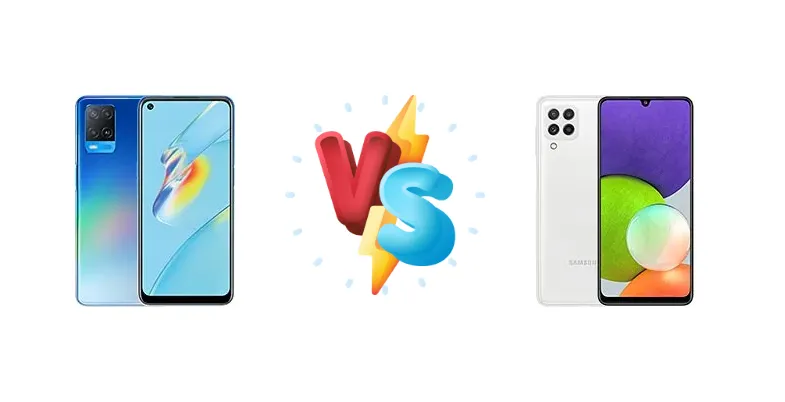
The Oppo A54 and Samsung Galaxy A22 represent compelling options in the sub-$200 smartphone market. Both aim to deliver essential features without breaking the bank, but they take different approaches to achieving this. This comparison dives deep into their specifications to determine which device offers the best value for your money, focusing on performance, display quality, and everyday usability.
🏆 Quick Verdict
For most users, the Samsung Galaxy A22 emerges as the better choice. While both phones share a 121-hour endurance rating, the Galaxy A22’s Helio G80 chipset, featuring Cortex-A75 cores, provides a noticeable performance uplift over the Oppo A54’s Helio P35, making it more suitable for gaming and demanding applications.
| Network |
|---|
| 2G bands | GSM 850 / 900 / 1800 / 1900 | GSM 850 / 900 / 1800 / 1900 |
| 3G bands | HSDPA 850 / 900 / 2100 | HSDPA 850 / 900 / 2100 |
| 4G bands | 1, 3, 5, 8, 38, 40, 41 | 1, 3, 5, 7, 8, 20, 28, 38, 40, 41 |
| Speed | HSPA, LTE | HSPA, LTE |
| Technology | GSM / HSPA / LTE | GSM / HSPA / LTE |
| Launch |
|---|
| Announced | 2021, March 26 | 2021, June 03 |
| Status | Available. Released 2021, April 01 | Available. Released 2021, July 01 |
| Body |
|---|
| Build | - | Glass front, plastic frame, plastic back |
| Dimensions | 163.6 x 75.7 x 8.4 mm (6.44 x 2.98 x 0.33 in) | 159.3 x 73.6 x 8.4 mm (6.27 x 2.90 x 0.33 in) |
| SIM | Nano-SIM + Nano-SIM | · Nano-SIM· Nano-SIM + Nano-SIM |
| Weight | 192 g (6.77 oz) | 186 g (6.56 oz) |
| Display |
|---|
| Resolution | 720 x 1600 pixels, 20:9 ratio (~270 ppi density) | 720 x 1600 pixels, 20:9 ratio (~274 ppi density) |
| Size | 6.51 inches, 102.3 cm2 (~82.6% screen-to-body ratio) | 6.4 inches, 98.9 cm2 (~84.3% screen-to-body ratio) |
| Type | IPS LCD | Super AMOLED, 90Hz, 600 nits |
| Platform |
|---|
| CPU | Octa-core (4x2.35 GHz Cortex-A53 & 4x1.8 GHz Cortex-A53) | Octa-core (2x2.0 GHz Cortex-A75 & 6x1.8 GHz Cortex-A55) |
| Chipset | Mediatek MT6765 Helio P35 (12 nm) | Mediatek MT6769V/CU Helio G80 (12 nm) |
| GPU | PowerVR GE8320 | Mali-G52 MC2 |
| OS | Android 10, ColorOS 7.2 | Android 11, upgradable to Android 13, One UI 5 |
| Memory |
|---|
| Card slot | microSDXC (dedicated slot) | microSDXC (dedicated slot) |
| Internal | 64GB 4GB RAM, 128GB 4GB RAM, 128GB 6GB RAM | 64GB 4GB RAM, 128GB 4GB RAM, 128GB 6GB RAM |
| | - | eMMC 5.1 |
| Main Camera |
|---|
| Features | LED flash, HDR, panorama | LED flash, panorama, HDR |
| Quad | - | 48 MP, f/1.8, (wide), 1/2.0", 0.8µm, PDAF, OIS
8 MP, f/2.2, 123˚ (ultrawide), 1/4.0", 1.12µm
2 MP (macro)
Auxiliary lens |
| Single | 16 MP, f/2.0, (wide), 1/3.06", 1.0µm | 13 MP, f/2.2, (wide), 1/3.1", 1.12µm |
| Triple | 13 MP, f/2.2, 25mm (wide), 1/3.06", 1.12µm, PDAF
2 MP (macro)
Auxiliary lens | - |
| Video | 1080p@30fps | 1080p@30fps |
| Selfie camera |
|---|
| Features | HDR | - |
| Single | 16 MP, f/2.0, (wide), 1/3.06", 1.0µm | 13 MP, f/2.2, (wide), 1/3.1", 1.12µm |
| Video | 1080p@30fps | 1080p@30fps |
| Sound |
|---|
| 3.5mm jack | Yes | Yes |
| 35mm jack | Yes | Yes |
| Loudspeaker | Yes | Yes |
| Comms |
|---|
| Bluetooth | 5.0, A2DP, LE, aptX HD | 5.0, A2DP, LE |
| NFC | No | Yes (market/region dependent) |
| Positioning | GPS, GLONASS, GALILEO, BDS | GPS, GLONASS, GALILEO, BDS |
| Radio | FM radio | FM radio |
| USB | USB Type-C 2.0, OTG | USB Type-C 2.0 |
| WLAN | Wi-Fi 802.11 a/b/g/n/ac, dual-band, Wi-Fi Direct | Wi-Fi 802.11 a/b/g/n/ac, dual-band, Wi-Fi Direct |
| Features |
|---|
| Sensors | Fingerprint (side-mounted), accelerometer, proximity, compass | Fingerprint (side-mounted), accelerometer, gyro, compass |
| | - | Virtual proximity sensing |
| Battery |
|---|
| Charging | 18W wired | 15W wired |
| Type | Li-Po 5000 mAh | Li-Po 5000 mAh |
| Misc |
|---|
| Colors | Crystal Black, Starry Blue | Black, White, Mint, Violet |
| Models | CPH2239 | SM-A225F, SM-A225F/DS, SM-A225M, SM-A225M/DS |
| Price | About 160 EUR | € 193.97 / £ 160.00 |
| SAR EU | - | 0.52 W/kg (head) 1.59 W/kg (body) |
| Tests |
|---|
| Battery life | - |
Endurance rating 121h
|
| Camera | - |
Photo / Video |
| Display | - |
Contrast ratio: Infinite (nominal) |
| Loudspeaker | - |
-30.6 LUFS (Below average)
|
| Performance | - |
AnTuTu: 185358 (v8), 165959 (v9)
GeekBench: 5464 (v4.4), 1372 (v5.1)
GFXBench: 16fps (ES 3.1 onscreen) |
Oppo A54
- Faster 18W charging
- Potentially lower price point
- Simple and straightforward user experience
- Inferior processor performance
- Likely less vibrant display
- Limited gaming capabilities
Samsung Galaxy A22
- More powerful Helio G80 processor
- Brighter and more vibrant display
- Better overall performance for apps and gaming
- Slower 15W charging
- Potentially higher price
- Samsung’s One UI can be resource intensive
Display Comparison
The Samsung Galaxy A22 boasts a significantly brighter display, reaching a measured peak brightness of 597 nits, compared to an unspecified brightness for the Oppo A54. This makes the A22 far more usable outdoors under direct sunlight. While both displays have an 'infinite' contrast ratio (typical for LCD/TFT panels), the higher brightness of the A22 translates to a more vivid and engaging viewing experience. The A54’s display specifications are less detailed, suggesting a more basic panel.
Camera Comparison
Both phones feature photo and video capabilities, but detailed camera specifications are limited. Without sensor size or aperture information, it’s difficult to make a definitive judgment. However, given Samsung’s generally superior image processing algorithms, the Galaxy A22 is likely to produce more refined and visually appealing photos, especially in challenging lighting conditions. The presence of a dedicated night mode on the A22 (likely) would further enhance its low-light performance. The A54’s camera is likely more basic in its feature set.
Performance
The core difference lies in the chipsets. The Samsung Galaxy A22’s Mediatek Helio G80 (12nm) utilizes a combination of 2x2.0 GHz Cortex-A75 and 6x1.8 GHz Cortex-A55 cores, offering a substantial performance advantage over the Oppo A54’s Helio P35 (12nm) with its 4x2.35 GHz Cortex-A53 and 4x1.8 GHz Cortex-A53 configuration. The A75 cores in the G80 provide a significant boost in single-core performance, crucial for app responsiveness, while the G80’s GPU is also more capable, leading to smoother gaming. The A54’s older Cortex-A53 architecture will struggle with more demanding tasks.
Battery Life
Interestingly, both the Oppo A54 and Samsung Galaxy A22 achieve the same endurance rating of 121 hours, despite differing battery capacities (not specified). This suggests efficient power management on both devices. However, the Galaxy A22’s 15W charging is slower than the Oppo A54’s 18W charging. While the difference isn’t massive, the A54 will reach 100% charge slightly faster, offering a convenience advantage.
Buying Guide
Buy the Oppo A54 if you prioritize a simple, reliable experience and are primarily focused on basic tasks like calling, texting, and light social media use. Its lower price point makes it ideal for first-time smartphone users or those on a very tight budget. Buy the Samsung Galaxy A22 if you want a phone capable of handling more demanding apps and occasional gaming, and appreciate a brighter, more vibrant display for media consumption. The A22 offers a better balance of performance and features for the price.
Frequently Asked Questions
❓ Will the Samsung Galaxy A22 struggle with graphically intensive games like PUBG Mobile?
While the Helio G80 isn't a flagship gaming chip, it's capable of running PUBG Mobile at medium settings with reasonable frame rates. Expect some occasional frame drops during intense action, but it's a significantly better gaming experience than the Oppo A54's Helio P35.
❓ Is the 15W charging on the Samsung Galaxy A22 noticeably slower than the 18W charging on the Oppo A54?
The difference in charging speed isn't dramatic, but the Oppo A54 will likely charge approximately 15-20% faster. This translates to roughly 30-45 minutes saved for a full charge, which can be convenient for users who frequently need to top up their battery.
❓ Does the Oppo A54 have any features that the Samsung Galaxy A22 lacks?
The Oppo A54's primary advantage is its slightly faster charging speed. Beyond that, the A54 doesn't offer any significant features that the A22 doesn't match or exceed. The A22 provides a more well-rounded package overall.