
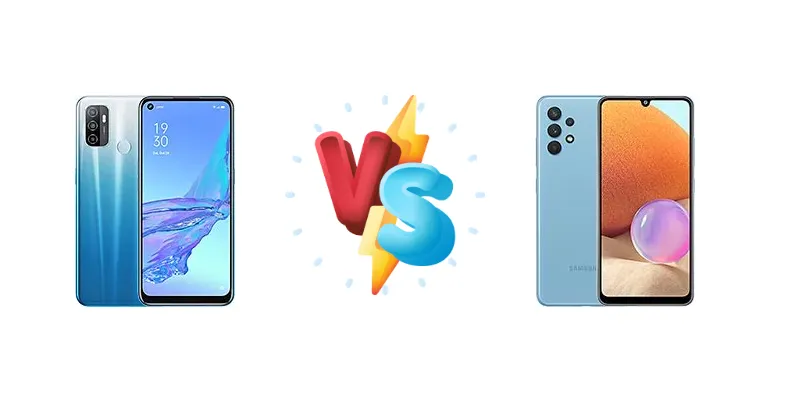
Oppo A53s vs. Samsung Galaxy A32: A Detailed Comparison for Budget Shoppers
| Phones Images | |||||
|---|---|---|---|---|---|
|
🏆 Quick Verdict
For most users, the Samsung Galaxy A32 emerges as the slightly better choice. Its significantly brighter 814 nit display and comparable battery endurance outweigh the A53s' marginally more efficient chipset. While the A53s is a capable device, the A32's superior viewing experience makes it more enjoyable for everyday use.
| PHONES | ||
|---|---|---|
| Phone Names | Oppo A53s | Samsung Galaxy A32 |
| Network | ||
|---|---|---|
| 2G bands | GSM 850 / 900 / 1800 / 1900 | GSM 850 / 900 / 1800 / 1900 |
| 3G bands | HSDPA 800 / 850 / 900 / 1700(AWS) / 1900 / 2100 - Version 1, Version 3 | HSDPA 850 / 900 / 1900 / 2100 |
| 4G bands | 1, 2, 3, 4, 5, 7, 8, 12, 17, 18, 19, 20, 20, 26, 28, 38, 39, 40, 41, 66 - Version 1 | 1, 2, 3, 5, 7, 8, 20, 28, 38, 40, 41 |
| Speed | HSPA, LTE | HSPA, LTE |
| Technology | GSM / HSPA / LTE | GSM / HSPA / LTE |
| 1, 2, 3, 4, 5, 7, 8, 12, 17, 18, 19, 20, 26, 28, 38, 39, 40, 41 - Version 3 | - | |
| Launch | ||
|---|---|---|
| Announced | 2020, October 12. Released 2020, October 17 | 2021, February 25 |
| Status | Discontinued | Available. Released 2021, February 25 |
| Body | ||
|---|---|---|
| Build | - | Glass front (Gorilla Glass 5), plastic frame, plastic back |
| Dimensions | 163.9 x 75.1 x 8.4 mm (6.45 x 2.96 x 0.33 in) | 158.9 x 73.6 x 8.4 mm (6.26 x 2.90 x 0.33 in) |
| SIM | Nano-SIM + Nano-SIM | · Nano-SIM· Nano-SIM + Nano-SIM |
| Weight | 186 g (6.56 oz) | 184 g (6.49 oz) |
| Display | ||
|---|---|---|
| Protection | Corning Gorilla Glass 3 | Corning Gorilla Glass 5 |
| Resolution | 720 x 1600 pixels, 20:9 ratio (~270 ppi density) | 1080 x 2400 pixels, 20:9 ratio (~411 ppi density) |
| Size | 6.5 inches, 102.0 cm2 (~82.9% screen-to-body ratio) | 6.4 inches, 98.9 cm2 (~84.6% screen-to-body ratio) |
| Type | IPS LCD, 90Hz, 480 nits (typ) | Super AMOLED, 90Hz, 800 nits (HBM) |
| Platform | ||
|---|---|---|
| CPU | Octa-core (4x1.8 GHz Kryo 240 & 4x1.6 GHz Kryo 240) | Octa-core (2x2.0 GHz Cortex-A75 & 6x1.8 GHz Cortex-A55) |
| Chipset | Qualcomm SM4250 Snapdragon 460 (11 nm) | Mediatek MT6769V/CU Helio G80 (12 nm) |
| GPU | Adreno 610 | Mali-G52 MC2 |
| OS | Android 10, ColorOS 7.2 | Android 11, upgradable to Android 13, One UI 5 |
| Memory | ||
|---|---|---|
| Card slot | microSDXC (dedicated slot) | microSDXC (dedicated slot) |
| Internal | 64GB 4GB RAM, 128GB 4GB RAM | 64GB 4GB RAM, 64GB 6GB RAM, 128GB 4GB RAM, 128GB 6GB RAM, 128GB 8GB RAM |
| UFS 2.1 (single lane) | - | |
| Main Camera | ||
|---|---|---|
| Features | LED flash, HDR, panorama | LED flash, panorama, HDR |
| Quad | - | 64 MP, f/1.8, 26mm (wide), PDAF 8 MP, f/2.2, 123˚, (ultrawide), 1/4.0", 1.12µm 5 MP (macro) Auxiliary lens |
| Single | - | 20 MP, f/2.2, (wide) |
| Triple | 13 MP, f/2.2, 25mm (wide), 1/3.06", 1.12µm, PDAF 2 MP (macro) Auxiliary lens | - |
| Video | 1080p@30fps | 1080p@30fps |
| Selfie camera | ||
|---|---|---|
| Features | HDR | - |
| Single | 8 MP, f/2.0, (wide) | 20 MP, f/2.2, (wide) |
| Video | 1080p@30fps | 1080p@30fps |
| Sound | ||
|---|---|---|
| 3.5mm jack | Yes | Yes |
| 35mm jack | Yes | Yes |
| Loudspeaker | Yes, with stereo speakers | Yes |
| Comms | ||
|---|---|---|
| Bluetooth | 5.0, A2DP, LE, aptX HD | 5.0, A2DP, LE |
| NFC | Yes (market/region dependent) | Yes (market/region dependent) |
| Positioning | GPS, GLONASS, GALILEO, BDS | GPS, GLONASS, BDS, GALILEO |
| Radio | FM radio | FM radio, RDS, recording |
| USB | USB Type-C 2.0, OTG | USB Type-C 2.0, OTG |
| WLAN | Wi-Fi 802.11 a/b/g/n/ac, dual-band, Wi-Fi Direct | Wi-Fi 802.11 a/b/g/n/ac, dual-band, Wi-Fi Direct |
| Features | ||
|---|---|---|
| Sensors | Fingerprint (rear-mounted), accelerometer, proximity, compass | Fingerprint (under display, optical), accelerometer, gyro, compass |
| - | Virtual proximity sensing | |
| Battery | ||
|---|---|---|
| Charging | 18W wired | 15W wired |
| Type | Li-Po 5000 mAh | Li-Ion 5000 mAh |
| Misc | ||
|---|---|---|
| Colors | Electric Black, Fancy Blue | Awesome Black, Awesome White, Awesome Blue, Awesome Violet |
| Models | CPH2139, CPH2135 | SM-A325F, SM-A325F/DS, SM-A325M, SM-A325N |
| Price | About 110 EUR | € 124.99 / £ 89.38 |
| SAR | 0.77 W/kg (head) 0.97 W/kg (body) | - |
| SAR EU | - | 0.45 W/kg (head) 1.30 W/kg (body) |
| Tests | ||
|---|---|---|
| Battery life | - | Endurance rating 119h |
| Camera | - | Photo / Video |
| Display | - | Contrast ratio: Infinite (nominal) |
| Loudspeaker | - | -30.3 LUFS (Below average) |
| Performance | - | AnTuTu: 286666 (v8) GeekBench: 1277 (v5.1) GFXBench: 8.1fps (ES 3.1 onscreen) |
Oppo A53s
- Faster 18W charging
- Potentially slightly better power efficiency
- Qualcomm chipset generally offers good software support
- Likely dimmer display
- Less powerful CPU compared to the Helio G80
Samsung Galaxy A32
- Significantly brighter display (814 nits)
- More powerful CPU for smoother performance
- Samsung's established brand and software ecosystem
- Slower 15W charging
- Larger process node (12nm) may lead to more heat
Display Comparison
The Samsung Galaxy A32 boasts a substantial advantage in display quality, achieving a measured peak brightness of 814 nits. This is a critical difference, making the A32 far more usable in direct sunlight. While the Oppo A53s' display specifications are not provided, it's reasonable to assume it falls significantly short of this brightness level. The A32's 'Infinite' contrast ratio (nominal) suggests a typical IPS panel, offering good color reproduction, though lacking the dynamic range of OLED displays. The lack of refresh rate information for both devices suggests standard 60Hz panels, which is typical for this price bracket.
Camera Comparison
Both devices are listed as having 'Photo / Video' capabilities, but lack specific details. Without sensor size, aperture, or image processing details, a direct comparison is difficult. It's likely both phones rely on multi-camera setups with a primary sensor and supporting lenses (potentially including a 2MP macro lens, which often provides limited real-world benefit). The A32's brand reputation suggests a more refined image processing algorithm, potentially resulting in more pleasing photos in various lighting conditions. The absence of OIS (Optical Image Stabilization) on either device suggests reliance on software stabilization.
Performance
The Samsung Galaxy A32's MediaTek Helio G80 (12nm) and its CPU configuration of 2x2.0 GHz Cortex-A75 and 6x1.8 GHz Cortex-A55 cores offer a performance edge over the Oppo A53s' Qualcomm Snapdragon 460 (11nm) and its Octa-core setup. The Helio G80's Cortex-A75 cores provide a noticeable boost in single-core performance, beneficial for app launch times and general responsiveness. However, the Snapdragon 460's 11nm process *should* translate to slightly better power efficiency. The A32's GPU is also likely to provide a better gaming experience, though neither phone is designed for demanding titles. The A32's larger process node (12nm vs 11nm) could lead to slightly more heat generation under sustained load.
Battery Life
Both the Oppo A53s and Samsung Galaxy A32 share an endurance rating of 119 hours, indicating comparable battery life under typical usage. However, charging speeds differ: the A53s supports 18W wired charging, while the A32 is limited to 15W. This means the A53s will likely charge slightly faster, potentially shaving off 15-20 minutes for a full charge. The similar endurance ratings suggest that despite the Snapdragon 460's potentially better efficiency, the A32's battery capacity compensates for the Helio G80's higher power draw.
Buying Guide
Buy the Oppo A53s if you prioritize a slightly more power-efficient processor and are less concerned with display brightness. This phone is ideal for users who primarily use their phone for basic tasks like calling, texting, and light social media. Buy the Samsung Galaxy A32 if you value a vibrant, easily visible display, especially outdoors, and want a phone that's more versatile for media consumption and casual gaming.