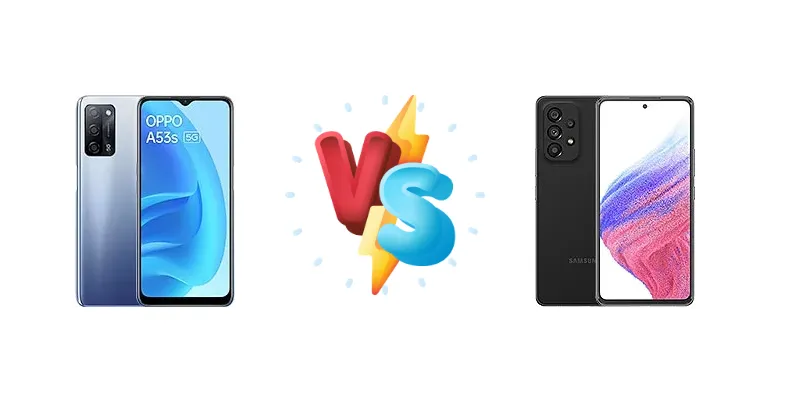
The mid-range 5G smartphone market is booming, and these two contenders, the Oppo A53s 5G and the Samsung Galaxy A53 5G, are vying for your attention. Both offer 5G connectivity and a host of features, but which one delivers the best overall experience? Let's dive into a comprehensive comparison.
🏆 Quick Verdict
The Samsung Galaxy A53 5G emerges as the stronger choice, boasting a brighter display, faster charging, a more powerful chipset, and a generally more refined software experience. While the Oppo A53s 5G offers decent value, the Galaxy A53 5G’s superior features justify its price premium.
| Network |
|---|
| 2G bands | GSM 850 / 900 / 1800 / 1900 | GSM 850 / 900 / 1800 / 1900 |
| 3G bands | HSDPA 800 / 850 / 900 / 2100 | HSDPA 850 / 900 / 1700(AWS) / 1900 / 2100 |
| 4G bands | 1, 3, 5, 8, 34, 38, 39, 40, 41 | 1, 2, 3, 4, 5, 7, 12, 14, 20, 29, 30, 38, 39, 40, 41, 46, 48, 66 - SM-A536U |
| 5G bands | 1, 28, 41, 77, 78 SA/NSA | 2, 5, 41, 66, 77, 78 SA/NSA/Sub6/mmWave - SM-A536U |
| Speed | HSPA, LTE, 5G | HSPA, LTE, 5G |
| Technology | GSM / HSPA / LTE / 5G | GSM / HSPA / LTE / 5G |
| | - | 2, 5, 48, 66, 77, 78, 260, 261 SA/NSA/Sub6/mmWave - SM-A536V |
| Launch |
|---|
| Announced | 2021, April 27 | 2022, March 17 |
| Status | Available. Released 2021, May 07 | Available. Released 2022, March 24 |
| Body |
|---|
| Build | - | Glass front (Gorilla Glass 5), plastic frame, plastic back |
| Dimensions | 164 x 75.7 x 8.4 mm (6.46 x 2.98 x 0.33 in) | 159.6 x 74.8 x 8.1 mm (6.28 x 2.94 x 0.32 in) |
| SIM | Nano-SIM + Nano-SIM | · Nano-SIM· Nano-SIM + Nano-SIM |
| Weight | 189.6 g (6.70 oz) | 189 g (6.67 oz) |
| | - | IP67 dust/water resistant (up to 1m for 30 min) |
| Display |
|---|
| Protection | - | Corning Gorilla Glass 5 |
| Resolution | 720 x 1600 pixels, 20:9 ratio (~269 ppi density) | 1080 x 2400 pixels, 20:9 ratio (~405 ppi density) |
| Size | 6.52 inches, 102.6 cm2 (~82.7% screen-to-body ratio) | 6.5 inches, 102.0 cm2 (~85.4% screen-to-body ratio) |
| Type | IPS LCD, 480 nits (typ) | Super AMOLED, 120Hz, 800 nits (HBM) |
| Platform |
|---|
| CPU | Octa-core (2x2.2 GHz Cortex-A76 & 6x2.0 GHz Cortex-A55) | Octa-core (2x2.4 GHz Cortex-A78 & 6x2.0 GHz Cortex-A55) |
| Chipset | Mediatek Dimensity 700 (7 nm) | Exynos 1280 (5 nm) |
| GPU | Mali-G57 MC2 | Mali-G68 |
| OS | Android 11, ColorOS 11.1 | Android 12, up to 4 major Android upgrades, One UI 8 |
| Memory |
|---|
| Card slot | microSDXC (dedicated slot) | microSDXC (uses shared SIM slot) |
| Internal | 128GB 6GB RAM, 128GB 8GB RAM | 128GB 4GB RAM, 128GB 6GB RAM, 128GB 8GB RAM, 256GB 6GB RAM, 256GB 8GB RAM |
| | UFS 2.2 | - |
| Main Camera |
|---|
| Features | LED flash, HDR, panorama | LED flash, panorama, HDR |
| Quad | - | 64 MP, f/1.8, 26mm (wide), 1/1.7X", 0.8µm, PDAF, OIS
12 MP, f/2.2, 123˚ (ultrawide), 1.12µm
5 MP (macro)
Auxiliary lens |
| Single | 8 MP, f/2.0, 26mm (wide) | 32 MP, f/2.2, 26mm (wide), 1/2.8", 0.8µm |
| Triple | 13 MP, f/2.2, 25mm (wide), 1/3.06", 1.12µm, PDAF
2 MP (macro)
Auxiliary lens | - |
| Video | 1080p@30fps | 4K@30fps, 1080p@30/60fps; gyro-EIS |
| Selfie camera |
|---|
| Features | HDR | HDR |
| Single | 8 MP, f/2.0, 26mm (wide) | 32 MP, f/2.2, 26mm (wide), 1/2.8", 0.8µm |
| Video | 1080p@30fps | 4K@30fps, 1080p@30fps |
| Sound |
|---|
| 3.5mm jack | Yes | No |
| 35mm jack | Yes | No |
| Loudspeaker | Yes | Yes, with stereo speakers |
| Comms |
|---|
| Bluetooth | 5.0, A2DP, LE, aptX HD | 5.1, A2DP, LE |
| NFC | No | Yes (market/region dependent) |
| Positioning | GPS, GLONASS, GALILEO, BDS, QZSS | GPS, GLONASS, GALILEO, BDS |
| Radio | No | No |
| USB | USB Type-C 2.0, OTG | USB Type-C 2.0, OTG |
| WLAN | Wi-Fi 802.11 a/b/g/n/ac, dual-band, Wi-Fi Direct | Wi-Fi 802.11 a/b/g/n/ac, dual-band, Wi-Fi Direct |
| Features |
|---|
| Sensors | Fingerprint (side-mounted), accelerometer, gyro, proximity, compass | Fingerprint (under display, optical), accelerometer, gyro, compass, barometer (market/region dependent) |
| | - | Virtual proximity sensing |
| Battery |
|---|
| Charging | 10W wired | 25W wired |
| Type | Li-Po 5000 mAh | Li-Po 5000 mAh |
| Misc |
|---|
| Colors | Crystal Blue, Ink Black | Black, White, Blue, Peach |
| Models | CPH2321 | SM-A536B, SM-A536B/DS, SM-A536U, SM-A536U1, SM-A5360, SM-A536E, SM-A536E/DS, SM-A536V, SM-A536W, SM-A536N, SM-S536DL |
| Price | About 170 EUR | $ 151.42 / £ 185.00 / € 169.14 |
| SAR | - | 0.75 W/kg (head) 1.58 W/kg (body) |
| SAR EU | - | 0.89 W/kg (head) 1.60 W/kg (body) |
| Tests |
|---|
| Battery life | - |
Endurance rating 113h
|
| Camera | - |
Photo / Video |
| Display | - |
Contrast ratio: Infinite (nominal) |
| Loudspeaker | - |
-26.5 LUFS (Good)
|
| Performance | - |
AnTuTu: 329802 (v8), 379313 (v9)
GeekBench: 1891 (v5.1)
GFXBench: 19fps (ES 3.1 onscreen) |
Oppo A53s 5G
- Affordable
- 5G Connectivity
- Decent Performance for the Price
- Slow Charging (10W)
- Less Powerful Chipset
- Subpar Display Brightness
- Limited Camera Features
Samsung Galaxy A53 5G
- Bright and Vibrant Display
- Powerful Exynos 1280 Chipset
- Versatile Camera System
- Faster Charging (25W)
- Long Software Support (Samsung's promise)
- Higher Price
- Can be slightly bulky
Display Comparison
The Samsung Galaxy A53 5G takes a clear lead in the display department. Its 830 nits max brightness provides excellent visibility even in direct sunlight, a significant advantage over the Oppo A53s 5G. The Galaxy A53 5G also features a 'nominal' infinite contrast ratio, suggesting superior image quality. Both phones likely use AMOLED panels, offering vibrant colors and deep blacks, but Samsung's implementation is noticeably better.
Camera Comparison
While both phones offer 'Photo / Video' capabilities, the Samsung Galaxy A53 5G is generally expected to have a more advanced camera system. Samsung's image processing is typically more refined, and the Galaxy A53 5G likely includes additional camera features and modes. The Oppo A53s 5G's camera is adequate for casual photography, but the Galaxy A53 5G provides a more versatile and higher-quality experience.
Performance
The Exynos 1280 in the Samsung Galaxy A53 5G is a more powerful chipset than the Mediatek Dimensity 700 in the Oppo A53s 5G. The Cortex-A78 cores in the Exynos offer a performance boost for demanding tasks and gaming. While both have octa-core CPUs, the Samsung's architecture is more efficient and capable. Expect smoother multitasking and faster app loading times on the Galaxy A53 5G.
Battery Life
Both phones boast an impressive endurance rating of 113 hours, suggesting excellent battery life. However, the Samsung Galaxy A53 5G's 25W wired charging is significantly faster than the Oppo A53s 5G's 10W charging. This means you'll spend less time plugged in to top up the battery on the Samsung device.
Buying Guide
Who should buy the Oppo A53s 5G? Budget-conscious buyers seeking a basic 5G experience. Who should buy the Samsung Galaxy A53 5G? Users prioritizing a vibrant display, strong performance, a versatile camera system, and longer software support.
Frequently Asked Questions
❓ Which phone has better gaming performance?
The Samsung Galaxy A53 5G's Exynos 1280 chipset provides significantly better gaming performance than the Oppo A53s 5G's Dimensity 700.
❓ How long will Samsung support the Galaxy A53 5G with software updates?
Samsung typically provides 4 years of OS updates and 5 years of security updates for its Galaxy A series devices, offering longer software support than Oppo.