
Oppo A53 5G vs Samsung Galaxy A32 5G: A Detailed Comparison
| Phones Images | |||||
|---|---|---|---|---|---|
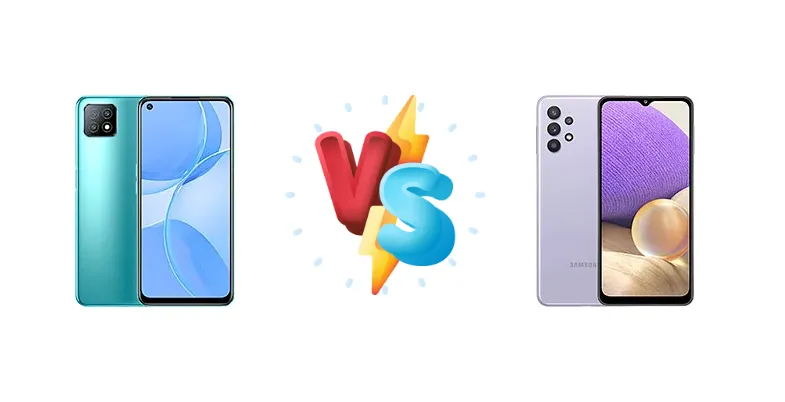
|
🏆 Quick Verdict
For the average user prioritizing display quality and slightly faster charging, the Samsung Galaxy A32 5G emerges as the better choice. While both phones share the same chipset, the A32 5G’s brighter display and 15W charging offer a more refined experience, despite the identical battery endurance rating.
| PHONES | ||
|---|---|---|
| Phone Names | Oppo A53 5G | Samsung Galaxy A32 5G |
| Network | ||
|---|---|---|
| 2G bands | GSM 850 / 900 / 1800 / 1900 | GSM 850 / 900 / 1800 / 1900 |
| 3G bands | HSDPA 850 / 900 / 1700(AWS) / 1900 / 2100 | HSDPA 850 / 900 / 1900 / 2100 |
| 4G bands | 1, 2, 3, 4, 5, 7, 8, 34, 38, 39, 40, 41 | 1, 2, 3, 4, 5, 7, 8, 12, 17, 20, 26, 28, 38, 40, 41, 66 |
| 5G bands | 1, 41, 77, 78 SA/NSA | 1, 3, 5, 7, 8, 20, 28, 38, 40, 41, 66, 78, 79 SA/NSA/Sub6 |
| Speed | HSPA, LTE, 5G | HSPA 42.2/5.76 Mbps, LTE Cat16 1024/75 Mbps, 5G |
| Technology | GSM / CDMA / HSPA / EVDO / LTE / 5G | GSM / CDMA / HSPA / LTE / 5G |
| CDMA2000 1xEV-DO | 25, 41, 66, 71 SA/NSA/Sub6 - SM-A326U | |
| Launch | ||
|---|---|---|
| Announced | 2020, December 18. Released 2020, December 21 | 2021, January 13 |
| Status | Discontinued | Available. Released 2021, January 22 |
| Body | ||
|---|---|---|
| Build | - | Glass front (Gorilla Glass 5), plastic frame, plastic back |
| Dimensions | 162.2 x 75 x 7.9 mm (6.39 x 2.95 x 0.31 in) | 164.2 x 76.1 x 9.1 mm (6.46 x 3.00 x 0.36 in) |
| SIM | Nano-SIM + Nano-SIM | · Nano-SIM· Nano-SIM + Nano-SIM |
| Weight | 175 g (6.17 oz) | 205 g (7.23 oz) |
| Display | ||
|---|---|---|
| Protection | Corning Gorilla Glass | Corning Gorilla Glass 5 |
| Resolution | 1080 x 2400 pixels, 20:9 ratio (~405 ppi density) | 720 x 1600 pixels, 20:9 ratio (~270 ppi density) |
| Size | 6.5 inches, 102.0 cm2 (~83.9% screen-to-body ratio) | 6.5 inches, 102.0 cm2 (~81.6% screen-to-body ratio) |
| Type | IPS LCD, 90Hz, 480 nits (typ) | TFT LCD, 60Hz (International), 90Hz (SM-A326U, SM-326DL only) |
| Platform | ||
|---|---|---|
| CPU | Octa-core (2x2.0 GHz Cortex-A76 & 6x2.0 GHz Cortex-A55) | Octa-core (2x2.0 GHz Cortex-A76 & 6x2.0 GHz Cortex-A55) |
| Chipset | Mediatek Dimensity 720 (7 nm) | Mediatek Dimensity 720 (7 nm) |
| GPU | Mali-G57 MC3 | Mali-G57 MC3 |
| OS | Android 10, ColorOS 7.2 | Android 11, upgradable to Android 13, One UI 5 |
| Memory | ||
|---|---|---|
| Card slot | No | microSDXC (uses shared SIM slot) |
| Internal | 128GB 4GB RAM, 128GB 6GB RAM, 128GB 8GB RAM | 64GB 4GB RAM, 128GB 4GB RAM, 128GB 6GB RAM, 128GB 8GB RAM |
| UFS 2.1 | - | |
| Main Camera | ||
|---|---|---|
| Features | LED flash, HDR, panorama | LED flash, panorama, HDR |
| Quad | - | 48 MP, f/1.8, 26mm (wide), 1/2.0", 0.8µm, PDAF 8 MP, f/2.2, 123˚, (ultrawide), 1/4.0", 1.12µm 5 MP (macro) Auxiliary lens |
| Single | 5 MP, AF | - |
| Triple | 16 MP, f/2.2, (wide), PDAF 2 MP (macro) Auxiliary lens | - |
| Video | 4K@30fps, 1080p@30/120fps, gyro-EIS | 4K@30fps, 1080p@30/120fps |
| Selfie camera | ||
|---|---|---|
| Features | HDR | - |
| Single | 8 MP, f/2.0, (wide) | 13 MP, f/2.2, (wide), 1/3.1", 1.12µm |
| Video | 1080p@30fps | 1080p@30fps |
| Sound | ||
|---|---|---|
| 3.5mm jack | Yes | Yes |
| 35mm jack | Yes | Yes |
| Loudspeaker | Yes | Yes |
| Comms | ||
|---|---|---|
| Bluetooth | 5.1, A2DP, LE, aptX HD | 5.0, A2DP, LE |
| NFC | No | Yes (market/region dependent) |
| Positioning | GPS, GLONASS, GALILEO, BDS | GPS, GLONASS, GALILEO, BDS |
| Radio | FM radio | FM radio |
| USB | USB Type-C 2.0, OTG | USB Type-C 2.0, OTG |
| WLAN | Wi-Fi 802.11 a/b/g/n/ac, dual-band, Wi-Fi Direct | Wi-Fi 802.11 a/b/g/n/ac, dual-band, Wi-Fi Direct |
| Features | ||
|---|---|---|
| Sensors | Fingerprint (side-mounted), accelerometer, gyro, proximity, compass | Fingerprint (side-mounted), accelerometer, gyro, compass |
| - | Virtual proximity sensing | |
| Battery | ||
|---|---|---|
| Charging | 10W wired | 15W wired |
| Stand-by | Up to 200 h | - |
| Talk time | Up to 3 h 30 min | - |
| Type | Li-Po 4040 mAh | Li-Ion 5000 mAh |
| Misc | ||
|---|---|---|
| Colors | Black, Green, Purple | Awesome Black, Awesome White, Awesome Blue, Awesome Violet |
| Models | PECM30, PECT30 | SM-A326B, SM-A326B/DS, SM-A326BR/DS, SM-A326BR, SM-A326U, SM-A326W, SM-A326U1, SM-A326K, SCG08, SM-S326DL |
| Price | About 160 EUR | € 111.89 / $ 78.64 / £ 77.53 |
| SAR | 0.85 W/kg (head) 0.79 W/kg (body) | - |
| SAR EU | - | 0.33 W/kg (head) 1.08 W/kg (body) |
| Tests | ||
|---|---|---|
| Battery life | - | Endurance rating 123h |
| Camera | - | Photo / Video |
| Display | - | Contrast ratio: 1470:1 (nominal) |
| Loudspeaker | - | -28.5 LUFS (Average) |
| Performance | - | AnTuTu: 226561 (v8) GeekBench: 1673 (v5.1) |
Oppo A53 5G
- Potentially lower price point
- 5G connectivity
- Functional and reliable performance
- Slower 10W charging
- Likely dimmer display
- Less refined software experience
Samsung Galaxy A32 5G
- Brighter 497 nit display
- Faster 15W charging
- Potentially better image processing
- May be slightly more expensive
- 5G connectivity (shared with A53)
- Similar CPU performance to A53
Display Comparison
Both the Oppo A53 5G and Samsung Galaxy A32 5G feature displays with similar contrast ratios – 1490:1 and 1470:1 respectively. However, the Samsung Galaxy A32 5G boasts a significantly brighter panel, reaching a measured 497 nits compared to an unspecified value for the Oppo A53 5G. This higher peak brightness translates to better outdoor visibility, a crucial advantage for users frequently exposed to sunlight. While both likely utilize LCD technology given the price point, the A32 5G’s superior brightness makes it the clear winner for media consumption and general usability.
Camera Comparison
Both phones offer 'Photo / Video' capabilities, but the context data lacks specifics regarding sensor size, aperture, or image processing. Given the budget nature of these devices, it’s reasonable to assume both rely on multi-camera setups with a primary sensor and supporting lenses (likely including a depth sensor and potentially a macro lens). Without detailed specifications, it’s difficult to definitively declare a winner. However, Samsung’s image processing algorithms are generally more refined, potentially leading to more pleasing results in challenging lighting conditions. The inclusion of Optical Image Stabilization (OIS) on either device is unlikely at this price point.
Performance
Both devices are powered by the Mediatek Dimensity 720 (7nm) chipset, featuring an octa-core CPU configuration with 2x2.0 GHz Cortex-A76 and 6x2.0 GHz Cortex-A55 cores. This means CPU performance will be virtually identical in day-to-day tasks and even in moderately demanding games. The real-world performance difference will likely come down to RAM management and software optimization, areas where Samsung generally has an edge. Thermal throttling, however, shouldn’t be a major concern given the efficiency of the 7nm process and the relatively modest power draw of the Dimensity 720.
Battery Life
Both the Oppo A53 5G and Samsung Galaxy A32 5G achieve an endurance rating of 123 hours, indicating comparable battery life under similar usage scenarios. However, the Samsung Galaxy A32 5G supports 15W wired charging, while the Oppo A53 5G is limited to 10W. This difference in charging speed means the A32 5G will reach a full charge approximately 35% faster, a significant convenience for users who prioritize quick top-ups. While the battery capacity isn't specified, the similar endurance ratings suggest comparable sizes.
Buying Guide
Buy the Oppo A53 5G if you need a functional 5G phone at the absolute lowest possible price and aren't concerned with display brightness or charging speed. Buy the Samsung Galaxy A32 5G if you prefer a more visually appealing experience with a brighter screen and a slightly faster charging solution, even if it means a small price premium.