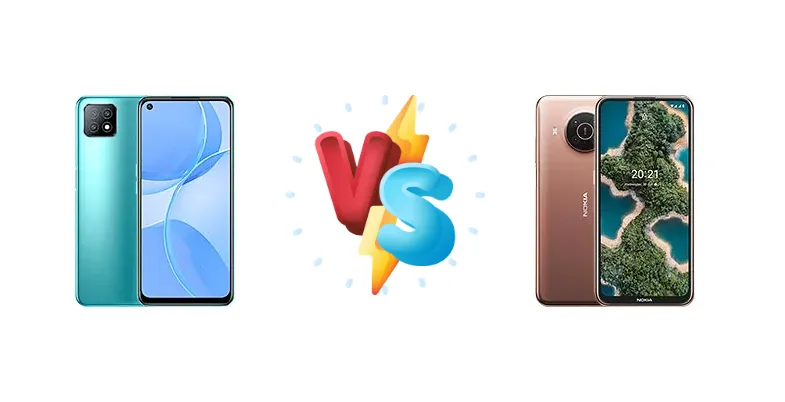
The Oppo A53 5G and Nokia X20 represent distinct approaches to the affordable 5G smartphone market. The A53 5G prioritizes a streamlined experience with a Mediatek Dimensity 720, while the Nokia X20 aims for longevity and a cleaner Android experience powered by the Qualcomm Snapdragon 480. This comparison dissects their core components to determine which device delivers the best value.
🏆 Quick Verdict
For the average user prioritizing consistent performance and faster charging, the Nokia X20 emerges as the better choice. Its Snapdragon 480, built on an 8nm process, offers a slight edge in efficiency and sustained performance compared to the Oppo A53 5G’s 7nm Dimensity 720, and the 18W charging is a significant advantage.
| Network |
|---|
| 2G bands | GSM 850 / 900 / 1800 / 1900 | GSM 850 / 900 / 1800 / 1900 |
| 3G bands | HSDPA 850 / 900 / 1700(AWS) / 1900 / 2100 | HSDPA 850 / 900 / 1700(AWS) / 1900 / 2100 |
| 4G bands | 1, 2, 3, 4, 5, 7, 8, 34, 38, 39, 40, 41 | 1, 2, 3, 4, 5, 7, 8, 12, 20, 28, 66, 38, 39, 40, 41 |
| 5G bands | 1, 41, 77, 78 SA/NSA | 1, 2, 3, 5, 7, 28, 38, 41, 66, 78 SA/NSA/Sub6 |
| Speed | HSPA, LTE, 5G | HSPA, LTE, 5G |
| Technology | GSM / CDMA / HSPA / EVDO / LTE / 5G | GSM / HSPA / LTE / 5G |
| | CDMA2000 1xEV-DO | - |
| Launch |
|---|
| Announced | 2020, December 18. Released 2020, December 21 | 2021, April 08 |
| Status | Discontinued | Available. Released 2021, May 12 |
| Body |
|---|
| Dimensions | 162.2 x 75 x 7.9 mm (6.39 x 2.95 x 0.31 in) | 168.9 x 79.7 x 9.1 mm (6.65 x 3.14 x 0.36 in) |
| SIM | Nano-SIM + Nano-SIM | · Nano-SIM· Nano-SIM + Nano-SIM |
| Weight | 175 g (6.17 oz) | 220 g (7.76 oz) |
| Display |
|---|
| Protection | Corning Gorilla Glass | Corning Gorilla Glass 5 |
| Resolution | 1080 x 2400 pixels, 20:9 ratio (~405 ppi density) | 1080 x 2400 pixels, 20:9 ratio (~395 ppi density) |
| Size | 6.5 inches, 102.0 cm2 (~83.9% screen-to-body ratio) | 6.67 inches, 107.4 cm2 (~79.8% screen-to-body ratio) |
| Type | IPS LCD, 90Hz, 480 nits (typ) | IPS LCD, 450 nits (typ) |
| Platform |
|---|
| CPU | Octa-core (2x2.0 GHz Cortex-A76 & 6x2.0 GHz Cortex-A55) | Octa-core (2x2.0 GHz Kryo 460 & 6x1.8 GHz Kryo 460) |
| Chipset | Mediatek Dimensity 720 (7 nm) | Qualcomm SM4350 Snapdragon 480 5G (8 nm) |
| GPU | Mali-G57 MC3 | Adreno 619 |
| OS | Android 10, ColorOS 7.2 | Android 11, upgradable to Android 14 |
| Memory |
|---|
| Card slot | No | microSDXC (uses shared SIM slot) |
| Internal | 128GB 4GB RAM, 128GB 6GB RAM, 128GB 8GB RAM | 128GB 6GB RAM, 128GB 8GB RAM |
| | UFS 2.1 | - |
| Main Camera |
|---|
| Features | LED flash, HDR, panorama | Zeiss optics, LED flash, HDR, panorama |
| Quad | - | 64 MP, (wide), PDAF
5 MP, (ultrawide)
2 MP (macro)
Auxiliary lens |
| Single | 5 MP, AF | 32 MP, (wide) |
| Triple | 16 MP, f/2.2, (wide), PDAF
2 MP (macro)
Auxiliary lens | - |
| Video | 4K@30fps, 1080p@30/120fps, gyro-EIS | 1080p@30/60fps |
| Selfie camera |
|---|
| Features | HDR | - |
| Single | 8 MP, f/2.0, (wide) | 32 MP, (wide) |
| Video | 1080p@30fps | 1080p@30fps |
| Sound |
|---|
| 3.5mm jack | Yes | Yes |
| 35mm jack | Yes | Yes |
| Loudspeaker | Yes | Yes |
| Comms |
|---|
| Bluetooth | 5.1, A2DP, LE, aptX HD | 5.0, A2DP, LE, aptX HD |
| NFC | No | Yes |
| Positioning | GPS, GLONASS, GALILEO, BDS | GPS, GLONASS, GALILEO |
| Radio | FM radio | FM radio |
| USB | USB Type-C 2.0, OTG | USB Type-C 2.0, OTG |
| WLAN | Wi-Fi 802.11 a/b/g/n/ac, dual-band, Wi-Fi Direct | Wi-Fi 802.11 a/b/g/n/ac, dual-band, Wi-Fi Direct |
| Features |
|---|
| Sensors | Fingerprint (side-mounted), accelerometer, gyro, proximity, compass | Fingerprint (side-mounted), accelerometer, gyro, proximity |
| Battery |
|---|
| Charging | 10W wired | 18W wired |
| Stand-by | Up to 200 h | - |
| Talk time | Up to 3 h 30 min | - |
| Type | Li-Po 4040 mAh | Li-Po 4470 mAh |
| Misc |
|---|
| Colors | Black, Green, Purple | Midnight Sun, Nordic Blue |
| Models | PECM30, PECT30 | TA-1341, TA-1344 |
| Price | About 160 EUR | About 130 EUR |
| SAR | 0.85 W/kg (head) 0.79 W/kg (body) | 1.04 W/kg (head) 0.62 W/kg (body) |
| SAR EU | - | 0.51 W/kg (head) 1.29 W/kg (body) |
Oppo A53 5G
- Potentially lower price point
- Mediatek Dimensity 720 is a capable chipset for everyday tasks
- Functional and reliable
- Slow 10W charging
- Less efficient chipset compared to Snapdragon 480
- Likely less refined software experience
Nokia X20
- Faster 18W charging
- More efficient Snapdragon 480 chipset
- Cleaner Android experience with guaranteed updates
- Potentially higher price
- Performance gains over A53 5G are incremental
- May not appeal to users who prefer customized UIs
Display Comparison
Neither device boasts a standout display. Both likely utilize LCD panels, common in this price bracket. The focus here isn't on visual fidelity, but on functionality. Without specific display specs, it's difficult to differentiate, but the Nokia X20's slightly higher price point *might* indicate a marginally better panel, though this is speculative. Bezels are likely comparable, prioritizing cost reduction over premium aesthetics.
Camera Comparison
Without detailed camera specs, a direct comparison is limited. Both phones likely feature a multi-camera setup with a primary sensor and supporting lenses. The Nokia X20’s brand reputation suggests a focus on image processing that aims for natural colors, while Oppo often leans towards more vibrant, saturated images. The absence of OIS on either device suggests reliance on software stabilization. Any differences in image quality will likely stem from software algorithms rather than hardware superiority.
Performance
The core difference lies in the chipsets. The Nokia X20’s Qualcomm Snapdragon 480 5G (8nm) benefits from a more efficient manufacturing process than the Oppo A53 5G’s Mediatek Dimensity 720 (7nm). While both CPUs feature a 2x2.0 GHz core configuration, the Snapdragon 480’s Kryo 460 cores are architecturally different from the Cortex-A76 in the Dimensity 720. The 8nm process generally translates to better thermal management, potentially reducing throttling during sustained tasks. The Dimensity 720, however, is a proven performer in its class, capable of handling everyday tasks and some light gaming. The Snapdragon 480's Adreno 619 GPU likely offers a slight graphical advantage.
Battery Life
The Oppo A53 5G is hampered by its slow 10W charging. This means significantly longer charge times compared to the Nokia X20’s 18W charging. While battery capacity isn’t specified, the faster charging on the Nokia X20 is a tangible benefit, allowing for quicker top-ups throughout the day. The Snapdragon 480’s 8nm process also contributes to better power efficiency, potentially offsetting any capacity differences.
Buying Guide
Buy the Oppo A53 5G if you need a basic, functional 5G phone and are comfortable with slower charging speeds. It’s a good option for users who primarily use their phone for calls, texts, and light social media. Buy the Nokia X20 if you prefer a cleaner Android experience, value slightly better performance for multitasking and light gaming, and appreciate the convenience of faster 18W wired charging.
Frequently Asked Questions
❓ Will the Snapdragon 480 in the Nokia X20 handle demanding games like PUBG Mobile?
The Snapdragon 480 can run PUBG Mobile, but expect to play at medium settings to maintain a stable frame rate. It's not a gaming powerhouse, but it's capable of providing a playable experience for casual gamers. The Dimensity 720 in the Oppo A53 5G will offer similar performance, but may experience more thermal throttling during extended gaming sessions.
❓ How long will it take to fully charge the Oppo A53 5G with its 10W charger?
With its 10W charging, the Oppo A53 5G will likely take over 3 hours to fully charge from 0%. This is a significant drawback compared to the Nokia X20’s 18W charging, which can reduce charging times considerably.
❓ Does the Nokia X20 receive regular software updates and security patches?
Nokia is known for its commitment to software updates. The X20 is part of Android One, guaranteeing at least 3 years of security updates and 2 major Android OS upgrades, providing a longer software support lifecycle than the Oppo A53 5G.