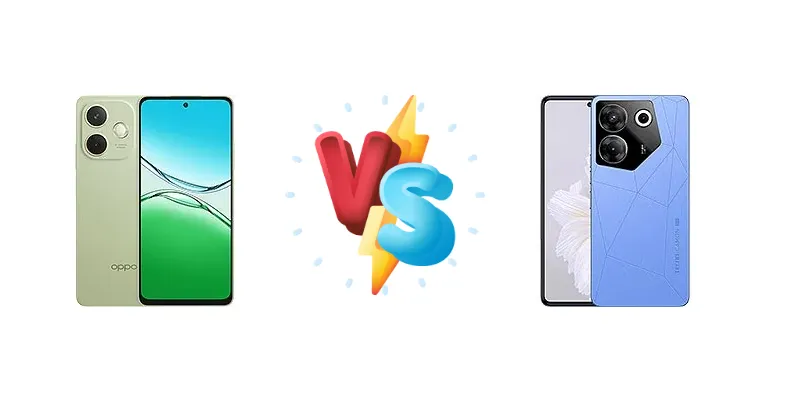
The Oppo A5 Energy and Tecno Camon 20 Pro 5G represent compelling options in the increasingly competitive mid-range 5G smartphone market. While both devices aim for affordability, they diverge significantly in their core processing power, with the Tecno boasting the more powerful Dimensity 8050 chipset. This comparison dissects these differences, focusing on real-world performance implications for users.
🏆 Quick Verdict
For the average user prioritizing smooth multitasking and demanding app performance, the Tecno Camon 20 Pro 5G is the clear winner. Its Dimensity 8050 offers a substantial performance uplift over the Oppo A5 Energy’s Dimensity 6300. However, the A5 Energy’s 45W charging and potentially lower price point make it a viable option for budget-conscious users.
| Network |
|---|
| 2G bands | GSM 850 / 900 / 1800 / 1900 | GSM 850 / 900 / 1800 / 1900 |
| 3G bands | HSDPA 850 / 900 / 2100 | HSDPA 850 / 900 / 1700(AWS) / 1900 / 2100 |
| 4G bands | 1, 3, 5, 8, 28, 34, 38, 39, 40, 41 | LTE |
| 5G bands | 1, 5, 8, 28, 41, 77, 78 SA/NSA | SA/NSA |
| Speed | HSPA, LTE, 5G | HSPA, LTE, 5G |
| Technology | GSM / CDMA / HSPA / LTE / 5G | GSM / HSPA / LTE / 5G |
| Launch |
|---|
| Announced | 2025, March 18 | 2023, May 09 |
| Status | Available. Released 2025, March 21 | Available. Released 2023, May 09 |
| Body |
|---|
| Dimensions | 164.8 x 75.5 x 7.9 mm (6.49 x 2.97 x 0.31 in) | 162.7 x 75.9 x 7.8 mm (6.41 x 2.99 x 0.31 in) |
| SIM | Nano-SIM + Nano-SIM | Nano-SIM + Nano-SIM |
| Weight | 194 g or 196 g (6.84 oz) | - |
| Display |
|---|
| Protection | Crystal Shield Glass | - |
| Resolution | 720 x 1604 pixels, 20:9 ratio (~264 ppi density) | 1080 x 2400 pixels, 20:9 ratio (~395 ppi density) |
| Size | 6.67 inches, 107.2 cm2 (~86.2% screen-to-body ratio) | 6.67 inches, 107.4 cm2 (~87.0% screen-to-body ratio) |
| Type | IPS LCD, 90Hz, 1000 nits (HBM) | AMOLED, 120Hz |
| | - | Always-on display |
| Platform |
|---|
| CPU | Octa-core (2x2.4 GHz Cortex-A76 & 6x2.0 GHz Cortex-A55) | Octa-core (1x3.0 GHz Cortex-A78 & 3x2.6 GHz Cortex-A78 & 4x2.0 GHz Cortex-A55) |
| Chipset | Mediatek Dimensity 6300 (6 nm) | Mediatek Dimensity 8050 (6 nm) |
| GPU | Mali-G57 MC2 | Mali-G77 MC9 |
| OS | Android 15, ColorOS 15 | Android 13, HIOS 13 |
| Memory |
|---|
| Card slot | microSDXC | microSDXC (dedicated slot) |
| Internal | 256GB 8GB RAM, 256GB 12GB RAM, 512GB 12GB RAM | 256GB 8GB RAM |
| Main Camera |
|---|
| Dual | 50 MP, f/1.8, 27mm (wide), PDAF
Auxiliary lens | - |
| Features | LED flash, HDR, panorama | Ring-LED flash, panorama, HDR |
| Triple | - | 64 MP, f/1.7, (wide), 1/1.7", 0.8µm, PDAF, OIS
2 MP (macro)
Auxiliary lens |
| Video | 1080p@30/60fps | 4K@30fps, 1080p@30fps, HDR |
| Selfie camera |
|---|
| Features | - | Dual-LED flash |
| Single | 8 MP, f/2.0, 25mm (wide) | 32 MP, f/2.5, 24mm (wide), 1/2.8", 0.8µm |
| Video | 1080p@30fps | 1080p@30fps |
| Sound |
|---|
| 3.5mm jack | - | Yes |
| 35mm jack | No | Yes |
| Loudspeaker | Yes, with stereo speakers | Yes, with stereo speakers |
| | - | 24-bit/192kHz audio |
| Comms |
|---|
| Bluetooth | 5.4, A2DP, LE, aptX HD, BLE Audio | 5.2, A2DP, LE |
| NFC | Yes | Yes |
| Positioning | GPS, GALILEO, GLONASS, BDS, QZSS | GPS |
| Radio | No | FM radio |
| USB | USB Type-C 2.0, OTG | USB Type-C 2.0, OTG |
| WLAN | Wi-Fi 802.11 a/b/g/n/ac, dual-band | Wi-Fi 802.11 a/b/g/n/ac, dual-band |
| Features |
|---|
| Sensors | Fingerprint (side-mounted), accelerometer, proximity, compass | Fingerprint (under display, optical), accelerometer, gyro, proximity, compass |
| Battery |
|---|
| Charging | 45W wired, 33W UFCS, PD | 33W wired |
| Type | 5800 mAh | 5000 mAh |
| Misc |
|---|
| Colors | Flower Pink, Mocha Brown (Mocha Chocolate), Jade Green (Moss Green) | Dark Welkin, Serenity Blue |
| Models | PKV110 | CK8n |
| Price | About 150 EUR | About 270 EUR |
Oppo A5 Energy
- Faster 45W charging for quicker top-ups
- Potentially lower price point for budget-conscious buyers
- UFCS and PD charging compatibility offers wider charger options
- Less powerful Dimensity 6300 chipset
- Likely lower performance in demanding games and apps
- Potentially less advanced camera processing
Tecno Camon 20 Pro 5G
- More powerful Dimensity 8050 chipset for smoother performance
- Improved CPU architecture for faster multitasking
- Potentially better camera image processing
- Slower 33W charging compared to the Oppo A5 Energy
- Likely a higher price tag
- Potentially shorter battery life under heavy load
Display Comparison
Neither device’s display specifications are provided, so a direct comparison is limited. However, given the price points, we can expect both to utilize LCD panels. The Tecno, positioned slightly higher, may benefit from a higher peak brightness or slightly improved color accuracy. Bezels are likely comparable, focusing on maximizing screen real estate within their respective budgets. Without specific data, it's reasonable to assume both displays prioritize functionality over premium features like high refresh rates or LTPO technology.
Camera Comparison
Without detailed camera specifications, analysis is limited. However, the Tecno Camon 20 Pro 5G, being the more premium offering, likely features a larger main sensor and potentially optical image stabilization (OIS). The Dimensity 8050 also includes a more capable image signal processor (ISP) than the 6300, enabling better image processing and potentially improved low-light performance. While both phones likely include multiple lenses, the quality of those secondary sensors (ultrawide, macro) is often negligible in this price range, and should not be a primary consideration. The ISP advantage of the 8050 is the key differentiator.
Performance
The core difference lies in the chipsets. The Tecno Camon 20 Pro 5G’s Dimensity 8050, built on a 6nm process, features a 1x3.0 GHz Cortex-A78 core, complemented by 3x2.6 GHz Cortex-A78 cores and 4x2.0 GHz Cortex-A55 cores. This configuration provides a significant advantage in CPU-intensive tasks compared to the Oppo A5 Energy’s Dimensity 6300. The 6300 utilizes 2x2.4 GHz Cortex-A76 cores and 6x2.0 GHz Cortex-A55 cores. The A78 cores in the 8050 are a generation newer and more efficient than the A76 cores, translating to faster processing and improved power efficiency. This difference will be most noticeable in gaming and demanding applications. While both use 6nm fabrication, the architectural improvements in the 8050 provide a clear performance edge.
Battery Life
Battery capacity isn’t specified for either device, but the charging capabilities offer a clear distinction. The Oppo A5 Energy supports 45W wired charging, 33W UFCS, and PD, promising significantly faster charging times than the Tecno Camon 20 Pro 5G’s 33W wired charging. If both phones have similar battery capacities, the A5 Energy will likely reach 100% charge much quicker. However, the Dimensity 8050 in the Tecno is more power-efficient, potentially offsetting the charging speed difference with longer battery life during typical usage.
Buying Guide
Buy the Oppo A5 Energy if you prioritize extended battery life and fast charging, and your primary use case revolves around everyday tasks like social media, calls, and light web browsing. Buy the Tecno Camon 20 Pro 5G if you demand a more responsive experience for gaming, video editing, or running multiple demanding applications simultaneously, and are willing to trade some charging speed for raw power.
Frequently Asked Questions
❓ Will the Dimensity 8050 in the Tecno Camon 20 Pro 5G handle graphically intensive games like Genshin Impact at high settings?
The Dimensity 8050 is capable of running Genshin Impact at medium to high settings with playable frame rates. However, sustained performance will depend on the phone’s thermal management. Expect some frame drops during extended gaming sessions, but overall, it offers a significantly better gaming experience than the Dimensity 6300.
❓ How much faster is the charging on the Oppo A5 Energy compared to the Tecno Camon 20 Pro 5G in real-world use?
The Oppo A5 Energy’s 45W charging can potentially charge the phone from 0-100% in around 60-75 minutes, depending on battery capacity. The Tecno Camon 20 Pro 5G’s 33W charging will likely take closer to 90-120 minutes for a full charge. This translates to a 30-60 minute difference, making the A5 Energy ideal for users who frequently need a quick top-up.
❓ Does the Tecno Camon 20 Pro 5G support 5G carrier aggregation for faster download speeds?
The Dimensity 8050 chipset supports 5G carrier aggregation, allowing it to combine multiple 5G channels for faster and more stable download speeds, provided your carrier supports this feature. This is a significant advantage over older or less capable 5G chipsets.