
Oppo A5 Energy vs OnePlus Nord CE 3 Lite: A Detailed Comparison
| Phones Images | |||||
|---|---|---|---|---|---|
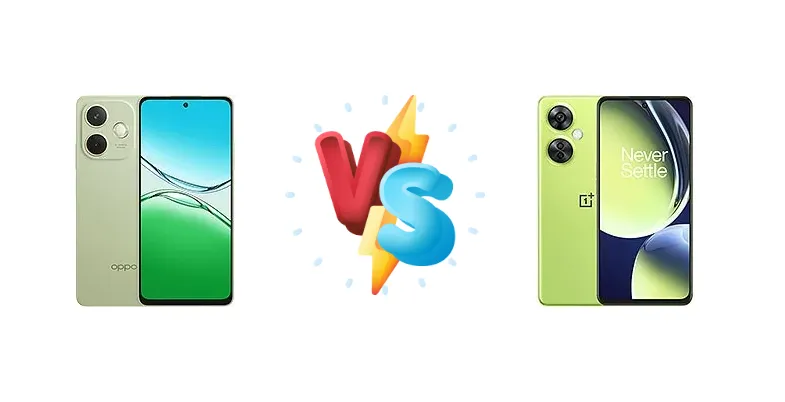
|
🏆 Quick Verdict
For the average user prioritizing fast charging and a slightly more refined software experience, the OnePlus Nord CE 3 Lite emerges as the winner. Its 67W charging significantly reduces downtime, and the Snapdragon 695 provides a familiar and well-optimized platform. However, the Oppo A5 Energy offers a compelling alternative for those seeking a potentially more power-efficient chipset.
| PHONES | ||
|---|---|---|
| Phone Names | Oppo A5 Energy | OnePlus Nord CE 3 Lite |
| Network | ||
|---|---|---|
| 2G bands | GSM 850 / 900 / 1800 / 1900 | GSM 850 / 900 / 1800 / 1900 |
| 3G bands | HSDPA 850 / 900 / 2100 | HSDPA 800 / 850 / 900 / 1700(AWS) / 1900 / 2100 - International |
| 4G bands | 1, 3, 5, 8, 28, 34, 38, 39, 40, 41 | 1, 2, 3, 4, 5, 7, 8, 12, 13, 17, 18, 19, 20, 26, 28, 32, 38, 39, 40, 41, 66 - International |
| 5G bands | 1, 5, 8, 28, 41, 77, 78 SA/NSA | 1, 3, 5, 7, 8, 20, 28, 38, 40, 41, 66, 77, 78 SA/NSA - International |
| Speed | HSPA, LTE, 5G | HSPA, LTE, 5G |
| Technology | GSM / CDMA / HSPA / LTE / 5G | GSM / HSPA / LTE / 5G |
| - | 1, 3, 5, 8, 28, 40, 41, 77, 78 SA/NSA - India | |
| Launch | ||
|---|---|---|
| Announced | 2025, March 18 | 2023, April 04 |
| Status | Available. Released 2025, March 21 | Available. Released 2023, April 11 |
| Body | ||
|---|---|---|
| Build | - | Glass front, plastic frame, plastic back |
| Dimensions | 164.8 x 75.5 x 7.9 mm (6.49 x 2.97 x 0.31 in) | 165.5 x 76 x 8.3 mm (6.52 x 2.99 x 0.33 in) |
| SIM | Nano-SIM + Nano-SIM | Nano-SIM + Nano-SIM |
| Weight | 194 g or 196 g (6.84 oz) | 195 g (6.88 oz) |
| Display | ||
|---|---|---|
| Protection | Crystal Shield Glass | Corning Gorilla Glass |
| Resolution | 720 x 1604 pixels, 20:9 ratio (~264 ppi density) | 1080 x 2400 pixels, 20:9 ratio (~391 ppi density) |
| Size | 6.67 inches, 107.2 cm2 (~86.2% screen-to-body ratio) | 6.72 inches, 109.6 cm2 (~87.1% screen-to-body ratio) |
| Type | IPS LCD, 90Hz, 1000 nits (HBM) | IPS LCD, 120Hz, 550 nits (typ), 680 nits (peak) |
| Platform | ||
|---|---|---|
| CPU | Octa-core (2x2.4 GHz Cortex-A76 & 6x2.0 GHz Cortex-A55) | Octa-core (2x2.2 GHz Kryo 660 Gold & 6x1.7 GHz Kryo 660 Silver) |
| Chipset | Mediatek Dimensity 6300 (6 nm) | Qualcomm SM6375 Snapdragon 695 5G (6 nm) |
| GPU | Mali-G57 MC2 | Adreno 619 |
| OS | Android 15, ColorOS 15 | Android 13, OxygenOS 13.1 |
| Memory | ||
|---|---|---|
| Card slot | microSDXC | microSDXC (uses shared SIM slot) |
| Internal | 256GB 8GB RAM, 256GB 12GB RAM, 512GB 12GB RAM | 128GB 8GB RAM, 256GB 8GB RAM |
| - | UFS 2.2 | |
| Main Camera | ||
|---|---|---|
| Dual | 50 MP, f/1.8, 27mm (wide), PDAF Auxiliary lens | - |
| Features | LED flash, HDR, panorama | LED flash, HDR, panorama |
| Triple | - | 108 MP, f/1.8, (wide), 1/1.67", 0.64µm, PDAF 2 MP (macro) Auxiliary lens |
| Video | 1080p@30/60fps | 1080p@30fps |
| Selfie camera | ||
|---|---|---|
| Features | - | HDR, panorama |
| Single | 8 MP, f/2.0, 25mm (wide) | 16 MP, f/2.4, (wide), 1.0µm |
| Video | 1080p@30fps | 1080p@30fps |
| Sound | ||
|---|---|---|
| 3.5mm jack | - | Yes |
| 35mm jack | No | Yes |
| Loudspeaker | Yes, with stereo speakers | Yes, with stereo speakers |
| Comms | ||
|---|---|---|
| Bluetooth | 5.4, A2DP, LE, aptX HD, BLE Audio | 5.1, A2DP, LE, aptX HD |
| NFC | Yes | Yes (market/region dependent) |
| Positioning | GPS, GALILEO, GLONASS, BDS, QZSS | GPS, GALILEO, GLONASS, BDS, QZSS |
| Radio | No | No |
| USB | USB Type-C 2.0, OTG | USB Type-C 2.0, OTG |
| WLAN | Wi-Fi 802.11 a/b/g/n/ac, dual-band | Wi-Fi 802.11 a/b/g/n/ac, dual-band |
| Features | ||
|---|---|---|
| Sensors | Fingerprint (side-mounted), accelerometer, proximity, compass | Fingerprint (side-mounted), accelerometer, gyro, proximity, compass |
| Battery | ||
|---|---|---|
| Charging | 45W wired, 33W UFCS, PD | 67W wired, 80% in 30 min |
| Type | 5800 mAh | Li-Po 5000 mAh |
| Misc | ||
|---|---|---|
| Colors | Flower Pink, Mocha Brown (Mocha Chocolate), Jade Green (Moss Green) | Pastel Lime, Chromatic Gray |
| Models | PKV110 | CPH2467, CPH2465 |
| Price | About 150 EUR | £ 169.98 / € 209.99 |
| SAR | - | 1.17 W/kg (head) 0.70 W/kg (body) |
| Tests | ||
|---|---|---|
| Performance | - | AnTuTu: 412006 (v9) GeekBench: 2052 (v5) GFXBench: 17fps (ES 3.1 onscreen) |
Oppo A5 Energy
- Potentially better power efficiency with Dimensity 6300
- UFCS/PD charging compatibility
- Competitive price point
- Slower charging speeds compared to Nord CE 3 Lite
- Oppo’s ColorOS may not appeal to all users
OnePlus Nord CE 3 Lite
- Significantly faster 67W charging
- Snapdragon 695 offers good 5G and gaming performance
- Cleaner software experience (closer to stock Android)
- Potentially lower battery life compared to A5 Energy
- May be slightly more expensive
Display Comparison
Neither device boasts a flagship-level display. Details on panel type (IPS vs AMOLED) and resolution are missing, but both target the budget segment. The key difference lies in charging technology, not display prowess. Expect similar viewing experiences, with color accuracy and brightness likely being average for this price point. Bezels are expected to be comparable, prioritizing cost-effectiveness over premium aesthetics.
Camera Comparison
Without detailed sensor information, a direct comparison is difficult. However, both phones likely feature a primary sensor paired with depth and macro lenses (the usefulness of the latter is questionable). The Snapdragon 695’s ISP (Image Signal Processor) is generally well-regarded, potentially offering slightly better image processing in challenging lighting conditions. Oppo’s image processing tends to favor vibrant colors, while OnePlus aims for a more natural look. The absence of OIS (Optical Image Stabilization) on either device suggests limited low-light performance.
Performance
The core difference lies in the chipsets. The Oppo A5 Energy’s Mediatek Dimensity 6300 (6nm) utilizes a 2x2.4 GHz Cortex-A76 and 6x2.0 GHz Cortex-A55 configuration. This architecture prioritizes efficiency, potentially leading to better battery life during sustained use. The OnePlus Nord CE 3 Lite’s Qualcomm Snapdragon 695 5G (6nm) employs 2x2.2 GHz Kryo 660 Gold and 6x1.7 GHz Kryo 660 Silver cores. While the clock speeds are slightly higher, the Snapdragon 695 is known for its strong 5G modem and generally good gaming performance. The Dimensity 6300’s newer architecture *could* offer improved per-watt performance, but real-world gains will depend on software optimization. RAM configurations are likely similar, impacting multitasking capabilities equally.
Battery Life
The OnePlus Nord CE 3 Lite’s 67W wired charging is a significant advantage, promising an 80% charge in just 30 minutes. This drastically reduces downtime compared to the Oppo A5 Energy’s 45W wired and 33W UFCS/PD charging. While the A5 Energy might have a slightly larger battery capacity (details missing), the faster charging of the Nord CE 3 Lite effectively mitigates any capacity difference for most users. The UFCS/PD support on the A5 Energy offers wider compatibility with chargers, but the speed advantage goes to OnePlus.
Buying Guide
Buy the Oppo A5 Energy if you prioritize long-term battery life and efficient multitasking, and are comfortable with Oppo’s ColorOS. This phone is ideal for users who primarily browse, use social media, and make occasional calls. Buy the OnePlus Nord CE 3 Lite if you value rapid charging, a smoother software experience (closer to stock Android), and a slightly more robust gaming capability. This phone suits users who frequently consume media and occasionally engage in mobile gaming.