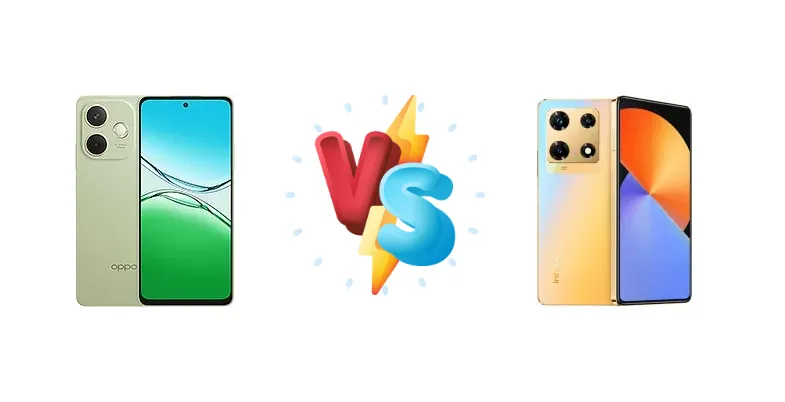
The Oppo A5 Energy and Infinix Note 30 Pro represent compelling options in the increasingly competitive mid-range smartphone market. Both devices aim to deliver a balance of performance and features without breaking the bank, but they take different approaches. The A5 Energy leverages the newer Mediatek Dimensity 6300, while the Note 30 Pro opts for the established Helio G99. This comparison will dissect their key differences to determine which phone best suits your needs.
🏆 Quick Verdict
For the average user prioritizing rapid charging and a slightly more versatile feature set, the Infinix Note 30 Pro emerges as the winner. Its 68W charging, including wireless capabilities, and reverse wireless charging offer a significant convenience advantage over the Oppo A5 Energy's 45W wired charging. However, the A5 Energy's Dimensity 6300 provides a slight performance edge.
| Network |
|---|
| 2G bands | GSM 850 / 900 / 1800 / 1900 | GSM 850 / 900 / 1800 / 1900 |
| 3G bands | HSDPA 850 / 900 / 2100 | HSDPA 850 / 900 / 1700(AWS) / 1900 / 2100 |
| 4G bands | 1, 3, 5, 8, 28, 34, 38, 39, 40, 41 | 1, 2, 3, 4, 5, 7, 8, 12, 17, 20, 28, 38, 40, 41, 66 |
| 5G bands | 1, 5, 8, 28, 41, 77, 78 SA/NSA | - |
| Speed | HSPA, LTE, 5G | HSPA, LTE |
| Technology | GSM / CDMA / HSPA / LTE / 5G | GSM / HSPA / LTE |
| Launch |
|---|
| Announced | 2025, March 18 | 2023, May 22 |
| Status | Available. Released 2025, March 21 | Available. Released 2023, May 22 |
| Body |
|---|
| Build | - | Glass front, plastic frame, glass back |
| Dimensions | 164.8 x 75.5 x 7.9 mm (6.49 x 2.97 x 0.31 in) | 162.7 x 76 x 8.2 mm (6.41 x 2.99 x 0.32 in) |
| SIM | Nano-SIM + Nano-SIM | Nano-SIM + Nano-SIM |
| Weight | 194 g or 196 g (6.84 oz) | 203 g (7.16 oz) |
| | - | IP53 |
| Display |
|---|
| Protection | Crystal Shield Glass | - |
| Resolution | 720 x 1604 pixels, 20:9 ratio (~264 ppi density) | 1080 x 2400 pixels, 20:9 ratio (~395 ppi density) |
| Size | 6.67 inches, 107.2 cm2 (~86.2% screen-to-body ratio) | 6.67 inches, 107.4 cm2 (~86.9% screen-to-body ratio) |
| Type | IPS LCD, 90Hz, 1000 nits (HBM) | AMOLED, 1B colors, 120Hz, 900 nits (peak) |
| | - | * the display diagonal size and resolution is unconfirmed |
| Platform |
|---|
| CPU | Octa-core (2x2.4 GHz Cortex-A76 & 6x2.0 GHz Cortex-A55) | Octa-core (2x2.2 GHz Cortex-A76 & 6x2.0 GHz Cortex-A55) |
| Chipset | Mediatek Dimensity 6300 (6 nm) | Mediatek Helio G99 (6 nm) |
| GPU | Mali-G57 MC2 | Mali-G57 MC2 |
| OS | Android 15, ColorOS 15 | Android 13, XOS 13 |
| Memory |
|---|
| Card slot | microSDXC | microSDXC (dedicated slot) |
| Internal | 256GB 8GB RAM, 256GB 12GB RAM, 512GB 12GB RAM | 256GB 8GB RAM |
| Main Camera |
|---|
| Dual | 50 MP, f/1.8, 27mm (wide), PDAF
Auxiliary lens | - |
| Features | LED flash, HDR, panorama | Quad-LED flash, HDR, panorama |
| Triple | - | 108 MP, (wide), 1/1.67", PDAF
2 MP (macro)
Auxiliary lens |
| Video | 1080p@30/60fps | 1440p@30fps, 1080p@30fps |
| Selfie camera |
|---|
| Features | - | LED flash, HDR |
| Single | 8 MP, f/2.0, 25mm (wide) | 32 MP, f/2.0, (wide), 1/2.8" |
| Video | 1080p@30fps | 1080p@30fps |
| Sound |
|---|
| 3.5mm jack | - | Yes |
| 35mm jack | No | Yes |
| Loudspeaker | Yes, with stereo speakers | Yes, with dual speakers |
| | - | Sound by JBL
24-bit/192kHz audio |
| Comms |
|---|
| Bluetooth | 5.4, A2DP, LE, aptX HD, BLE Audio | Yes |
| NFC | Yes | Yes (market/region dependent) |
| Positioning | GPS, GALILEO, GLONASS, BDS, QZSS | GPS |
| Radio | No | FM radio |
| USB | USB Type-C 2.0, OTG | USB Type-C 2.0, OTG |
| WLAN | Wi-Fi 802.11 a/b/g/n/ac, dual-band | Wi-Fi 802.11 a/b/g/n/ac, dual-band, Wi-Fi Direct |
| Features |
|---|
| Sensors | Fingerprint (side-mounted), accelerometer, proximity, compass | Fingerprint (side-mounted), accelerometer, gyro, proximity, compass |
| Battery |
|---|
| Charging | 45W wired, 33W UFCS, PD | 68W wired, PD3.0, 80% in 30 min
15W wireless
Reverse wireless |
| Type | 5800 mAh | 5000 mAh |
| Misc |
|---|
| Colors | Flower Pink, Mocha Brown (Mocha Chocolate), Jade Green (Moss Green) | Magic Black, Variable Gold |
| Models | PKV110 | X678B |
| Price | About 150 EUR | - |
Oppo A5 Energy
- Slightly more powerful CPU (Dimensity 6300)
- Potentially better CPU performance in benchmarks
- Clean and efficient software experience (typical of Oppo)
- Slower charging speed (45W wired only)
- Lacks wireless charging capabilities
- No reverse wireless charging
Infinix Note 30 Pro
- Faster 68W wired charging with PD3.0
- 15W wireless charging and reverse wireless charging
- Proven Helio G99 chipset with gaming optimizations
- Slightly lower CPU clock speed
- Potentially less efficient CPU architecture
- Infinix UI can be more cluttered than Oppo's ColorOS
Display Comparison
Neither device's display specifications are provided, so a direct comparison is limited. However, given their price points, both likely utilize LCD panels with FHD+ resolution. The absence of LTPO technology suggests standard refresh rates (likely 60Hz or 90Hz). The user experience will likely hinge on color calibration and peak brightness, areas where Infinix historically performs well with its AMOLED panels in higher-tier devices, potentially giving it an edge if it carries over that expertise. Bezels are expected to be comparable, typical of this price bracket.
Camera Comparison
Without detailed camera specifications, analysis is limited. Both phones likely feature multi-camera setups, but the quality will depend heavily on sensor size and image processing. The absence of information regarding OIS (Optical Image Stabilization) suggests neither phone prioritizes it. The Helio G99’s ISP (Image Signal Processor) is well-regarded, potentially giving the Infinix Note 30 Pro an advantage in image processing, particularly in low-light conditions. The inclusion of a 2MP macro lens on either device is likely a marketing tactic, offering minimal practical benefit due to its low resolution and fixed focus.
Performance
The core difference lies in the chipsets. The Oppo A5 Energy’s Mediatek Dimensity 6300 (6nm) features a slightly higher clocked Cortex-A76 core (2.4 GHz vs 2.2 GHz in the Infinix Note 30 Pro’s Helio G99). While both CPUs share the same Cortex-A55 efficiency cores, the Dimensity 6300’s newer architecture and higher clock speed should translate to a modest performance advantage in CPU-intensive tasks. The Helio G99, however, is a proven performer, particularly in gaming, and benefits from extensive software optimization. Both devices likely pair their chipsets with 8GB of RAM, but the type of RAM (LPDDR4x vs LPDDR5) isn't specified, impacting memory bandwidth. Thermal management will be crucial; the 6nm process node of both chips suggests reasonable efficiency, but sustained loads could reveal differences in cooling solutions.
Battery Life
The battery capacity isn't specified for either device, but both likely fall in the 5000mAh range, typical for this segment. The key differentiator is charging speed. The Infinix Note 30 Pro’s 68W wired charging, coupled with PD3.0 support and a claimed 80% charge in 30 minutes, is significantly faster than the Oppo A5 Energy’s 45W wired charging. Furthermore, the Note 30 Pro adds 15W wireless charging and reverse wireless charging, offering unparalleled convenience. While a larger battery on the A5 Energy could offset the slower charging, the Note 30 Pro’s charging versatility is a major advantage.
Buying Guide
Buy the Oppo A5 Energy if you prioritize raw processing power for everyday tasks and light gaming, and are comfortable with a more streamlined charging experience. Buy the Infinix Note 30 Pro if you value faster charging speeds, wireless charging convenience, and a broader range of features like reverse wireless charging, making it ideal for users who are frequently on the go and rely heavily on their phone throughout the day.
Frequently Asked Questions
❓ Does the Helio G99 in the Infinix Note 30 Pro get noticeably hot during extended gaming sessions?
The Helio G99 is known for its efficiency, but sustained gaming will inevitably generate heat. Infinix typically employs thermal management solutions like graphite sheets to mitigate this. While it may get warm, it's unlikely to throttle performance significantly unless under extreme conditions. User reports will be crucial to confirm real-world thermal performance.
❓ How does the 45W charging on the Oppo A5 Energy compare to standard 33W charging in terms of real-world top-up times?
While 45W is faster than 33W, the difference isn't dramatic. Expect a full charge to take around 60-75 minutes with the A5 Energy, compared to potentially 80-90 minutes with a 33W charger. The Infinix Note 30 Pro's 68W charging offers a much more substantial time saving.
❓ Is the reverse wireless charging on the Infinix Note 30 Pro useful for charging accessories like earbuds?
Yes, the 15W reverse wireless charging is quite practical for topping up accessories like TWS earbuds or smartwatches. It's not a replacement for a dedicated charger, but it's incredibly convenient for emergency charging or when you're traveling light.