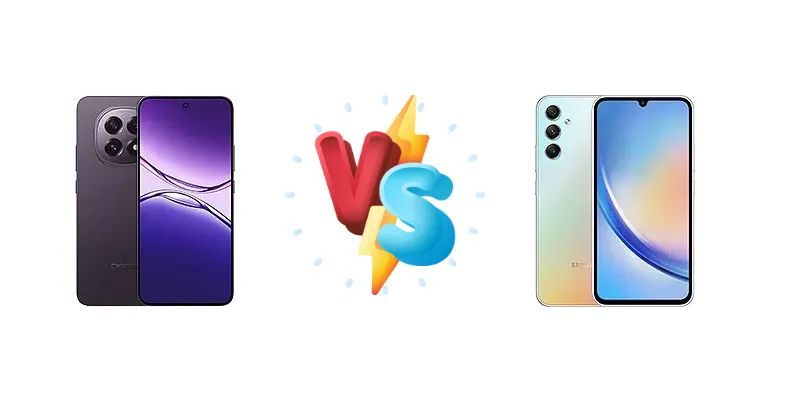
The mid-range smartphone market is fiercely competitive, and the Oppo A5 (China) and Samsung Galaxy A34 represent compelling options for budget-conscious buyers. This comparison focuses on the key differences between these two devices, specifically the Oppo A5’s newer Snapdragon 6 Gen 1 chipset against the Samsung Galaxy A34’s Dimensity 1080, and how those differences translate into real-world performance and user experience.
🏆 Quick Verdict
For most users, the Samsung Galaxy A34 emerges as the slightly better all-rounder. While the Oppo A5 boasts a more efficient 4nm Snapdragon chip and faster 45W charging, the A34’s brighter display and established software support provide a more polished experience.
| Network |
|---|
| 2G bands | GSM 850 / 900 / 1800 / 1900 | GSM 850 / 900 / 1800 / 1900 |
| 3G bands | HSDPA 850 / 900 / 2100 | HSDPA 850 / 900 / 1700(AWS) / 1900 / 2100 |
| 4G bands | 1, 3, 5, 8, 28, 34, 38, 39, 40, 41 | 1, 2, 3, 4, 5, 7, 8, 12, 17, 20, 26, 28, 32, 38, 40, 41, 66 |
| 5G bands | 1, 5, 8, 28, 41, 77, 78 SA/NSA | 1, 3, 7, 8, 20, 28, 38, 40, 41, 77, 78 SA/NSA/Sub6 |
| Speed | HSPA, LTE, 5G | HSPA, LTE, 5G |
| Technology | GSM / HSPA / LTE / 5G | GSM / HSPA / LTE / 5G |
| Launch |
|---|
| Announced | 2025, March 18 | 2023, March 14 |
| Status | Available. Released 2025, March 26 | Available. Released 2023, March 24 |
| Body |
|---|
| Build | - | Glass front (Gorilla Glass 5), plastic frame, plastic back |
| Dimensions | 161.6 x 74.5 x 7.7 mm (6.36 x 2.93 x 0.30 in) | 161.3 x 78.1 x 8.2 mm (6.35 x 3.07 x 0.32 in) |
| SIM | Nano-SIM + Nano-SIM | · Nano-SIM· Nano-SIM + Nano-SIM |
| Weight | 185 g or 189 g (6.53 oz) | 199 g (7.02 oz) |
| | - | IP67 dust/water resistant (up to 1m for 30 min) |
| Display |
|---|
| Protection | Crystal Shield Glass | Corning Gorilla Glass 5 |
| Resolution | 1080 x 2412 pixels, 20:9 ratio (~394 ppi density) | 1080 x 2340 pixels, 19.5:9 ratio (~390 ppi density) |
| Size | 6.7 inches, 108.0 cm2 (~89.7% screen-to-body ratio) | 6.6 inches, 106.9 cm2 (~84.9% screen-to-body ratio) |
| Type | AMOLED, 1B colors, 120Hz, 600 nits (typ), 1200 nits (HBM) | Super AMOLED, 120Hz, 1000 nits (HBM) |
| Platform |
|---|
| CPU | Octa-core (4x2.2 GHz Cortex-A78 & 4x1.8 GHz Cortex-A55) | Octa-core (2x2.6 GHz Cortex-A78 & 6x2.0 GHz Cortex-A55) |
| Chipset | Qualcomm SM6450 Snapdragon 6 Gen 1 (4 nm) | Mediatek Dimensity 1080 (6 nm) |
| GPU | Adreno 710 | Mali-G68 MC4 |
| OS | Android 15, ColorOS 15 | Android 13, up to 4 major Android upgrades, One UI 6.1 |
| Memory |
|---|
| Card slot | No | microSDXC (uses shared SIM slot) |
| Internal | 128GB 8GB RAM, 256GB 8GB RAM, 256GB 12GB RAM, 512GB 12GB RAM | 128GB 4GB RAM, 128GB 6GB RAM, 128GB 8GB RAM, 256GB 6GB RAM, 256GB 8GB RAM |
| Main Camera |
|---|
| Dual | 50 MP, f/1.8, 27mm (wide), PDAF
Auxiliary lens | - |
| Features | Color spectrum sensor, LED flash, HDR, panorama | LED flash, panorama, HDR |
| Triple | - | 48 MP, f/1.8, 26mm (wide), 1/2.0", 0.8µm, PDAF, OIS
8 MP, f/2.2, 123˚, (ultrawide), 1/4.0", 1.12µm
5 MP (macro) |
| Video | 4K@30fps, 1080p@30/120fps, gyro-EIS | 4K@30fps, 1080p@30/60fps, 720p@480fps |
| Selfie camera |
|---|
| Single | 8 MP, f/2.0, 25mm (wide) | 13 MP, f/2.2, 26mm (wide), 1/3.1", 1.12µm |
| Video | 1080p@30fps | 4K@30fps, 1080p@30fps |
| Sound |
|---|
| 3.5mm jack | - | No |
| 35mm jack | No | No |
| Loudspeaker | Yes, with stereo speakers | Yes, with stereo speakers |
| Comms |
|---|
| Bluetooth | 5.1, A2DP, LE, aptX HD, BLE Audio | 5.3, A2DP, LE |
| NFC | Yes | Yes (market/region dependent) |
| Positioning | GPS, GALILEO, GLONASS, BDS, QZSS | GPS, GLONASS, GALILEO, BDS |
| Radio | No | No |
| USB | USB Type-C 2.0, OTG | USB Type-C 2.0, OTG |
| WLAN | Wi-Fi 802.11 a/b/g/n/ac, dual-band | Wi-Fi 802.11 a/b/g/n/ac, dual-band, Wi-Fi Direct |
| Features |
|---|
| Sensors | Fingerprint (under display, optical), accelerometer, gyro, proximity, compass | Fingerprint (under display, optical), accelerometer, gyro, compass |
| | - | Virtual proximity sensing |
| Battery |
|---|
| Charging | 45W wired, PD | 25W wired |
| Type | Si/C Li-Ion 6500 mAh | Li-Ion 5000 mAh |
| Misc |
|---|
| Colors | Black, Blue, Pink | Lime, Graphite, Violet, Silver |
| Models | PKQ110 | SM-A346E, SM-A346B, SM-A346B/DS, SM-A346B/DSN, SM-A346E/DS, SM-A346E/DSN, SM-A346M, SM-A346M/N, SM-A346M/DSN, SM-A3460 |
| Price | About 160 EUR | € 169.99 / $ 175.00 / £ 164.99 / ₹ 23,999 |
| SAR EU | - | 0.55 W/kg (head) 1.49 W/kg (body) |
| Tests |
|---|
| Battery life | - |
Endurance rating 133h
|
| Camera | - |
Photo / Video |
| Display | - |
Contrast ratio: Infinite (nominal) |
| Loudspeaker | - |
-26.1 LUFS (Good)
|
| Performance | - |
AnTuTu: 472126 (v9)
GeekBench: 2316 (v5.5), 2518 (v6)
GFXBench: 23fps (ES 3.1 onscreen) |
Oppo A5 (China)
- Faster 45W charging with PD support
- More power-efficient 4nm Snapdragon 6 Gen 1 chipset
- Potentially better thermal management
- Display likely inferior to the A34 in brightness and color accuracy
- Software support may be less extensive than Samsung
Samsung Galaxy A34
- Brighter and more vibrant AMOLED display (1009 nits)
- Established software support and updates from Samsung
- Generally refined camera image processing
- Slower 25W charging
- Less power-efficient 6nm Dimensity 1080 chipset
Display Comparison
The Samsung Galaxy A34 takes a clear lead in display quality, achieving a measured peak brightness of 1009 nits. This significantly surpasses what we’d expect from the Oppo A5, though specific brightness data is unavailable. The A34’s ‘Infinite’ contrast ratio (nominal) suggests a typical AMOLED panel, offering deep blacks and vibrant colors. While the Oppo A5’s panel specifics are unknown, it likely won’t match the A34’s vibrancy. The A34’s larger display size also contributes to a more immersive viewing experience.
Camera Comparison
Both phones offer photo and video capabilities, but detailed camera specs are lacking. Without sensor size or aperture information, a direct comparison is difficult. However, Samsung generally excels in image processing, delivering consistently pleasing results. The Oppo A5’s camera performance will likely be good, but may not reach the same level of refinement as the A34. The presence of a 2MP macro camera on both devices is largely a marketing gimmick and shouldn’t heavily influence purchasing decisions.
Performance
The chipset battle is intriguing. The Oppo A5 utilizes the Qualcomm Snapdragon 6 Gen 1 (4nm), while the Samsung Galaxy A34 features the MediaTek Dimensity 1080 (6nm). While the Dimensity 1080 has a slightly higher clocked Cortex-A78 core (2.6 GHz vs 2.2 GHz), the Snapdragon 6 Gen 1’s 4nm process offers superior power efficiency. This means the Oppo A5 is likely to run cooler under sustained load, potentially reducing thermal throttling. However, the Dimensity 1080’s six Cortex-A55 cores versus the A5’s four could provide better multi-tasking performance. Both devices benefit from ample RAM, though specific configurations aren’t detailed here.
Battery Life
Both the Oppo A5 and Samsung Galaxy A34 share an endurance rating of 133 hours, suggesting similar overall battery life despite differing battery capacities (not specified). However, the Oppo A5’s 45W wired charging with PD support is a significant advantage over the A34’s 25W charging. This translates to considerably faster charging times, allowing users to quickly top up their battery when needed. While the A34’s endurance rating is respectable, the A5’s faster charging provides a more convenient user experience.
Buying Guide
Buy the Oppo A5 (China) if you prioritize efficient performance for everyday tasks and value faster charging speeds. This phone is ideal for users who frequently multitask and need a device that won’t overheat quickly. Buy the Samsung Galaxy A34 if you prefer a brighter, more vibrant display, a more refined software experience with longer guaranteed updates, and a generally more balanced feature set, even if it means slightly slower charging.
Frequently Asked Questions
❓ Does the MediaTek Dimensity 1080 in the Samsung Galaxy A34 suffer from significant thermal throttling during extended gaming sessions?
While the Dimensity 1080 is a capable chipset, its 6nm process is less efficient than the Oppo A5’s 4nm Snapdragon 6 Gen 1. This means the A34 is more prone to thermal throttling during prolonged, demanding tasks like gaming. Expect some performance dips after extended play, though the severity will depend on ambient temperature and game settings.
❓ Is the 45W charging on the Oppo A5 (China) significantly faster in real-world use compared to the Samsung Galaxy A34’s 25W charging?
Yes, the 45W charging on the Oppo A5 will noticeably reduce charging times. While exact 0-100% times aren’t available, expect the A5 to charge considerably faster, potentially shaving off 30-60 minutes compared to the A34. This is a significant benefit for users who frequently need to quickly top up their battery.
❓ How does the software experience differ between the Oppo A5 (China) and the Samsung Galaxy A34?
Samsung’s One UI is a mature and feature-rich software experience with a strong track record of updates and security patches. Oppo’s ColorOS, while also feature-packed, generally receives fewer major Android version updates. The A34 will likely receive longer software support, making it a better choice for users who prioritize long-term usability.