
Oppo A5 (China) vs OnePlus Nord CE 3 Lite: A Deep Dive into Mid-Range 5G Contenders
| Phones Images | |||||
|---|---|---|---|---|---|
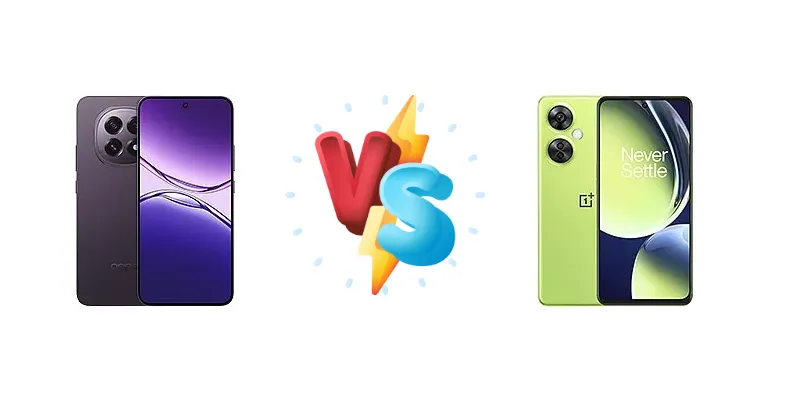
|
🏆 Quick Verdict
For the average user prioritizing fast charging and a slightly more refined software experience, the OnePlus Nord CE 3 Lite emerges as the winner. Its 67W charging significantly reduces downtime, and the established OnePlus OxygenOS offers a smoother user interface. However, the Oppo A5's more efficient chipset could appeal to power users.
| PHONES | ||
|---|---|---|
| Phone Names | Oppo A5 (China) | OnePlus Nord CE 3 Lite |
| Network | ||
|---|---|---|
| 2G bands | GSM 850 / 900 / 1800 / 1900 | GSM 850 / 900 / 1800 / 1900 |
| 3G bands | HSDPA 850 / 900 / 2100 | HSDPA 800 / 850 / 900 / 1700(AWS) / 1900 / 2100 - International |
| 4G bands | 1, 3, 5, 8, 28, 34, 38, 39, 40, 41 | 1, 2, 3, 4, 5, 7, 8, 12, 13, 17, 18, 19, 20, 26, 28, 32, 38, 39, 40, 41, 66 - International |
| 5G bands | 1, 5, 8, 28, 41, 77, 78 SA/NSA | 1, 3, 5, 7, 8, 20, 28, 38, 40, 41, 66, 77, 78 SA/NSA - International |
| Speed | HSPA, LTE, 5G | HSPA, LTE, 5G |
| Technology | GSM / HSPA / LTE / 5G | GSM / HSPA / LTE / 5G |
| - | 1, 3, 5, 8, 28, 40, 41, 77, 78 SA/NSA - India | |
| Launch | ||
|---|---|---|
| Announced | 2025, March 18 | 2023, April 04 |
| Status | Available. Released 2025, March 26 | Available. Released 2023, April 11 |
| Body | ||
|---|---|---|
| Build | - | Glass front, plastic frame, plastic back |
| Dimensions | 161.6 x 74.5 x 7.7 mm (6.36 x 2.93 x 0.30 in) | 165.5 x 76 x 8.3 mm (6.52 x 2.99 x 0.33 in) |
| SIM | Nano-SIM + Nano-SIM | Nano-SIM + Nano-SIM |
| Weight | 185 g or 189 g (6.53 oz) | 195 g (6.88 oz) |
| Display | ||
|---|---|---|
| Protection | Crystal Shield Glass | Corning Gorilla Glass |
| Resolution | 1080 x 2412 pixels, 20:9 ratio (~394 ppi density) | 1080 x 2400 pixels, 20:9 ratio (~391 ppi density) |
| Size | 6.7 inches, 108.0 cm2 (~89.7% screen-to-body ratio) | 6.72 inches, 109.6 cm2 (~87.1% screen-to-body ratio) |
| Type | AMOLED, 1B colors, 120Hz, 600 nits (typ), 1200 nits (HBM) | IPS LCD, 120Hz, 550 nits (typ), 680 nits (peak) |
| Platform | ||
|---|---|---|
| CPU | Octa-core (4x2.2 GHz Cortex-A78 & 4x1.8 GHz Cortex-A55) | Octa-core (2x2.2 GHz Kryo 660 Gold & 6x1.7 GHz Kryo 660 Silver) |
| Chipset | Qualcomm SM6450 Snapdragon 6 Gen 1 (4 nm) | Qualcomm SM6375 Snapdragon 695 5G (6 nm) |
| GPU | Adreno 710 | Adreno 619 |
| OS | Android 15, ColorOS 15 | Android 13, OxygenOS 13.1 |
| Memory | ||
|---|---|---|
| Card slot | No | microSDXC (uses shared SIM slot) |
| Internal | 128GB 8GB RAM, 256GB 8GB RAM, 256GB 12GB RAM, 512GB 12GB RAM | 128GB 8GB RAM, 256GB 8GB RAM |
| - | UFS 2.2 | |
| Main Camera | ||
|---|---|---|
| Dual | 50 MP, f/1.8, 27mm (wide), PDAF Auxiliary lens | - |
| Features | Color spectrum sensor, LED flash, HDR, panorama | LED flash, HDR, panorama |
| Triple | - | 108 MP, f/1.8, (wide), 1/1.67", 0.64µm, PDAF 2 MP (macro) Auxiliary lens |
| Video | 4K@30fps, 1080p@30/120fps, gyro-EIS | 1080p@30fps |
| Selfie camera | ||
|---|---|---|
| Features | - | HDR, panorama |
| Single | 8 MP, f/2.0, 25mm (wide) | 16 MP, f/2.4, (wide), 1.0µm |
| Video | 1080p@30fps | 1080p@30fps |
| Sound | ||
|---|---|---|
| 3.5mm jack | - | Yes |
| 35mm jack | No | Yes |
| Loudspeaker | Yes, with stereo speakers | Yes, with stereo speakers |
| Comms | ||
|---|---|---|
| Bluetooth | 5.1, A2DP, LE, aptX HD, BLE Audio | 5.1, A2DP, LE, aptX HD |
| NFC | Yes | Yes (market/region dependent) |
| Positioning | GPS, GALILEO, GLONASS, BDS, QZSS | GPS, GALILEO, GLONASS, BDS, QZSS |
| Radio | No | No |
| USB | USB Type-C 2.0, OTG | USB Type-C 2.0, OTG |
| WLAN | Wi-Fi 802.11 a/b/g/n/ac, dual-band | Wi-Fi 802.11 a/b/g/n/ac, dual-band |
| Features | ||
|---|---|---|
| Sensors | Fingerprint (under display, optical), accelerometer, gyro, proximity, compass | Fingerprint (side-mounted), accelerometer, gyro, proximity, compass |
| Battery | ||
|---|---|---|
| Charging | 45W wired, PD | 67W wired, 80% in 30 min |
| Type | Si/C Li-Ion 6500 mAh | Li-Po 5000 mAh |
| Misc | ||
|---|---|---|
| Colors | Black, Blue, Pink | Pastel Lime, Chromatic Gray |
| Models | PKQ110 | CPH2467, CPH2465 |
| Price | About 160 EUR | £ 169.98 / € 209.99 |
| SAR | - | 1.17 W/kg (head) 0.70 W/kg (body) |
| Tests | ||
|---|---|---|
| Performance | - | AnTuTu: 412006 (v9) GeekBench: 2052 (v5) GFXBench: 17fps (ES 3.1 onscreen) |
Oppo A5 (China)
- More efficient Snapdragon 6 Gen 1 chipset
- Potentially better thermal management
- 4nm process for improved power efficiency
- Slower 45W charging
- China-specific software may lack global features
OnePlus Nord CE 3 Lite
- 67W SuperVOOC charging for rapid top-ups
- OxygenOS offers a refined software experience
- Established brand reputation for software updates
- Less efficient Snapdragon 695 5G chipset
- 6nm process may lead to higher temperatures under load
Display Comparison
Neither device boasts a standout display. Both are expected to feature LCD panels, typical for this price bracket. The key difference lies under the hood. While specific display specs are unavailable, the Oppo A5's focus on efficiency suggests a potentially optimized panel for power consumption. However, without knowing the peak brightness or color gamut coverage, it's difficult to declare a clear winner. Bezels are likely comparable, reflecting the cost-conscious design of both phones.
Camera Comparison
Camera details are sparse, but we can infer some differences. Both phones likely feature a multi-camera setup, but the emphasis will be on the main sensor. Without knowing the megapixel count or sensor size, it’s difficult to make a definitive judgment. However, the Oppo A5, being a China-market device, may prioritize different image processing styles – often leaning towards more vibrant, saturated colors. The Nord CE 3 Lite, adhering to OnePlus’s global aesthetic, will likely aim for more natural-looking images. The inclusion of a 2MP macro lens on either device is largely a marketing gimmick and shouldn’t heavily influence purchasing decisions.
Performance
The core battleground is the chipset. The Oppo A5’s Snapdragon 6 Gen 1 (4nm) utilizes newer Cortex-A78 cores for its performance cluster, offering a theoretical advantage in single-core tasks compared to the Nord CE 3 Lite’s Snapdragon 695 (6nm) with Kryo 660 Gold cores. The 4nm process node of the 6 Gen 1 is crucial; it translates to improved thermal efficiency and potentially lower power consumption under load. However, the Snapdragon 695 5G benefits from a larger process node, which can sometimes allow for higher sustained clock speeds. The Nord CE 3 Lite’s 6nm process, while less efficient, may offer a more stable performance profile. The A5’s CPU architecture suggests a slight edge in demanding applications, but real-world performance will depend on software optimization and thermal throttling.
Battery Life
The OnePlus Nord CE 3 Lite’s 67W charging is a significant advantage. The advertised 80% charge in 30 minutes drastically reduces downtime compared to the Oppo A5’s 45W charging. While the A5’s Snapdragon 6 Gen 1 is more power-efficient, the Nord CE 3 Lite’s faster charging mitigates the impact of a potentially smaller battery capacity. The 4nm process of the A5 will contribute to longer standby times, but the convenience of rapid charging offered by the Nord CE 3 Lite is a compelling benefit for many users.
Buying Guide
Buy the Oppo A5 (China) if you prioritize long-term efficiency and potentially better thermal management during sustained workloads, even if it means slower charging. This phone suits users who value a potentially cooler-running device for extended gaming or video recording. Buy the OnePlus Nord CE 3 Lite if you value rapid charging and a polished software experience. This is the ideal choice for users who frequently find themselves needing to top up their battery quickly and appreciate a streamlined, user-friendly interface.