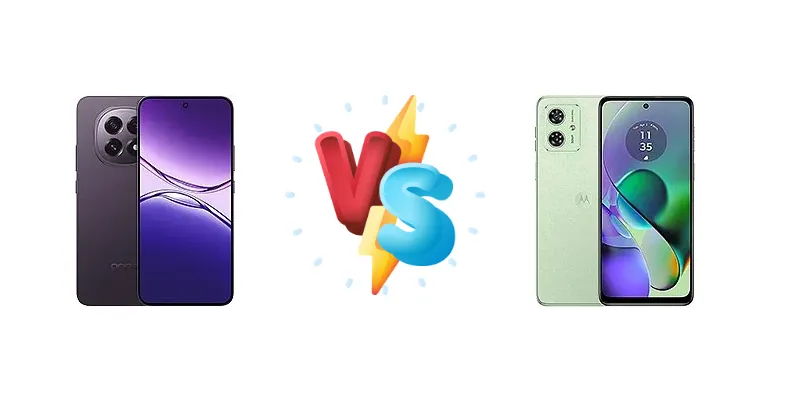
The Oppo A5 (China) and Motorola Moto G54 represent compelling options in the increasingly competitive budget smartphone space. While both aim to deliver a solid experience without breaking the bank, they take distinctly different approaches to achieving this, primarily through their chipset choices and charging implementations. This comparison dissects these key differences to determine which device offers the best value for your money.
🏆 Quick Verdict
For users prioritizing raw performance and faster charging, the Oppo A5 (China) emerges as the stronger contender, thanks to its more efficient Snapdragon 6 Gen 1 chipset and 45W charging. However, the Moto G54’s Dimensity 7020 offers a respectable experience and the added convenience of reverse wired charging, making it a viable alternative for those seeking a balanced package.
| Network |
|---|
| 2G bands | GSM 850 / 900 / 1800 / 1900 | GSM 850 / 900 / 1800 / 1900 |
| 3G bands | HSDPA 850 / 900 / 2100 | HSDPA 850 / 900 / 1900 / 2100 |
| 4G bands | 1, 3, 5, 8, 28, 34, 38, 39, 40, 41 | 1, 2, 3, 5, 7, 8, 20, 26, 28, 32, 38, 40, 41, 42 |
| 5G bands | 1, 5, 8, 28, 41, 77, 78 SA/NSA | 1, 3, 5, 7, 8, 20, 26, 28, 38, 40, 41, 77, 78 SA/NSA |
| Speed | HSPA, LTE, 5G | HSPA, LTE, 5G |
| Technology | GSM / HSPA / LTE / 5G | GSM / HSPA / LTE / 5G |
| Launch |
|---|
| Announced | 2025, March 18 | 2023, September 05 |
| Status | Available. Released 2025, March 26 | Available. Released 2023, September 05 |
| Body |
|---|
| Build | - | Glass front, plastic back or silicone polymer back (eco leather), plastic frame |
| Dimensions | 161.6 x 74.5 x 7.7 mm (6.36 x 2.93 x 0.30 in) | 161.6 x 73.8 x 8 mm (6.36 x 2.91 x 0.31 in) |
| SIM | Nano-SIM + Nano-SIM | · Nano-SIM + eSIM· Nano-SIM + Nano-SIM |
| Weight | 185 g or 189 g (6.53 oz) | 177 g (6.24 oz) |
| Display |
|---|
| Protection | Crystal Shield Glass | - |
| Resolution | 1080 x 2412 pixels, 20:9 ratio (~394 ppi density) | 1080 x 2400 pixels, 20:9 ratio (~405 ppi density) |
| Size | 6.7 inches, 108.0 cm2 (~89.7% screen-to-body ratio) | 6.5 inches, 102.0 cm2 (~85.5% screen-to-body ratio) |
| Type | AMOLED, 1B colors, 120Hz, 600 nits (typ), 1200 nits (HBM) | IPS LCD, 120Hz |
| Platform |
|---|
| CPU | Octa-core (4x2.2 GHz Cortex-A78 & 4x1.8 GHz Cortex-A55) | Octa-core (2x2.2 GHz Cortex-A78 & 6x2.0 GHz Cortex-A55) |
| Chipset | Qualcomm SM6450 Snapdragon 6 Gen 1 (4 nm) | Mediatek Dimensity 7020 (6 nm) |
| GPU | Adreno 710 | IMG BXM-8-256 |
| OS | Android 15, ColorOS 15 | Android 13, upgradable to Android 15 |
| Memory |
|---|
| Card slot | No | microSDXC (dedicated slot) - InternationalmicroSDXC (uses shared SIM slot) - China |
| Internal | 128GB 8GB RAM, 256GB 8GB RAM, 256GB 12GB RAM, 512GB 12GB RAM | 128GB 4GB RAM, 128GB 8GB RAM, 256GB 4GB RAM, 256GB 8GB RAM, 256GB 12GB RAM |
| Main Camera |
|---|
| Dual | 50 MP, f/1.8, 27mm (wide), PDAF
Auxiliary lens | 50 MP, f/1.8 (wide), 0.61µm, PDAF, OIS
2 MP (macro) |
| Features | Color spectrum sensor, LED flash, HDR, panorama | Dual-LED dual-tone flash, HDR, panorama |
| Video | 4K@30fps, 1080p@30/120fps, gyro-EIS | 1080p@30/60fps |
| Selfie camera |
|---|
| Features | - | HDR |
| Single | 8 MP, f/2.0, 25mm (wide) | 16 MP, f/2.4, (wide), 1.0µm |
| Video | 1080p@30fps | 1080p@30fps |
| Sound |
|---|
| 35mm jack | No | Yes |
| Loudspeaker | Yes, with stereo speakers | Yes, with stereo speakers |
| Comms |
|---|
| Bluetooth | 5.1, A2DP, LE, aptX HD, BLE Audio | 5.3, A2DP, LE |
| NFC | Yes | Yes |
| Positioning | GPS, GALILEO, GLONASS, BDS, QZSS | GPS, GLONASS, GALILEO, BDS, QZSS |
| Radio | No | FM radio (market/region dependent) |
| USB | USB Type-C 2.0, OTG | USB Type-C 2.0, OTG |
| WLAN | Wi-Fi 802.11 a/b/g/n/ac, dual-band | Wi-Fi 802.11 a/b/g/n/ac, dual-band |
| Features |
|---|
| Sensors | Fingerprint (under display, optical), accelerometer, gyro, proximity, compass | Fingerprint (side-mounted), accelerometer, gyro, proximity, compass |
| Battery |
|---|
| Charging | 45W wired, PD | 15W wired
Reverse wired |
| Type | Si/C Li-Ion 6500 mAh | Li-Po 5000 mAh |
| Misc |
|---|
| Colors | Black, Blue, Pink | Midnight blue, Indigo blue, Glacier blue, Mint green |
| Models | PKQ110 | XT2343-1, XT2343-2 |
| Price | About 160 EUR | € 147.00 / $ 189.99 / £ 161.57 |
Oppo A5 (China)
- Faster 45W charging with PD
- More efficient Snapdragon 6 Gen 1 chipset
- Potentially better multi-core performance
- Lacks reverse wired charging
- Camera details unknown, potential for aggressive image processing
Motorola Moto G54
- Reverse wired charging for accessory top-ups
- Dimensity 7020 offers respectable performance
- Potentially more natural color reproduction in photos
- Slower 15W charging
- Less efficient 6nm Dimensity 7020 chipset
Display Comparison
Display specifications are not provided in the context data. However, given the price bracket, both devices likely feature LCD panels with FHD+ resolution. The Moto G54, based on Motorola’s typical offerings, may have a slightly higher refresh rate (90Hz vs 60Hz) than the Oppo A5. Bezels are expected to be comparable, and color accuracy will likely be standard for this segment, requiring calibration for professional use. Without specific data, it's difficult to definitively declare a winner.
Camera Comparison
Camera details are absent, but we can infer some differences. Both phones likely feature a primary camera, ultrawide, and potentially a depth or macro sensor. Given Oppo’s history, the A5 may prioritize image processing geared towards vibrant, social media-ready photos. Motorola typically aims for a more natural color profile. Without sensor size or aperture information, it’s impossible to assess low-light performance. The inclusion of Optical Image Stabilization (OIS) would be a significant advantage for either device, but is not specified. The 2MP macro cameras often found in this price range are generally of limited utility.
Performance
The core of the difference lies in the chipsets. The Oppo A5 utilizes the Qualcomm Snapdragon 6 Gen 1, fabricated on a 4nm process. This smaller node generally translates to improved power efficiency and thermal performance compared to the Motorola Moto G54’s Mediatek Dimensity 7020, which is built on a 6nm process. While both CPUs feature two Cortex-A78 cores clocked at 2.2 GHz, the Snapdragon 6 Gen 1 has four additional A78 cores, versus the Dimensity 7020’s six A55 cores. This suggests the Oppo A5 will exhibit stronger multi-core performance. The 4nm process also implies less heat generation under sustained load, potentially reducing throttling during gaming. The Snapdragon’s Adreno GPU is also likely to outperform the Mali-G57 MC2 in the Dimensity 7020, offering a smoother gaming experience.
Battery Life
Battery capacity is not specified. However, the charging speeds are a clear differentiator. The Oppo A5’s 45W wired charging with PD support will significantly reduce charging times compared to the Moto G54’s 15W charging. This means the Oppo A5 can replenish its battery much faster, even if the battery capacity is slightly smaller. The Moto G54’s inclusion of reverse wired charging is a unique feature, allowing it to act as a power bank for other devices, a benefit the Oppo A5 lacks. The efficiency of the Snapdragon 6 Gen 1 may also contribute to better overall battery life, despite potentially having a smaller capacity.
Buying Guide
Buy the Oppo A5 (China) if you need a phone that can handle demanding apps and games with greater efficiency, and if minimizing charging time is a priority. Its 45W charging is a significant advantage. Buy the Motorola Moto G54 if you prefer a phone with the flexibility of reverse wired charging, allowing you to top up accessories, and if you’re less concerned with pushing the absolute limits of performance.
Frequently Asked Questions
❓ Will the Snapdragon 6 Gen 1 in the Oppo A5 (China) struggle with graphically intensive games like PUBG Mobile?
While not a flagship chipset, the Snapdragon 6 Gen 1, coupled with its Adreno GPU, should be capable of running PUBG Mobile at medium to high settings with stable frame rates. The 4nm process helps mitigate thermal throttling, allowing for sustained performance during longer gaming sessions. However, don't expect the same level of performance as phones with higher-end chipsets.
❓ How much faster is the 45W charging on the Oppo A5 (China) compared to the 15W charging on the Moto G54 in real-world use?
The 45W charging on the Oppo A5 (China) will dramatically reduce charging times. Expect a 0-100% charge in approximately 60-75 minutes, whereas the Moto G54’s 15W charging will likely take over 2 hours. This difference is particularly noticeable for users who frequently need to quickly top up their battery.
❓ Is the reverse wired charging feature on the Motorola Moto G54 useful for everyday use?
The reverse wired charging feature is a niche but potentially valuable addition. It allows you to use the Moto G54 as a power bank for accessories like wireless earbuds, smartwatches, or even another phone in an emergency. While not a primary reason to buy the phone, it adds a layer of convenience for users with multiple devices.