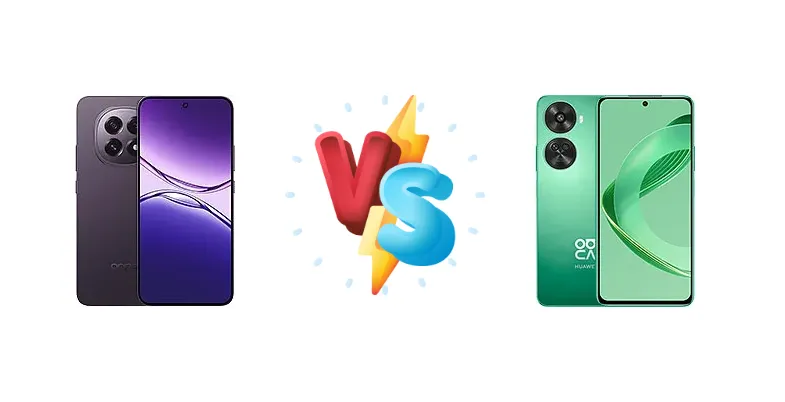
The Oppo A5 (China) and Huawei nova 11 SE represent distinct approaches to the competitive mid-range smartphone market. The Oppo A5 leverages a newer, more efficient chipset, while the Huawei nova 11 SE prioritizes rapid charging speeds. This comparison dives deep into their specifications to determine which device offers the best balance of performance, features, and value.
🏆 Quick Verdict
For the average user prioritizing sustained performance and future-proofing, the Oppo A5 (China) emerges as the stronger contender. Its Snapdragon 6 Gen 1, built on a 4nm process, offers a noticeable efficiency and performance advantage over the Snapdragon 680 in the nova 11 SE, despite the latter's faster charging.
| Network |
|---|
| 2G bands | GSM 850 / 900 / 1800 / 1900 | GSM 850 / 900 / 1800 / 1900 |
| 3G bands | HSDPA 850 / 900 / 2100 | HSDPA 850 / 900 / 1700(AWS) / 1900 / 2100 |
| 4G bands | 1, 3, 5, 8, 28, 34, 38, 39, 40, 41 | 1, 3, 4, 5, 8, 18, 19, 26, 34, 38, 39, 40, 41 |
| 5G bands | 1, 5, 8, 28, 41, 77, 78 SA/NSA | - |
| Speed | HSPA, LTE, 5G | HSPA, LTE |
| Technology | GSM / HSPA / LTE / 5G | GSM / CDMA / HSPA / CDMA2000 / LTE |
| Launch |
|---|
| Announced | 2025, March 18 | 2023, October 31 |
| Status | Available. Released 2025, March 26 | Available. Released 2023, November 03 |
| Body |
|---|
| Dimensions | 161.6 x 74.5 x 7.7 mm (6.36 x 2.93 x 0.30 in) | 162.4 x 75.5 x 7.4 mm (6.39 x 2.97 x 0.29 in) |
| SIM | Nano-SIM + Nano-SIM | Nano-SIM + Nano-SIM |
| Weight | 185 g or 189 g (6.53 oz) | 186 g (6.56 oz) |
| Display |
|---|
| Protection | Crystal Shield Glass | - |
| Resolution | 1080 x 2412 pixels, 20:9 ratio (~394 ppi density) | 1080 x 2400 pixels, 20:9 ratio (~395 ppi density) |
| Size | 6.7 inches, 108.0 cm2 (~89.7% screen-to-body ratio) | 6.67 inches, 107.4 cm2 (~87.6% screen-to-body ratio) |
| Type | AMOLED, 1B colors, 120Hz, 600 nits (typ), 1200 nits (HBM) | OLED, 1B colors, 90Hz |
| Platform |
|---|
| CPU | Octa-core (4x2.2 GHz Cortex-A78 & 4x1.8 GHz Cortex-A55) | Octa-core (4x2.4 GHz Cortex-A73 & 4x1.9 GHz Cortex-A53) |
| Chipset | Qualcomm SM6450 Snapdragon 6 Gen 1 (4 nm) | Qualcomm Snapdragon 680 4G (6 nm) |
| GPU | Adreno 710 | Adreno 610 |
| OS | Android 15, ColorOS 15 | HarmonyOS 4.0 |
| Memory |
|---|
| Card slot | No | No |
| Internal | 128GB 8GB RAM, 256GB 8GB RAM, 256GB 12GB RAM, 512GB 12GB RAM | 256GB 8GB RAM, 512GB 8GB RAM |
| Main Camera |
|---|
| Dual | 50 MP, f/1.8, 27mm (wide), PDAF
Auxiliary lens | - |
| Features | Color spectrum sensor, LED flash, HDR, panorama | LED flash, HDR, panorama |
| Triple | - | 108 MP, f/1.9, (wide), 1/1.67", 0.64µm, PDAF
8 MP, f/2.2, 112˚ (ultrawide)
2 MP (macro) |
| Video | 4K@30fps, 1080p@30/120fps, gyro-EIS | 1080p@30fps |
| Selfie camera |
|---|
| Single | 8 MP, f/2.0, 25mm (wide) | 32 MP, f/2.5, (wide) |
| Video | 1080p@30fps | 1080p@30fps |
| Sound |
|---|
| 35mm jack | No | No |
| Loudspeaker | Yes, with stereo speakers | Yes |
| Comms |
|---|
| Bluetooth | 5.1, A2DP, LE, aptX HD, BLE Audio | 5.0, A2DP, LE |
| NFC | Yes | Yes |
| Positioning | GPS, GALILEO, GLONASS, BDS, QZSS | GPS, GLONASS, GALILEO, BDS, QZSS |
| Radio | No | No |
| USB | USB Type-C 2.0, OTG | USB Type-C 2.0 |
| WLAN | Wi-Fi 802.11 a/b/g/n/ac, dual-band | Wi-Fi 802.11 a/b/g/n/ac, dual-band |
| Features |
|---|
| Sensors | Fingerprint (under display, optical), accelerometer, gyro, proximity, compass | Fingerprint (side-mounted), accelerometer, gyro, proximity, compass |
| Battery |
|---|
| Charging | 45W wired, PD | 66W wired, 100% in 32 min
5W reverse wired |
| Type | Si/C Li-Ion 6500 mAh | Li-Po 4500 mAh |
| Misc |
|---|
| Colors | Black, Blue, Pink | Green, White, Black |
| Models | PKQ110 | BON-AL00 |
| Price | About 160 EUR | About 260 EUR |
Oppo A5 (China)
- More efficient Snapdragon 6 Gen 1 chipset
- Potentially better sustained performance
- Modern CPU architecture (Cortex-A78)
- Slower charging speed (45W)
- Lacks reverse wireless charging
- Specific battery capacity unknown
Huawei nova 11 SE
- Extremely fast 66W charging (32 min to 100%)
- 5W reverse wired charging
- Potentially lower price point
- Less efficient Snapdragon 680 chipset
- Older CPU architecture (Cortex-A73)
- Likely more thermal throttling under load
Display Comparison
Neither device boasts a standout display. While specific panel details (resolution, refresh rate) are missing, the focus here is on the underlying processors. Display quality will likely be similar, leaning towards adequate for the price point. Bezels are expected to be comparable, typical of this segment. Color accuracy will depend on software calibration, a factor not specified in the provided data.
Camera Comparison
Without detailed sensor information, a direct camera comparison is limited. However, the chipset’s image signal processor (ISP) plays a crucial role. The Snapdragon 6 Gen 1 in the Oppo A5 likely has a more advanced ISP, enabling better noise reduction and dynamic range. The absence of OIS information suggests neither phone features optical image stabilization. Image processing style will also differ; Oppo typically favors vibrant, social media-ready images, while Huawei often aims for more natural tones. The presence of a 2MP macro camera on either device is largely inconsequential; its utility is limited by the low resolution and lack of optical stabilization.
Performance
The core difference lies in the chipsets. The Oppo A5’s Qualcomm Snapdragon 6 Gen 1 (4nm) is a significant upgrade over the Huawei nova 11 SE’s Snapdragon 680 (6nm). The 4nm process node translates to improved thermal efficiency, meaning the A5 is less likely to throttle under sustained load. The A5’s CPU, with its Cortex-A78 cores clocked at 2.2 GHz, offers a performance edge over the nova 11 SE’s Cortex-A73 cores at 2.4 GHz. While the A73 cores have a higher clock speed, the A78 architecture is more modern and efficient. This benefits demanding tasks like gaming and video editing. The A5 will likely provide a smoother experience in graphically intensive applications.
Battery Life
The Huawei nova 11 SE’s 66W charging is a clear advantage, promising a full charge in just 32 minutes. The Oppo A5’s 45W charging, while respectable, is slower. However, the Snapdragon 6 Gen 1’s superior efficiency in the A5 could offset the smaller battery capacity (not specified in the data). The nova 11 SE also offers 5W reverse wired charging, a convenient feature for topping up accessories, which the A5 lacks. Real-world battery life will depend heavily on usage patterns, but the A5’s more efficient chipset should translate to longer screen-on time for similar tasks.
Buying Guide
Buy the Oppo A5 (China) if you need a phone that handles multitasking and light gaming with greater ease, and if long-term software support and efficient power consumption are important to you. Buy the Huawei nova 11 SE if you prioritize extremely fast charging and frequently find yourself needing to top up your battery quickly, and if you are already invested in the Huawei ecosystem.
Frequently Asked Questions
❓ Will the Snapdragon 680 in the Huawei nova 11 SE struggle with demanding games like PUBG Mobile?
The Snapdragon 680 is capable of running PUBG Mobile, but you'll likely need to lower graphics settings to maintain a stable frame rate. The older Cortex-A73 cores and less powerful GPU will limit performance compared to the Oppo A5's Snapdragon 6 Gen 1, which can handle higher settings with less stuttering.
❓ How much faster is the 66W charging on the Huawei nova 11 SE compared to the 45W charging on the Oppo A5 in real-world use?
The 66W charging on the nova 11 SE will get you from 0-100% in approximately 32 minutes. The 45W charging on the A5 will take considerably longer, likely around 60-75 minutes, depending on the battery capacity. This difference is most noticeable when you need a quick top-up before leaving the house.
❓ Does the Oppo A5 (China) support 5G connectivity?
The provided specifications only mention 4G support for the Snapdragon 680 in the Huawei nova 11 SE. The Snapdragon 6 Gen 1 in the Oppo A5 *typically* supports 5G, but this needs to be verified based on the specific model and region. Check the product listing to confirm 5G compatibility.