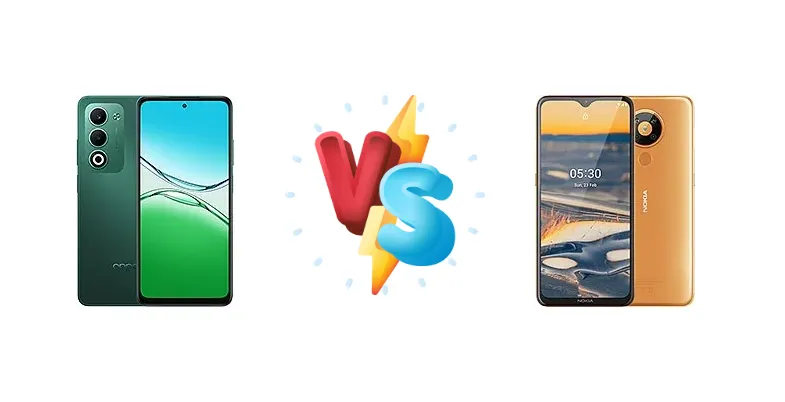
The Oppo A5 4G and Nokia 5.3 represent compelling options in the crowded budget smartphone market. While both aim to deliver essential smartphone functionality at an accessible price point, they diverge significantly in their approach to performance and convenience, particularly regarding charging speed and processing power. This comparison dissects these differences to help you determine which device best suits your needs.
🏆 Quick Verdict
For the average user prioritizing quick top-ups and a more responsive experience, the Oppo A5 4G emerges as the stronger contender. Its 45W charging and more modern Snapdragon 6s Gen1 chipset offer tangible benefits over the Nokia 5.3’s slower 10W charging and older Snapdragon 665, despite the Nokia's potentially cleaner software experience.
| Network |
|---|
| 2G bands | GSM 850 / 900 / 1800 / 1900 | GSM 850 / 900 / 1800 / 1900 |
| 3G bands | HSDPA 800 / 850 / 900 / 1700(AWS) / 1900 / 2100 - version 1 | HSDPA 850 / 900 / 1900 / 2100 - Global |
| 4G bands | 1, 2, 3, 4, 5, 7, 8, 12, 13, 17, 18, 19, 26, 28, 38, 40, 41, 66 - version 1 | 1, 3, 5, 7, 8, 20, 28, 38, 40, 41 - Global |
| Speed | HSPA, LTE | HSPA 42.2/5.76 Mbps, LTE Cat4 150/50 Mbps |
| Technology | GSM / HSPA / LTE | GSM / HSPA / LTE |
| | - | 1, 3, 5, 8, 40, 41 - India |
| Launch |
|---|
| Announced | 2025, May 15 | 2020, March 19. Released 2020, April 02 |
| Status | Available. Released 2025, May 15 | Discontinued |
| Body |
|---|
| Build | - | Glass front (Gorilla Glass 3), plastic back, plastic frame |
| Dimensions | 165.7 x 76.2 x 8 mm (6.52 x 3.00 x 0.31 in) | 164.3 x 76.6 x 8.5 mm (6.47 x 3.02 x 0.33 in) |
| SIM | Nano-SIM + Nano-SIM | · Nano-SIM· Nano-SIM + Nano-SIM |
| Weight | 193 g (6.81 oz) | 185 g (6.53 oz) |
| Display |
|---|
| Protection | Corning Gorilla Glass 7i, Mohs level 4 | Corning Gorilla Glass 3 |
| Resolution | 720 x 1604 pixels, 20:9 ratio (~264 ppi density) | 720 x 1600 pixels, 20:9 ratio (~268 ppi density) |
| Size | 6.67 inches, 107.2 cm2 (~84.9% screen-to-body ratio) | 6.55 inches, 103.6 cm2 (~82.3% screen-to-body ratio) |
| Type | IPS LCD, 90Hz, 1000 nits (HBM) | IPS LCD, 450 nits (typ) |
| Platform |
|---|
| CPU | Octa-core (4x2.1 GHz Cortex-A73 & 4x1.8 GHz Cortex-A53) | Octa-core (4x2.0 GHz Kryo 260 Gold & 4x1.8 GHz Kryo 260 Silver) |
| Chipset | Qualcomm SM-6115 Snapdragon 6s 4G Gen1 (11 nm) | Qualcomm SM6125 Snapdragon 665 (11 nm) |
| GPU | Adreno 610 | Adreno 610 |
| OS | Android 15, ColorOS 15 | Android 10, upgradable to Android 11, Android One |
| Memory |
|---|
| Card slot | microSDXC | microSDXC (dedicated slot) |
| Internal | 128GB 4GB RAM, 128GB 6GB RAM, 128GB 8GB RAM, 256GB 4GB RAM, 256GB 6GB RAM, 256GB 8GB RAM | 64GB 3GB RAM, 64GB 4GB RAM, 64GB 6GB RAM, 128GB 4GB RAM |
| | - | eMMC 5.1 |
| Main Camera |
|---|
| Dual | 50 MP, f/1.8, (wide), PDAF
2 MP, f/2.4, (wide) | - |
| Features | LED flash, HDR, panorama | LED flash, HDR, panorama |
| Quad | - | 13 MP, f/1.8, (wide), PDAF
5 MP, 13mm (ultrawide)
2 MP (macro)
Auxiliary lens |
| Video | 1080p@30fps | 4K@30fps, 1080p@30fps |
| Selfie camera |
|---|
| Features | Panorama | - |
| Single | 5 MP, f/2.2, (wide) | 8 MP, f/2.0, (wide) |
| Video | 1080p@30fps | 1080p@30fps |
| Sound |
|---|
| 3.5mm jack | - | Yes |
| 35mm jack | Yes | Yes |
| Loudspeaker | Yes | Yes |
| Comms |
|---|
| Bluetooth | 5.0, A2DP, LE, aptX | 4.2, A2DP, LE, aptX |
| NFC | Yes, (market/region dependent) | Yes |
| Positioning | GPS, GALILEO, GLONASS, BDS, QZSS | GPS, GLONASS, BDS |
| Radio | Unspecified | FM radio |
| USB | USB Type-C 2.0, OTG | USB Type-C 2.0, OTG |
| WLAN | Wi-Fi 802.11 a/b/g/n/ac, dual-band | Wi-Fi 802.11 b/g/n/ac, Wi-Fi Direct |
| Features |
|---|
| Sensors | Fingerprint (side-mounted), accelerometer, proximity, compass | Fingerprint (rear-mounted), accelerometer, proximity |
| Battery |
|---|
| Charging | 45W wired, 33W PPS, 13.5W PD, 50% in 36 min | 10W wired |
| Type | 6000 mAh | Li-Po 4000 mAh |
| Misc |
|---|
| Colors | Midnight Purple, Aurora Green, Mist White | Cyan, Sand, Charcoal |
| Models | CPH2727 | TA-1234, TA-1223, TA-1227, TA-1229 |
| Price | About 150 EUR | About 290 EUR |
| SAR | - | 1.03 W/kg (head) 0.95 W/kg (body) |
| SAR EU | - | 0.70 W/kg (head) 1.39 W/kg (body) |
| EU LABEL |
|---|
| Battery | 64:03h endurance, 1600 cycles | - |
| Energy | Class A | - |
| Free fall | Class A (270 falls) | - |
| Repairability | Class B | - |
Oppo A5 4G
- Significantly faster 45W charging
- More powerful Snapdragon 6s Gen1 processor
- Potentially better image processing
- Longer battery lifespan (1600 cycles)
- May have a more customized Android skin
- Potentially higher price point
Nokia 5.3
- Cleaner, near-stock Android experience
- Potentially longer battery endurance due to lower power draw
- Generally more affordable
- Simple and straightforward user interface
- Slow 10W charging
- Less powerful Snapdragon 665 processor
- Potentially slower app loading and multitasking
Display Comparison
Neither device boasts a standout display. While specific display specs are not provided, both likely utilize LCD panels common in this price bracket. The focus here isn't on visual fidelity, but on the underlying performance. The Oppo A5 4G's more powerful chipset could contribute to smoother scrolling and animations, even if the panel itself is similar to the Nokia 5.3's.
Camera Comparison
Without detailed camera specifications, a direct comparison is difficult. However, it’s reasonable to assume both phones feature modest camera systems geared towards casual photography. The absence of information regarding sensor size or optical image stabilization suggests neither device will excel in low-light conditions. The focus should be on image processing capabilities, which are tied to the chipset. The Oppo A5 4G’s more powerful Snapdragon 6s Gen1 likely offers more sophisticated image processing algorithms, potentially resulting in slightly better image quality, especially in challenging lighting scenarios. We can assume both phones will include a standard set of camera modes, but don't expect flagship-level performance.
Performance
The Oppo A5 4G’s Qualcomm SM-6115 Snapdragon 6s Gen1 (11 nm) represents a clear advantage over the Nokia 5.3’s Snapdragon 665 (11 nm). The A5 4G’s CPU configuration – octa-core with 4x2.1 GHz Cortex-A73 and 4x1.8 GHz Cortex-A53 cores – offers a performance uplift compared to the Nokia’s 4x2.0 GHz Kryo 260 Gold & 4x1.8 GHz Kryo 260 Silver setup. The Cortex-A73 cores in the Oppo are generally more efficient and powerful than the Kryo 260 Gold cores. This translates to faster app loading times, smoother multitasking, and a more responsive user experience, particularly noticeable when switching between applications. While both are 11nm chips, the architectural improvements in the 6s Gen1 provide a tangible benefit.
Battery Life
The Oppo A5 4G boasts a significant advantage in charging speed with its 45W wired charging, supporting 33W PPS and 13.5W PD, achieving a 50% charge in just 36 minutes. This is a game-changer for users who frequently need to top up their phones quickly. The Nokia 5.3, limited to 10W wired charging, will take considerably longer to reach a full charge. While the Nokia 5.3 may have a comparable or slightly larger battery capacity (not specified), the Oppo A5 4G’s faster charging mitigates the impact of any capacity difference. The Oppo A5 4G also claims 64:03h endurance and 1600 cycles, suggesting a robust battery lifespan.
Buying Guide
Buy the Oppo A5 4G if you need rapid charging, a more powerful processor for multitasking and light gaming, and don't mind a potentially more customized Android experience. Buy the Nokia 5.3 if you prioritize a cleaner, near-stock Android interface, longer battery endurance (due to potentially lower power draw from the less powerful chipset), and are less concerned with charging speed or demanding performance.
Frequently Asked Questions
❓ Will the Oppo A5 4G’s 45W charging damage the battery over time?
While fast charging generates more heat, the Oppo A5 4G incorporates charging management technology to mitigate potential battery degradation. The claimed 1600 charge cycles also suggest a robust battery lifespan, indicating the charging system is designed for longevity. However, consistently using extremely fast charging *can* contribute to faster degradation over several years.
❓ Is the Snapdragon 665 in the Nokia 5.3 still capable of running popular apps like TikTok and Instagram smoothly?
Yes, the Snapdragon 665 is sufficient for running everyday apps like TikTok and Instagram. However, you may experience occasional slowdowns when multitasking or running more demanding applications. The Oppo A5 4G’s Snapdragon 6s Gen1 will provide a noticeably smoother experience in these scenarios.
❓ Does the Nokia 5.3 receive regular software updates?
Nokia is known for providing relatively timely Android updates, even on its budget devices. However, the update schedule may not be as frequent or long-lasting as on more expensive phones. The Oppo A5 4G’s update support will depend on Oppo’s regional policies.
❓ How does the software experience differ between the Oppo A5 4G and Nokia 5.3?
The Nokia 5.3 runs a near-stock version of Android, offering a clean and uncluttered user interface. The Oppo A5 4G utilizes ColorOS, Oppo’s custom Android skin, which includes various features and customizations. ColorOS can be more visually appealing to some, but others may prefer the simplicity of the Nokia’s stock Android experience.