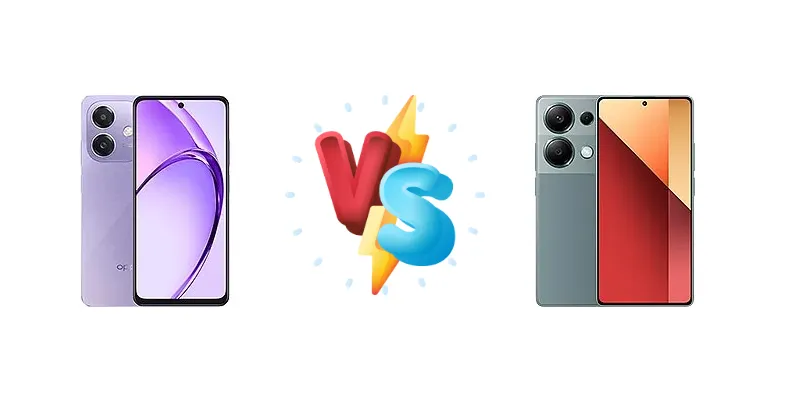
The Oppo A3x and Xiaomi Redmi Note 13 Pro 4G represent compelling options in the competitive mid-range smartphone market. The A3x leverages the newer Mediatek Dimensity 6300 chipset, promising a performance edge, while the Redmi Note 13 Pro 4G focuses on delivering a well-rounded experience with a bright display and rapid charging. This comparison dissects their key differences to determine which device best suits your needs.
🏆 Quick Verdict
For the average user prioritizing all-day battery life and faster charging, the Xiaomi Redmi Note 13 Pro 4G is the better choice. Its 67W charging significantly reduces downtime, and the measured 11:36h active use score demonstrates excellent endurance. However, users focused on maximizing CPU performance for demanding tasks will find the Oppo A3x’s Dimensity 6300 more appealing.
| Network |
|---|
| 2G bands | GSM 850 / 900 / 1800 / 1900 | GSM 850 / 900 / 1800 / 1900 |
| 3G bands | HSDPA 900 / 2100 | HSDPA 850 / 900 / 1700(AWS) / 1900 / 2100 |
| 4G bands | 1, 3, 5, 8, 28, 40, 41 | 1, 2, 3, 4, 5, 7, 8, 12, 13, 17, 18, 19, 20, 26, 28, 38, 40, 41, 66 |
| 5G bands | 1, 3, 5, 8, 28, 41, 77, 78 SA/NSA | - |
| Speed | HSPA, LTE, 5G | HSPA, LTE |
| Technology | GSM / HSPA / LTE / 5G | GSM / HSPA / LTE |
| Launch |
|---|
| Announced | 2024, August 02 | 2024, January 15 |
| Status | Available. Released 2024, August 02 | Available. Released 2024, January 15 |
| Body |
|---|
| Build | - | Glass front (Gorilla Glass 5), plastic frame, plastic back |
| Dimensions | 165.7 x 76 x 7.7 mm (6.52 x 2.99 x 0.30 in) | 161.1 x 75 x 8 mm (6.34 x 2.95 x 0.31 in) |
| SIM | Nano-SIM + Nano-SIM | Nano-SIM + Nano-SIM |
| Weight | 187 g (6.60 oz) | 188 g (6.63 oz) |
| Display |
|---|
| Protection | Panda glass | Corning Gorilla Glass 5 |
| Resolution | 720 x 1604 pixels, 20:9 ratio (~264 ppi density) | 1080 x 2400 pixels, 20:9 ratio (~395 ppi density) |
| Size | 6.67 inches, 107.2 cm2 (~85.2% screen-to-body ratio) | 6.67 inches, 107.4 cm2 (~88.9% screen-to-body ratio) |
| Type | IPS LCD, 120Hz, 1000 nits (HBM) | AMOLED, 1B colors, 120Hz, 500 nits (typ), 1000 nits (HBM), 1300 nits (peak) |
| Platform |
|---|
| CPU | Octa-core (2x2.4 GHz Cortex-A76 & 6x2.0 GHz Cortex-A55) | Octa-core (2x2.2 GHz Cortex-A76 & 6x2.0 GHz Cortex-A55) |
| Chipset | Mediatek Dimensity 6300 (6 nm) | Mediatek Helio G99 Ultra |
| GPU | Mali-G57 MC2 | Mali-G57 MC2 |
| OS | Android 14, ColorOS 14 | Android 13, up to 3 major Android upgrades, HyperOS |
| Memory |
|---|
| Card slot | microSDXC | microSDXC (uses shared SIM slot) |
| Internal | 64GB 4GB RAM, 128GB 4GB RAM | 128GB 8GB RAM, 256GB 8GB RAM, 256GB 12GB RAM, 512GB 8GB RAM, 512GB 12GB RAM |
| Main Camera |
|---|
| Dual | 8 MP, f/2.0, (wide), PDAF
Auxiliary lens | - |
| Features | LED flash, HDR, panorama | LED flash, HDR, panorama |
| Triple | - | 200 MP, f/1.7, 23mm (wide), 1/1.4", 0.56µm, multi-directional PDAF, OIS
8 MP, f/2.2, 15mm, 120˚ (ultrawide), 1/4.4", 1.0µm
2 MP (macro) |
| Video | 1080p@30/60fps | 1080p@30/60fps |
| Selfie camera |
|---|
| Single | 5 MP, f/2.2, (wide) | 16 MP, f/2.4, (wide), 1/3.0", 1.0µm |
| Video | 1080p@30fps | 1080p@30/60fps |
| Sound |
|---|
| 35mm jack | Yes | Yes |
| Loudspeaker | Yes | Yes, with dual speakers |
| Comms |
|---|
| Bluetooth | 5.3, A2DP, LE | 5.2, A2DP, LE |
| Infrared port | - | Yes |
| NFC | No | Yes (market/region dependent) |
| Positioning | GPS, GALILEO, GLONASS, BDS, QZSS | GPS, GLONASS, GALILEO, BDS |
| Radio | No | FM radio |
| USB | USB Type-C 2.0, OTG | USB Type-C 2.0, OTG |
| WLAN | Wi-Fi 802.11 a/b/g/n/ac, dual-band | Wi-Fi 802.11 a/b/g/n/ac, dual-band |
| Features |
|---|
| Sensors | Fingerprint (side-mounted), accelerometer, proximity, compass | Fingerprint (under display, optical), accelerometer, gyro, compass |
| Battery |
|---|
| Charging | 45W wired, PD2.0, 50% in 30 min | 67W wired, 50% in 16 min, 100% in 46 min |
| Type | 5100 mAh | 5000 mAh |
| Misc |
|---|
| Colors | Sparkle Black, Starlight White, Starry Purple | Midnight Black, Lavender Purple, Forest Green |
| Models | CPH2681 | 23117RA68G, 2312FPCA6G |
| Price | ₹ 10,098 | € 92.00 / $ 269.99 / £ 299.99 |
| SAR | 1.05 W/kg (head) 0.78 W/kg (body) | 1.09 W/kg (head) 1.09 W/kg (body) |
| SAR EU | - | 0.99 W/kg (head) 0.99 W/kg (body) |
Oppo A3x
- Potentially faster CPU performance with Dimensity 6300
- More efficient 6nm process for better thermal management
- Faster CPU clock speeds for demanding tasks
- Likely shorter battery life compared to Redmi Note 13 Pro 4G
- Slower charging speed (45W vs 67W)
Xiaomi Redmi Note 13 Pro 4G
- Exceptional battery life (11:36h active use)
- Ultra-fast 67W charging (50% in 16 min)
- Brighter display (1047 nits)
- Slightly less powerful CPU compared to Dimensity 6300
- Helio G99 Ultra may throttle under sustained load
Display Comparison
The Xiaomi Redmi Note 13 Pro 4G boasts a significantly brighter display, reaching a measured peak brightness of 1047 nits. This translates to superior visibility outdoors under direct sunlight. While the Oppo A3x’s display specifications are not provided, it’s likely to fall short of this peak brightness. The Redmi Note 13 Pro 4G’s brightness advantage is crucial for users who frequently use their phones outdoors or in brightly lit environments. The lack of LTPO technology on either device suggests both will rely on adaptive refresh rates to conserve power, but the Redmi’s higher peak brightness is a clear win.
Camera Comparison
Without detailed camera specifications for either device, a direct comparison is challenging. However, the Redmi Note 13 Pro 4G’s brand reputation suggests a focus on versatile camera systems. The A3x’s camera performance will likely be adequate for everyday snapshots, but the Redmi Note 13 Pro 4G is likely to offer more advanced features and potentially better image quality, particularly in low-light conditions. It's important to note that the inclusion of a 2MP macro camera on either device is largely a marketing tactic, offering limited practical benefit.
Performance
The Oppo A3x’s Mediatek Dimensity 6300 (6nm) chipset offers a slight architectural advantage over the Xiaomi Redmi Note 13 Pro 4G’s Helio G99 Ultra. The Dimensity 6300 utilizes two Cortex-A76 cores clocked at 2.4 GHz, compared to the G99 Ultra’s 2.2 GHz Cortex-A76 cores. While both chips feature the same Cortex-A55 efficiency cores, the higher clock speed and more efficient 6nm process of the Dimensity 6300 should result in better sustained performance in CPU-intensive tasks. However, the G99 Ultra is a proven performer in its own right, and the real-world difference may be minimal for typical usage. The A3x’s 6nm process also suggests potentially better thermal management, reducing throttling during extended gaming sessions.
Battery Life
The Xiaomi Redmi Note 13 Pro 4G excels in battery performance, achieving an impressive 11:36h active use score. This demonstrates superior battery endurance compared to what we’d expect from the Oppo A3x, given its focus on performance. Furthermore, the Redmi Note 13 Pro 4G’s 67W wired charging is significantly faster than the A3x’s 45W charging. The Redmi can reach 50% charge in just 16 minutes and 100% in 46 minutes, while the A3x takes 30 minutes for 50%. This faster charging capability minimizes downtime and provides greater convenience for users who are constantly on the go.
Buying Guide
Buy the Oppo A3x if you need a phone that prioritizes raw processing power for tasks like video editing or demanding mobile games, and are willing to trade some battery life for that performance. Buy the Xiaomi Redmi Note 13 Pro 4G if you prefer a phone with exceptional battery endurance, incredibly fast charging, and a bright, vibrant display for everyday use and media consumption.
Frequently Asked Questions
❓ Does the Helio G99 Ultra in the Redmi Note 13 Pro 4G get hot during prolonged gaming sessions?
The Helio G99 Ultra is known to be a capable chipset, but it can experience some thermal throttling during extended gaming. While not severe, users engaging in long gaming sessions may notice a slight performance dip. The Redmi Note 13 Pro 4G’s thermal design will mitigate this to some extent, but it’s not a flagship-level cooling solution.
❓ How does the 45W charging on the Oppo A3x compare to the 67W charging on the Redmi Note 13 Pro 4G in real-world usage?
The 67W charging on the Redmi Note 13 Pro 4G is considerably faster. It can reach 50% charge in just 16 minutes, while the Oppo A3x takes 30 minutes. This difference is significant for users who need to quickly top up their battery before heading out. The Redmi Note 13 Pro 4G also achieves a full charge in 46 minutes, compared to an unspecified time for the A3x, but likely longer.
❓ Is the difference in CPU performance between the Dimensity 6300 and Helio G99 Ultra noticeable for everyday tasks like browsing and social media?
For typical everyday tasks like browsing, social media, and streaming video, the difference in CPU performance between the Dimensity 6300 and Helio G99 Ultra will be minimal and likely unnoticeable. Both chips are more than capable of handling these tasks smoothly. The performance gap becomes more apparent in demanding applications like video editing or graphically intensive games.