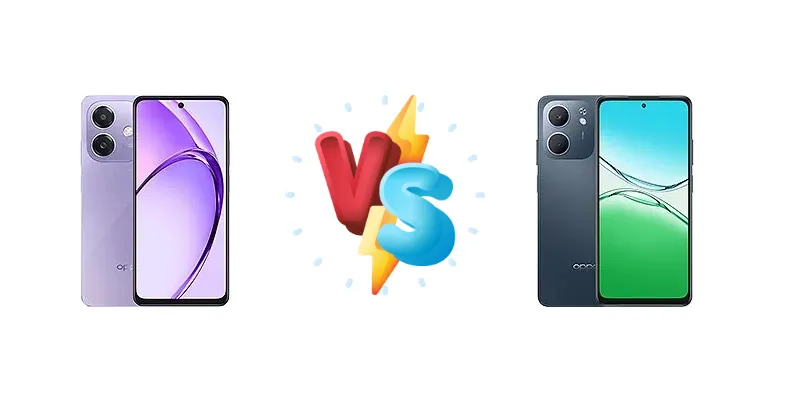
Oppo's A-series consistently delivers compelling value in the mid-range segment. The A3x and A5x both center around the Mediatek Dimensity 6300 chipset, promising strong performance. However, subtle differences in charging technology and implementation dictate which device caters to specific user needs. This comparison dissects those nuances to help you choose.
🏆 Quick Verdict
For the average user, the Oppo A5x emerges as the slightly better choice. While both phones offer identical processing power thanks to the Dimensity 6300, the A5x’s inclusion of 33W PPS charging alongside PD2.0 provides a more versatile and potentially faster charging experience, especially with compatible chargers.
| Network |
|---|
| 2G bands | GSM 850 / 900 / 1800 / 1900 | GSM 850 / 900 / 1800 / 1900 |
| 3G bands | HSDPA 900 / 2100 | HSDPA 850 / 900 / 2100 |
| 4G bands | 1, 3, 5, 8, 28, 40, 41 | LTE |
| 5G bands | 1, 3, 5, 8, 28, 41, 77, 78 SA/NSA | SA/NSA |
| Speed | HSPA, LTE, 5G | HSPA, LTE, 5G |
| Technology | GSM / HSPA / LTE / 5G | GSM / HSPA / LTE / 5G |
| Launch |
|---|
| Announced | 2024, August 02 | 2025, May 23 |
| Status | Available. Released 2024, August 02 | Available. Released 2025, May 25 |
| Body |
|---|
| Dimensions | 165.7 x 76 x 7.7 mm (6.52 x 2.99 x 0.30 in) | 165.7 x 76.2 x 8 mm (6.52 x 3.00 x 0.31 in) |
| SIM | Nano-SIM + Nano-SIM | Nano-SIM + Nano-SIM |
| Weight | 187 g (6.60 oz) | 193 g (6.81 oz) |
| Display |
|---|
| Protection | Panda glass | Unspecified |
| Resolution | 720 x 1604 pixels, 20:9 ratio (~264 ppi density) | 720 x 1604 pixels, 20:9 ratio (~264 ppi density) |
| Size | 6.67 inches, 107.2 cm2 (~85.2% screen-to-body ratio) | 6.67 inches, 107.2 cm2 (~84.9% screen-to-body ratio) |
| Type | IPS LCD, 120Hz, 1000 nits (HBM) | IPS LCD, 120Hz, 1000 nits (HBM) |
| Platform |
|---|
| CPU | Octa-core (2x2.4 GHz Cortex-A76 & 6x2.0 GHz Cortex-A55) | Octa-core (2x2.4 GHz Cortex-A76 & 6x2.0 GHz Cortex-A55) |
| Chipset | Mediatek Dimensity 6300 (6 nm) | Mediatek Dimensity 6300 (6 nm) |
| GPU | Mali-G57 MC2 | Mali-G57 MC2 |
| OS | Android 14, ColorOS 14 | Android 15, ColorOS 15 |
| Memory |
|---|
| Card slot | microSDXC | microSDXC |
| Internal | 64GB 4GB RAM, 128GB 4GB RAM | 64GB 4GB RAM, 128GB 4GB RAM, 128GB 6GB RAM |
| Main Camera |
|---|
| Dual | 8 MP, f/2.0, (wide), PDAF
Auxiliary lens | - |
| Features | LED flash, HDR, panorama | LED flash, HDR, panorama |
| Single | - | 32 MP, f/1.9, (wide), AF |
| Video | 1080p@30/60fps | Yes |
| Selfie camera |
|---|
| Single | 5 MP, f/2.2, (wide) | 5 MP, f/2.2, (wide) |
| Video | 1080p@30fps | Yes |
| Sound |
|---|
| 35mm jack | Yes | Yes |
| Loudspeaker | Yes | Yes |
| Comms |
|---|
| Bluetooth | 5.3, A2DP, LE | 5.1, A2DP, LE |
| NFC | No | No |
| Positioning | GPS, GALILEO, GLONASS, BDS, QZSS | GPS, GALILEO, GLONASS, BDS, QZSS |
| Radio | No | Unspecified |
| USB | USB Type-C 2.0, OTG | USB Type-C 2.0, OTG |
| WLAN | Wi-Fi 802.11 a/b/g/n/ac, dual-band | Wi-Fi 802.11 a/b/g/n/ac, dual-band |
| Features |
|---|
| Sensors | Fingerprint (side-mounted), accelerometer, proximity, compass | Fingerprint (side-mounted), accelerometer, proximity, compass |
| Battery |
|---|
| Charging | 45W wired, PD2.0, 50% in 30 min | 45W wired, 33W PPS, 13.5W PD, 50% in 37 min |
| Type | 5100 mAh | 6000 mAh |
| Misc |
|---|
| Colors | Sparkle Black, Starlight White, Starry Purple | Tranquil Lake Green, Laser White |
| Models | CPH2681 | - |
| Price | ₹ 10,098 | ₹ 11,499 |
| SAR | 1.05 W/kg (head) 0.78 W/kg (body) | - |
Oppo A3x
- Fast 45W PD2.0 charging
- Efficient Dimensity 6300 chipset
- Likely competitive pricing
- Lacks PPS charging versatility
- Camera likely average for the segment
Oppo A5x
- Versatile charging with 45W, 33W PPS, and 13.5W PD
- Efficient Dimensity 6300 chipset
- Wider charger compatibility
- Slightly slower 50% charge time (37 mins vs 30 mins)
- Camera likely average for the segment
Display Comparison
Both the Oppo A3x and A5x are expected to feature similar LCD panels, typical for this price bracket. While specific details like peak brightness and color gamut coverage are currently unavailable, the focus here isn't on display prowess. Bezels are likely to be comparable, and neither device is expected to feature high refresh rate panels. The display experience will likely be functional and adequate, but not a standout feature.
Camera Comparison
Without detailed camera specifications, it's difficult to draw definitive conclusions. However, given the A-series positioning, both phones likely feature a primary camera around the 50MP mark, accompanied by depth and macro sensors (the utility of the latter is questionable). Image processing will likely lean towards Oppo’s signature vibrant style. The absence of Optical Image Stabilization (OIS) is probable, meaning low-light performance will rely heavily on software algorithms. Differences in camera performance will likely stem from software tuning rather than hardware.
Performance
The core of both devices is the Mediatek Dimensity 6300 (6nm). This octa-core processor, featuring 2x 2.4 GHz Cortex-A76 and 6x 2.0 GHz Cortex-A55 cores, delivers consistent performance for daily tasks, social media, and moderate gaming. The 6nm process node ensures reasonable thermal efficiency. Since both phones share the same chipset and likely similar RAM configurations (LPDDR4X is probable), performance differences will be negligible in most real-world scenarios. Thermal throttling, if any, will be similar on both devices.
Battery Life
Both devices support 45W wired charging, but the A5x adds 33W PPS (Programmable Power Supply) alongside 13.5W PD. While the A3x achieves 50% charge in 30 minutes, the A5x takes 37 minutes. However, PPS allows for more dynamic voltage and current adjustments, potentially leading to faster and more efficient charging with compatible chargers. The A5x’s inclusion of PPS provides broader compatibility and optimized charging with a wider range of power adapters, making it more versatile for users who switch between chargers frequently.
Buying Guide
Buy the Oppo A3x if you prioritize a straightforward, fast-charging experience and are confident your chargers support PD2.0. It’s a solid all-rounder for everyday tasks. Buy the Oppo A5x if you frequently use multiple chargers, travel often, or want the flexibility of PPS charging for potentially faster and more efficient power delivery with compatible adapters. It’s the better option for power users.
Frequently Asked Questions
❓ What is PPS charging and why is it beneficial on the Oppo A5x?
PPS (Programmable Power Supply) is a charging standard that allows for more dynamic voltage and current adjustments during charging. This results in potentially faster and more efficient charging, especially when paired with a compatible charger. The A5x’s support for PPS alongside PD2.0 provides greater flexibility and optimized charging with a wider range of power adapters.
❓ Will I notice a performance difference between the Oppo A3x and A5x during gaming?
No, you likely won't notice a significant performance difference during gaming. Both phones utilize the same Mediatek Dimensity 6300 chipset and likely have similar RAM configurations. Gaming performance will be largely identical, limited by the chipset's capabilities and thermal management.
❓ Does the Oppo A3x or A5x support 5G connectivity?
While the Dimensity 6300 supports 5G, the specific 5G band support on the A3x and A5x will depend on the regional variants. Check the official specifications for your region to confirm 5G compatibility.
❓ Is the 45W charging on both phones equally fast with any USB-C charger?
Not necessarily. The Oppo A3x utilizes PD2.0, while the A5x supports both PD2.0 and PPS. To achieve the full 45W charging speed, you'll need a compatible charger that supports the appropriate Power Delivery protocol. The A5x offers more flexibility with its PPS support.