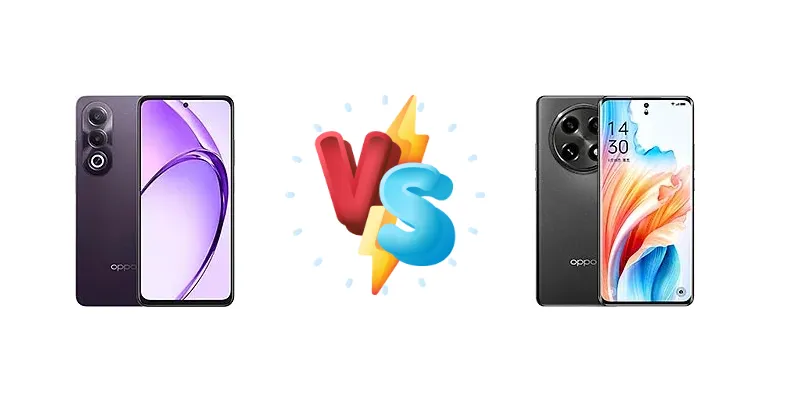
Oppo's A-series consistently delivers compelling value, but the A3x (China variant) and A2 Pro present a nuanced choice. The A3x focuses on providing a solid foundation with the Dimensity 6300, while the A2 Pro steps up with the more powerful Dimensity 7050 and faster charging. This comparison dissects the key differences to determine which device best suits your needs.
🏆 Quick Verdict
For most users, the Oppo A2 Pro is the superior choice. Its Dimensity 7050 chipset offers a noticeable performance boost over the A3x’s Dimensity 6300, and the significantly faster 67W charging dramatically improves usability. While the A3x remains a capable device, the A2 Pro’s enhancements justify the price difference.
| Network |
|---|
| 2G bands | GSM 850 / 900 / 1800 / 1900 | GSM 850 / 900 / 1800 / 1900 |
| 3G bands | HSDPA 850 / 900 / 2100 | HSDPA 850 / 900 / 2100 |
| 4G bands | 1, 3, 5, 8, 28, 34, 38, 39, 40, 41 | 1, 3, 5, 8, 28, 34, 38, 39, 40, 41 |
| 5G bands | 1, 5, 8, 28, 41, 77, 78 SA/NSA | 1, 5, 8, 28, 41, 77, 78 SA/NSA |
| Speed | HSPA, LTE, 5G | HSPA, LTE, 5G |
| Technology | GSM / CDMA / HSPA / CDMA2000 / LTE / 5G | GSM / CDMA / HSPA / CDMA2000 / LTE / 5G |
| Launch |
|---|
| Announced | 2024, July 27 | 2023, September 15 |
| Status | Available. Released 2024, August | Available. Released 2023, September 22 |
| Body |
|---|
| Dimensions | 165.7 x 76 x 7.7 mm (6.52 x 2.99 x 0.30 in) | 162.7 x 74.3 x 8 mm (6.41 x 2.93 x 0.31 in) |
| SIM | Nano-SIM + Nano-SIM | Nano-SIM + Nano-SIM |
| Weight | 186 g (6.56 oz) | 183 g or 185 g (6.46 oz) |
| Display |
|---|
| Resolution | 720 x 1604 pixels, 20:9 ratio (~264 ppi density) | 1080 x 2412 pixels, 20:9 ratio (~394 ppi density) |
| Size | 6.67 inches, 107.2 cm2 (~85.2% screen-to-body ratio) | 6.7 inches, 108.0 cm2 (~89.4% screen-to-body ratio) |
| Type | IPS LCD, 120Hz, 1000 nits (HBM) | AMOLED, 1B colors, 120Hz, 500 nits (typ), 800 nits (HBM), 950 nits (peak) |
| Platform |
|---|
| CPU | Octa-core (2x2.4 GHz Cortex-A76 & 6x2.0 GHz Cortex-A55) | Octa-core (2x2.6 GHz Cortex-A78 & 6x2.0 GHz Cortex-A55) |
| Chipset | Mediatek Dimensity 6300 (6 nm) | Mediatek Dimensity 7050 (6 nm) |
| GPU | Mali-G57 MC2 | Mali-G68 MC4 |
| OS | Android 14, ColorOS 14 | Android 13, ColorOS 13.1 |
| Memory |
|---|
| Card slot | microSDXC | No |
| Internal | 128GB 4GB RAM, 128GB 6GB RAM, 256GB 8GB RAM, 512GB 8GB RAM | 256GB 8GB RAM, 256GB 12GB RAM, 512GB 12GB RAM |
| Main Camera |
|---|
| Dual | 32 MP, f/1.8, (wide), PDAF
Auxiliary lens | 64 MP, f/1.7, 25mm (wide), 1/2.0", 0.7µm, PDAF
Auxiliary lens |
| Features | LED flash, HDR, panorama | LED flash, HDR, panorama |
| Video | 1080p@30/60fps | 4K@30fps, 1080p@30/60/120fps, gyro-EIS |
| Selfie camera |
|---|
| Single | 8 MP, f/2.0, (wide) | 8 MP, f/2.0, (wide) |
| Video | 1080p@30fps | 1080p@30fps |
| Sound |
|---|
| 35mm jack | Yes | No |
| Loudspeaker | Yes | Yes |
| Comms |
|---|
| Bluetooth | 5.3, A2DP, LE, aptX HD | 5.3, A2DP, LE, aptX HD |
| Infrared port | - | Yes |
| NFC | No | Unspecified |
| Positioning | GPS, GALILEO, GLONASS, BDS, QZSS | GPS, GLONASS, GALILEO, BDS, QZSS |
| Radio | No | No |
| USB | USB Type-C 2.0, OTG | USB Type-C 2.0, OTG |
| WLAN | Wi-Fi 802.11 a/b/g/n/ac, dual-band | Wi-Fi 802.11 a/b/g/n/ac/6, dual-band |
| Features |
|---|
| Sensors | Fingerprint (side-mounted), accelerometer, proximity, compass | Fingerprint (under display, optical), accelerometer, gyro, proximity, compass |
| Battery |
|---|
| Charging | 45W wired, PD, 50% in 30 min | 67W wired, PD, 54% in 20 min
Reverse wired |
| Type | 5100 mAh | Li-Po 5000 mAh |
| Misc |
|---|
| Colors | Black, Purple, White | Black, Purple, Brown |
| Models | PKD130 | PJG110 |
| Price | About 150 EUR | About 240 EUR |
Oppo A3x (China)
- Lower price point
- Capable for everyday tasks
- Decent performance for the price
- Slower charging speed
- Less powerful chipset
- Potentially limited software support
Oppo A2 Pro
- Faster Dimensity 7050 chipset
- Significantly faster 67W charging
- Reverse wired charging support
- Higher price
- May not offer a dramatically different camera experience
Display Comparison
Both devices are expected to feature LCD panels, typical for this price segment. However, specific details like resolution and refresh rate are missing. The focus here is on the internal hardware. While neither is expected to compete with flagship OLED displays, the real-world impact will be minimal for average users. Bezels are likely similar, and color accuracy will depend on Oppo’s software calibration.
Camera Comparison
Without detailed camera specifications, a direct comparison is difficult. However, Oppo generally focuses on software optimization. The A2 Pro’s more powerful chipset will likely enable faster image processing and potentially better low-light performance. The absence of information regarding sensor sizes and OIS makes it impossible to definitively declare a winner. It’s reasonable to assume both phones will feature a standard multi-camera setup, but the A2 Pro’s processing capabilities give it an edge.
Performance
The core difference lies in the chipsets. The Oppo A2 Pro’s Mediatek Dimensity 7050, with its 2x2.6 GHz Cortex-A78 cores, represents a clear upgrade over the A3x’s Dimensity 6300 and its 2x2.4 GHz Cortex-A76 cores. The A78 cores in the 7050 offer improved single-core performance, translating to snappier app launches and smoother multitasking. While both chips are built on a 6nm process, the architectural improvements in the 7050 provide a tangible advantage. The A2 Pro will handle graphically intensive games and demanding applications with greater ease. Both share 6x2.0 GHz Cortex-A55 efficiency cores, meaning power consumption during light tasks should be comparable.
Battery Life
The A2 Pro’s 67W wired charging is a significant advantage, achieving 54% charge in just 20 minutes. This is substantially faster than the A3x’s 45W charging, which takes 30 minutes to reach 50%. While battery capacity isn’t specified, the faster charging speed of the A2 Pro mitigates any potential disadvantage from a slightly smaller battery. The A2 Pro also supports reverse wired charging, a feature absent on the A3x, adding to its versatility.
Buying Guide
Buy the Oppo A3x (China) if you prioritize a lower price point and are comfortable with potentially limited software updates and availability outside of China. It’s a good option for everyday tasks and light gaming. Buy the Oppo A2 Pro if you value faster performance for gaming and demanding apps, and appreciate the convenience of significantly quicker 67W charging, along with the potential for broader software support and availability.
Frequently Asked Questions
❓ Is the Dimensity 7050 in the Oppo A2 Pro powerful enough for demanding games like Genshin Impact?
Yes, the Dimensity 7050 is a capable chipset for Genshin Impact and similar titles. While you may need to adjust graphics settings for optimal frame rates, it offers a significant performance improvement over the Dimensity 6300 in the A3x, allowing for a smoother gaming experience.
❓ How much faster is the 67W charging on the Oppo A2 Pro compared to the 45W charging on the A3x in real-world use?
The A2 Pro’s 67W charging can add approximately 54% charge in 20 minutes, while the A3x takes 30 minutes to reach 50%. This translates to a noticeably quicker top-up, especially useful for users who frequently need to recharge their phones throughout the day. The A2 Pro’s faster charging significantly reduces downtime.
❓ Will the Oppo A2 Pro receive more software updates than the Oppo A3x?
Generally, devices with newer and more powerful chipsets receive longer software support. The A2 Pro, with its Dimensity 7050, is likely to receive more Android version updates and security patches compared to the A3x and its Dimensity 6300. However, Oppo’s specific update policy should be consulted for confirmation.