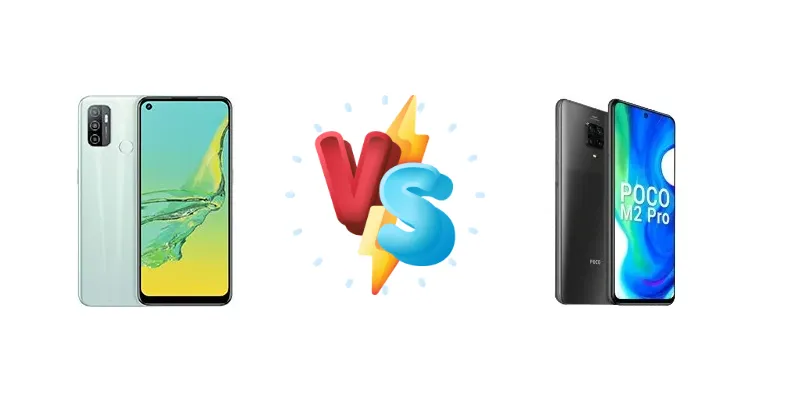
The Xiaomi Poco M2 Pro and Oppo A33 (2020) represent distinct approaches to the budget smartphone market. The Poco M2 Pro, with its Snapdragon 720G, aims for a balance of performance and features, while the Oppo A33 focuses on affordability with the Snapdragon 460. This comparison dissects their key differences to help you choose the best fit.
🏆 Quick Verdict
For most users, the Xiaomi Poco M2 Pro is the superior choice. Its Snapdragon 720G chipset, built on an 8nm process, delivers significantly better performance and gaming capabilities than the Oppo A33’s Snapdragon 460. The 33W fast charging is a substantial advantage, offsetting the slightly higher price.
| Network |
|---|
| 2G bands | GSM 850 / 900 / 1800 / 1900 | GSM 850 / 900 / 1800 / 1900 |
| 3G bands | HSDPA 850 / 900 / 2100 | HSDPA 850 / 900 / 1700(AWS) / 1900 / 2100 |
| 4G bands | 1, 3, 5, 7, 8, 38, 40, 41 | 1, 3, 5, 8, 40, 41 |
| Speed | HSPA, LTE | HSPA, LTE |
| Technology | GSM / HSPA / LTE | GSM / HSPA / LTE |
| Launch |
|---|
| Announced | 2020, September 28. Released 2020, October 01 | 2020, July 07. Released 2020, July 14 |
| Status | Discontinued | Discontinued |
| Body |
|---|
| Build | - | Glass front (Gorilla Glass 5), glass back (Gorilla Glass 5), plastic frame |
| Dimensions | 163.9 x 75.1 x 8.4 mm (6.45 x 2.96 x 0.33 in) | 165.8 x 76.7 x 8.8 mm (6.53 x 3.02 x 0.35 in) |
| SIM | Nano-SIM + Nano-SIM | Nano-SIM + Nano-SIM |
| Weight | 186 g (6.56 oz) | 209 g (7.37 oz) |
| | - | Water-repellent coating |
| Display |
|---|
| Protection | Corning Gorilla Glass 3 | Corning Gorilla Glass 5 |
| Resolution | 720 x 1600 pixels, 20:9 ratio (~269 ppi density) | 1080 x 2400 pixels, 20:9 ratio (~395 ppi density) |
| Size | 6.5 inches, 102.8 cm2 (~83.5% screen-to-body ratio) | 6.67 inches, 107.4 cm2 (~84.5% screen-to-body ratio) |
| Type | IPS LCD, 90Hz | IPS LCD, HDR10, 450 nits (typ) |
| Platform |
|---|
| CPU | Octa-core (4x1.8 GHz Kryo 240 & 4x1.6 GHz Kryo 240) | Octa-core (2x2.3 GHz Kryo 465 Gold & 6x1.8 GHz Kryo 465 Silver) |
| Chipset | Qualcomm SM4250 Snapdragon 460 (11 nm) | Qualcomm SM7125 Snapdragon 720G (8 nm) |
| GPU | Adreno 610 | Adreno 618 |
| OS | Android 10, ColorOS 7.2 | Android 10, MIUI 12 |
| Memory |
|---|
| Card slot | microSDXC (dedicated slot) | microSDXC (dedicated slot) |
| Internal | 32GB 3GB RAM, 32GB 4GB RAM | 64GB 4GB RAM, 64GB 6GB RAM, 128GB 6GB RAM |
| | UFS 2.1 gear 3 (one-lane) | UFS 2.1 |
| Main Camera |
|---|
| Features | LED flash, HDR, panorama | LED flash, HDR, panorama |
| Quad | - | 48 MP, f/1.8, 26mm (wide), 1/2.0", 0.8µm, PDAF
8 MP, f/2.2, 119˚ (ultrawide), 1/4.0", 1.12µm
5 MP (macro), AF
Auxiliary lens |
| Triple | 13 MP, f/2.2, 25mm (wide), 1/3.06", 1.12µm, PDAF
2 MP (macro)
Auxiliary lens | - |
| Video | 1080p@30fps | 4K@30fps, 1080p@30/60/120fps, 720p@960fps, gyro-EIS |
| Selfie camera |
|---|
| Features | HDR | HDR, panorama |
| Single | 8 MP, f/2.0, (wide) | 16 MP, f/2.5, (wide), 1/3.06" 1.0µm |
| Video | 1080p@30fps | 1080p@30/120fps |
| Sound |
|---|
| 3.5mm jack | Yes | Yes |
| 35mm jack | Yes | Yes |
| Loudspeaker | Yes, with stereo speakers | Yes |
| Comms |
|---|
| Bluetooth | 5.0, A2DP, LE, aptX HD | 5.0, A2DP, LE |
| Infrared port | - | Yes |
| NFC | No | No |
| Positioning | GPS, GLONASS, GALILEO, BDS | GPS, GLONASS, GALILEO, BDS |
| Radio | No | FM radio, recording |
| USB | USB Type-C 2.0, OTG | USB Type-C 2.0, OTG |
| WLAN | Wi-Fi 802.11 a/b/g/n/ac, dual-band, Wi-Fi Direct | Wi-Fi 802.11 a/b/g/n/ac, dual-band, Wi-Fi Direct |
| Features |
|---|
| Sensors | Fingerprint (rear-mounted), accelerometer, proximity, compass | Fingerprint (side-mounted), accelerometer, gyro, proximity, compass |
| Battery |
|---|
| Charging | 18W wired | 33W wired |
| Type | Li-Po 5000 mAh | Li-Po 5000 mAh |
| Misc |
|---|
| Colors | Moonlight Black, Mint Cream | Out Of The Blue, Green and Greener, Two Shades of Black |
| Models | CPH2137 | - |
| Price | About 130 EUR | About 170 EUR |
| SAR EU | - | 0.91 W/kg (head) 0.56 W/kg (body) |
| Pricing |
|---|
| 128GB 6GB RAM | - | ₹ 16,999 |
| 64GB 6GB RAM | - | ₹ 9,999 |
Oppo A33 (2020)
- More affordable price point
- Sufficient for basic smartphone tasks
- Potentially longer software support (Oppo's ColorOS)
- Significantly weaker performance
- Slower charging speed
- Less future-proof
Xiaomi Poco M2 Pro
- Superior performance with Snapdragon 720G
- Faster 33W wired charging
- Better gaming capabilities
- Slightly higher price
- MIUI can be resource intensive
- Potential for more bloatware
Display Comparison
Neither device boasts a standout display. While specific display specs (resolution, panel type) are missing for the Oppo A33, its market positioning suggests an LCD panel. The Poco M2 Pro’s display is likely a standard FHD+ LCD. The key difference lies in processing power impacting UI smoothness. The Snapdragon 720G will provide a more responsive experience when navigating the interface and scrolling through content, even on a similar panel.
Camera Comparison
Without detailed camera specs for the Oppo A33, a direct comparison is limited. However, the Poco M2 Pro’s camera system is likely to be more versatile. While both phones likely feature a primary camera, the Poco M2 Pro benefits from the image signal processor (ISP) within the Snapdragon 720G, offering better image processing capabilities, dynamic range, and low-light performance. The inclusion of a dedicated ISP is a major advantage, even if the sensor sizes are similar.
Performance
The core difference between these phones is the chipset. The Xiaomi Poco M2 Pro’s Snapdragon 720G (8nm) is a significant upgrade over the Oppo A33’s Snapdragon 460 (11nm). The 720G features a Kryo 465 Gold/Silver core configuration (2x2.3 GHz & 6x1.8 GHz) compared to the 460’s Kryo 240 configuration (4x1.8 GHz & 4x1.6 GHz). This translates to roughly 30-40% faster CPU performance and a more capable Adreno 618 GPU in the Poco M2 Pro, making it suitable for moderate gaming. The 8nm process of the 720G also contributes to better thermal efficiency, reducing throttling during sustained workloads.
Battery Life
The Poco M2 Pro’s 33W wired charging is a game-changer. While battery capacity isn’t specified for the Oppo A33, it’s unlikely to match the charging speed of the Poco. 33W charging can replenish a battery from 0-100% in approximately 60-75 minutes, while the Oppo A33’s 18W charging will take considerably longer. This faster charging is particularly beneficial for users who frequently use their phones throughout the day.
Buying Guide
Buy the Oppo A33 (2020) if you prioritize absolute affordability and basic smartphone functionality – calls, texts, and light social media use. You’re willing to compromise on performance and future-proofing. Buy the Xiaomi Poco M2 Pro if you want a smoother user experience, better gaming performance, faster charging, and a phone that will remain usable for longer, even if it means spending a bit more upfront.
Frequently Asked Questions
❓ Will the Poco M2 Pro handle demanding games like PUBG Mobile smoothly?
Yes, the Snapdragon 720G in the Poco M2 Pro is capable of running PUBG Mobile at medium to high settings with stable frame rates. While it won't deliver the absolute highest performance, it provides a significantly better gaming experience than the Oppo A33's Snapdragon 460.
❓ Is the difference in charging speed between 18W and 33W really noticeable in everyday use?
Absolutely. The 33W charging on the Poco M2 Pro can add several hours of usage in just 30 minutes of charging, whereas the Oppo A33’s 18W charging will take much longer to achieve the same level of charge. This is a significant convenience factor for users who are constantly on the go.
❓ Does the Poco M2 Pro's MIUI software have a lot of bloatware?
MIUI is known for including pre-installed apps (bloatware). However, many of these can be uninstalled or disabled. While it's a valid concern, the performance benefits of the Snapdragon 720G outweigh the minor inconvenience of dealing with some pre-installed apps.