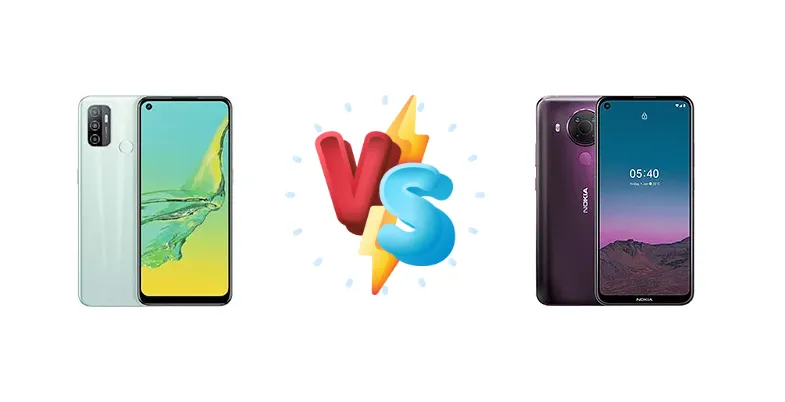
The Oppo A33 (2020) and Nokia 5.4 represent two compelling options in the crowded budget smartphone market. While both aim to deliver a functional Android experience without breaking the bank, they differ significantly in their underlying hardware, particularly in their Qualcomm Snapdragon chipsets. This comparison dissects those differences to determine which phone offers the best value for your money.
🏆 Quick Verdict
For most users, the Nokia 5.4 emerges as the better choice. Its Snapdragon 662 chipset provides a noticeable performance uplift over the Oppo A33’s Snapdragon 460, translating to smoother multitasking and a more responsive user experience. While the Oppo A33 offers slightly faster charging, the Nokia 5.4’s superior processing power is more impactful for daily use.
| Network |
|---|
| 2G bands | GSM 850 / 900 / 1800 / 1900 | GSM 850 / 900 / 1800 / 1900 |
| 3G bands | HSDPA 850 / 900 / 2100 | HSDPA 850 / 900 / 1900 / 2100 - International |
| 4G bands | 1, 3, 5, 7, 8, 38, 40, 41 | 1, 3, 5, 7, 8, 20, 28, 38, 40, 41 - International |
| Speed | HSPA, LTE | HSPA 42.2/5.76 Mbps, LTE Cat4 150/50 Mbps |
| Technology | GSM / HSPA / LTE | GSM / HSPA / LTE |
| | - | 1, 2, 3, 4, 5, 7, 8, 12, 13, 17, 28, 66 - NA, LATAM |
| Launch |
|---|
| Announced | 2020, September 28. Released 2020, October 01 | 2020, December 15. Released 2020, December 25 |
| Status | Discontinued | Discontinued |
| Body |
|---|
| Dimensions | 163.9 x 75.1 x 8.4 mm (6.45 x 2.96 x 0.33 in) | 161 x 76 x 8.7 mm (6.34 x 2.99 x 0.34 in) |
| SIM | Nano-SIM + Nano-SIM | · Nano-SIM· Nano-SIM + Nano-SIM |
| Weight | 186 g (6.56 oz) | 181 g (6.38 oz) |
| Display |
|---|
| Protection | Corning Gorilla Glass 3 | - |
| Resolution | 720 x 1600 pixels, 20:9 ratio (~269 ppi density) | 720 x 1560 pixels, 19.5:9 ratio (~269 ppi density) |
| Size | 6.5 inches, 102.8 cm2 (~83.5% screen-to-body ratio) | 6.39 inches, 100.2 cm2 (~81.9% screen-to-body ratio) |
| Type | IPS LCD, 90Hz | IPS LCD, 400 nits (typ) |
| Platform |
|---|
| CPU | Octa-core (4x1.8 GHz Kryo 240 & 4x1.6 GHz Kryo 240) | Octa-core (4x2.0 GHz Kryo 260 Gold & 4x1.8 GHz Kryo 260 Silver) |
| Chipset | Qualcomm SM4250 Snapdragon 460 (11 nm) | Qualcomm SM6115 Snapdragon 662 (11 nm) |
| GPU | Adreno 610 | Adreno 610 |
| OS | Android 10, ColorOS 7.2 | Android 10, upgradable to Android 12 |
| Memory |
|---|
| Card slot | microSDXC (dedicated slot) | microSDXC (dedicated slot) |
| Internal | 32GB 3GB RAM, 32GB 4GB RAM | 64GB 4GB RAM, 64GB 6GB RAM, 128GB 4GB RAM |
| | UFS 2.1 gear 3 (one-lane) | - |
| Main Camera |
|---|
| Features | LED flash, HDR, panorama | LED flash, HDR, panorama |
| Quad | - | 48 MP, f/1.8, (wide), PDAF
5 MP, 13mm (ultrawide)
2 MP (macro)
Auxiliary lens |
| Triple | 13 MP, f/2.2, 25mm (wide), 1/3.06", 1.12µm, PDAF
2 MP (macro)
Auxiliary lens | - |
| Video | 1080p@30fps | 1080p@30fps |
| Selfie camera |
|---|
| Features | HDR | - |
| Single | 8 MP, f/2.0, (wide) | 16 MP, f/2.0, (wide) |
| Video | 1080p@30fps | 1080p@30fps |
| Sound |
|---|
| 3.5mm jack | Yes | Yes |
| 35mm jack | Yes | Yes |
| Loudspeaker | Yes, with stereo speakers | Yes |
| Comms |
|---|
| Bluetooth | 5.0, A2DP, LE, aptX HD | 4.2, A2DP, aptX Adaptive |
| NFC | No | Yes (market/region dependent) |
| Positioning | GPS, GLONASS, GALILEO, BDS | GPS, GLONASS, GALILEO, BDS |
| Radio | No | FM radio |
| USB | USB Type-C 2.0, OTG | USB Type-C 2.0, OTG |
| WLAN | Wi-Fi 802.11 a/b/g/n/ac, dual-band, Wi-Fi Direct | Wi-Fi 802.11 b/g/n |
| Features |
|---|
| Sensors | Fingerprint (rear-mounted), accelerometer, proximity, compass | Fingerprint (rear-mounted), accelerometer, gyro, proximity |
| Battery |
|---|
| Charging | 18W wired | 10W wired |
| Type | Li-Po 5000 mAh | Li-Po 4000 mAh |
| Misc |
|---|
| Colors | Moonlight Black, Mint Cream | Polar Night, Dusk |
| Models | CPH2137 | TA-1333, TA-1340, TA-1337, TA-1328, TA-1325 |
| Price | About 130 EUR | About 90 EUR |
| SAR | - | 0.68 W/kg (head) 1.02 W/kg (body) |
| SAR EU | - | 0.99 W/kg (head) 0.96 W/kg (body) |
Oppo A33 (2020)
- Faster 18W charging
- Potentially slightly longer battery life with minimal use
- Lower price point (potentially)
- Significantly weaker processor
- Less responsive user experience
- Poorer gaming performance
Nokia 5.4
- More powerful Snapdragon 662 processor
- Smoother multitasking and app switching
- Better gaming performance
- More efficient processor for potentially similar battery life
- Slower 10W charging
- Potentially higher price point
Display Comparison
Neither Oppo nor Nokia provide display specifications beyond the basic resolution. However, given the price points, both likely utilize LCD panels. The real differentiator lies under the hood. The performance gap between the Snapdragon 460 and 662 will be far more noticeable than any minor display differences. Expect similar viewing experiences in typical conditions, but the Nokia 5.4’s processor will ensure smoother animations and transitions.
Camera Comparison
Without detailed camera specs, a direct comparison is difficult. However, both phones likely feature similar budget camera setups. The Nokia 5.4’s more powerful processor *could* contribute to slightly faster image processing and potentially better low-light performance, but this is speculative. The presence of a dedicated image signal processor (ISP) within the Snapdragon 662 allows for more sophisticated image processing algorithms. It's reasonable to assume the Nokia 5.4 will deliver more consistently good results, even if the sensor sizes are comparable.
Performance
The Nokia 5.4’s Qualcomm SM6115 Snapdragon 662 is the clear winner here. While both chipsets are built on an 11nm process, the Snapdragon 662 features Kryo 260 cores clocked up to 2.0 GHz, compared to the Snapdragon 460’s Kryo 240 cores peaking at 1.8 GHz. This translates to a roughly 15-20% performance advantage for the Nokia 5.4 in CPU-intensive tasks. The Snapdragon 662 also boasts a more capable Adreno 610 GPU, offering a better gaming experience than the Snapdragon 460’s Adreno 610. Users who play mobile games or frequently multitask will significantly benefit from the Nokia 5.4’s superior processing power.
Battery Life
The Oppo A33 (2020) supports 18W wired charging, while the Nokia 5.4 is limited to 10W. This means the Oppo A33 will charge faster from 0-100%. However, the Snapdragon 662 in the Nokia 5.4 is more power-efficient than the Snapdragon 460. This efficiency could offset the slower charging speed, resulting in comparable real-world battery life, especially for moderate users. The Nokia 5.4’s more efficient processor means less power draw during typical usage, potentially extending battery life between charges.
Buying Guide
Buy the Oppo A33 (2020) if your primary need is a basic smartphone for essential tasks like calls, texts, and light social media, and you prioritize slightly faster 18W charging. Buy the Nokia 5.4 if you value a more fluid user experience, better performance for app switching and moderate gaming, and are willing to accept slower 10W charging in exchange for a more capable processor.
Frequently Asked Questions
❓ Will the Nokia 5.4 handle demanding games like PUBG Mobile smoothly?
The Snapdragon 662 in the Nokia 5.4 is capable of running PUBG Mobile, but you’ll likely need to stick to medium graphics settings for a consistently smooth experience. The Snapdragon 460 in the Oppo A33 will struggle with PUBG, even on the lowest settings.
❓ How much faster will the Oppo A33 charge compared to the Nokia 5.4?
The Oppo A33’s 18W charging will significantly reduce charging times. Expect roughly 30-45 minutes faster to reach a full charge compared to the Nokia 5.4’s 10W charging, assuming both use the included chargers.
❓ Is the difference in processor speed noticeable for everyday tasks like browsing and social media?
Yes, the Snapdragon 662 in the Nokia 5.4 will provide a noticeably smoother and more responsive experience for everyday tasks. App loading times will be faster, and multitasking will be less prone to lag compared to the Oppo A33.
❓ Does the Nokia 5.4 have any software advantages over the Oppo A33?
The Nokia 5.4 benefits from Nokia’s commitment to Android One, promising three years of security updates and two major OS upgrades. This is a significant advantage over the Oppo A33, which may receive fewer software updates.