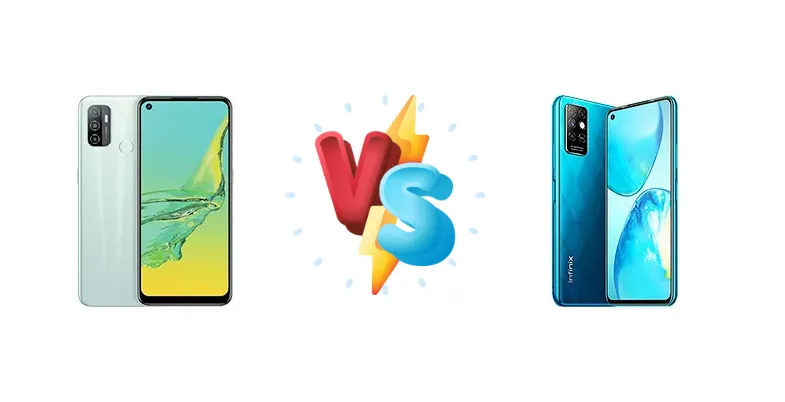
The sub-$150 smartphone market is fiercely competitive. The Oppo A33 (2020) and Infinix Note 8i represent compelling options, but cater to slightly different priorities. The Oppo leverages Qualcomm's Snapdragon 460, while the Infinix opts for MediaTek's Helio G80. This comparison will dissect their strengths and weaknesses to determine which device delivers the best overall experience.
🏆 Quick Verdict
For the average user prioritizing consistent performance and a slightly more refined software experience, the Infinix Note 8i emerges as the winner. Its Helio G80 chipset, built on a 12nm process, offers a noticeable performance edge over the Oppo A33's Snapdragon 460, despite the latter's smaller 11nm node. Both offer 18W charging, making the performance difference the key differentiator.
| Network |
|---|
| 2G bands | GSM 850 / 900 / 1800 / 1900 | GSM 850 / 900 / 1800 / 1900 |
| 3G bands | HSDPA 850 / 900 / 2100 | HSDPA 850 / 900 / 2100 |
| 4G bands | 1, 3, 5, 7, 8, 38, 40, 41 | 1, 3, 5, 7, 8, 20, 38, 40, 41 |
| Speed | HSPA, LTE | HSPA 42.2/5.76 Mbps, LTE Cat4 150/50 Mbps |
| Technology | GSM / HSPA / LTE | GSM / HSPA / LTE |
| | - | 1, 3, 7, 8, 20, 28 |
| Launch |
|---|
| Announced | 2020, September 28. Released 2020, October 01 | 2020, October 15. Released 2020, November 15 |
| Status | Discontinued | Discontinued |
| Body |
|---|
| Dimensions | 163.9 x 75.1 x 8.4 mm (6.45 x 2.96 x 0.33 in) | 171.4 x 77.7 x 8.9 mm (6.75 x 3.06 x 0.35 in) |
| SIM | Nano-SIM + Nano-SIM | Nano-SIM + Nano-SIM |
| Weight | 186 g (6.56 oz) | - |
| Display |
|---|
| Protection | Corning Gorilla Glass 3 | Corning Gorilla Glass |
| Resolution | 720 x 1600 pixels, 20:9 ratio (~269 ppi density) | 720 x 1640 pixels (~264 ppi density) |
| Size | 6.5 inches, 102.8 cm2 (~83.5% screen-to-body ratio) | 6.78 inches, 109.2 cm2 (~82.0% screen-to-body ratio) |
| Type | IPS LCD, 90Hz | IPS LCD, 480 nits (peak) |
| Platform |
|---|
| CPU | Octa-core (4x1.8 GHz Kryo 240 & 4x1.6 GHz Kryo 240) | Octa-core (2x2.0 GHz Cortex-A75 & 6x1.8 GHz Cortex-A55) |
| Chipset | Qualcomm SM4250 Snapdragon 460 (11 nm) | Mediatek MT6769V/CU Helio G80 (12 nm) |
| GPU | Adreno 610 | Mali-G52 MC2 |
| OS | Android 10, ColorOS 7.2 | Android 10, XOS 7.1 |
| Memory |
|---|
| Card slot | microSDXC (dedicated slot) | microSDXC (dedicated slot) |
| Internal | 32GB 3GB RAM, 32GB 4GB RAM | 64GB 4GB RAM, 128GB 4GB RAM, 128GB 6GB RAM |
| | UFS 2.1 gear 3 (one-lane) | - |
| Main Camera |
|---|
| Features | LED flash, HDR, panorama | Quad-LED flash, HDR, panorama |
| Quad | - | 48 MP, (wide), 1/2.0", 0.8µm, PDAF
2 MP (macro)
Auxiliary lenses |
| Triple | 13 MP, f/2.2, 25mm (wide), 1/3.06", 1.12µm, PDAF
2 MP (macro)
Auxiliary lens | - |
| Video | 1080p@30fps | 1440p@30fps |
| Selfie camera |
|---|
| Features | HDR | Dual-LED flash |
| Single | 8 MP, f/2.0, (wide) | 8 MP |
| Video | 1080p@30fps | 1080p@30fps |
| Sound |
|---|
| 3.5mm jack | Yes | Yes |
| 35mm jack | Yes | Yes |
| Loudspeaker | Yes, with stereo speakers | Yes |
| Comms |
|---|
| Bluetooth | 5.0, A2DP, LE, aptX HD | 5.0, A2DP, LE |
| NFC | No | No |
| Positioning | GPS, GLONASS, GALILEO, BDS | GPS |
| Radio | No | FM radio |
| USB | USB Type-C 2.0, OTG | USB Type-C 2.0, OTG |
| WLAN | Wi-Fi 802.11 a/b/g/n/ac, dual-band, Wi-Fi Direct | Wi-Fi 802.11 a/b/g/n/ac, dual-band, Wi-Fi Direct |
| Features |
|---|
| Sensors | Fingerprint (rear-mounted), accelerometer, proximity, compass | Fingerprint (side-mounted), accelerometer, proximity, compass |
| Battery |
|---|
| Charging | 18W wired | 18W wired |
| Type | Li-Po 5000 mAh | 5200 mAh |
| Misc |
|---|
| Colors | Moonlight Black, Mint Cream | Gray, Blue, Green |
| Models | CPH2137 | X683, X683B |
| Price | About 130 EUR | About 150 EUR |
Oppo A33 (2020)
- Qualcomm Snapdragon chipset offers generally stable performance.
- Established brand reputation with Oppo.
- Potentially more refined software experience.
- Snapdragon 460 is less powerful than the Helio G80.
- Likely less capable GPU for gaming.
- May struggle with demanding multitasking.
Infinix Note 8i
- MediaTek Helio G80 provides a noticeable performance boost.
- Better GPU for light gaming.
- More responsive user interface.
- Infinix software can be less polished than Oppo's.
- Potential for more pre-installed bloatware.
- Brand recognition is lower than Oppo.
Display Comparison
Neither device boasts a standout display. Both likely feature LCD panels, typical for this price bracket. The focus here isn't on visual fidelity, but on usability. Without specific display specs, we can assume both offer adequate brightness for indoor use. The absence of high refresh rates or advanced panel technologies like LTPO suggests neither is geared towards media consumption or gaming enthusiasts.
Camera Comparison
Without detailed camera specifications, a direct comparison is difficult. However, it's safe to assume both devices rely on budget-friendly sensors. The marketing often emphasizes megapixel count over sensor size and quality in this segment. Any claims of advanced features like OIS are unlikely. Image processing will likely be the differentiating factor, with Infinix often leaning towards more vibrant, saturated images, while Oppo typically aims for a more natural look. The usefulness of any 2MP macro or depth sensors on either device is questionable.
Performance
The core difference lies in the chipsets. The Infinix Note 8i’s MediaTek Helio G80 (12nm) features a dual-cluster CPU configuration with 2x2.0 GHz Cortex-A75 cores and 6x1.8 GHz Cortex-A55 cores. This contrasts with the Oppo A33’s Qualcomm Snapdragon 460 (11nm) which utilizes an octa-core setup of 4x1.8 GHz Kryo 240 and 4x1.6 GHz Kryo 240. While the Snapdragon 460 benefits from a smaller manufacturing process (11nm vs 12nm), the Helio G80’s Cortex-A75 cores provide a significant architectural advantage in single-core performance, translating to snappier app launches and smoother multitasking. This is particularly beneficial for users who frequently switch between applications. The Helio G80 also has a more capable GPU, making it the better choice for light gaming.
Battery Life
Both phones feature 18W wired charging, suggesting similar charging speeds – likely around 2-2.5 hours for a full charge. Without knowing the battery capacity of each device, it’s hard to definitively say which offers better battery life. However, the more efficient Helio G80 in the Infinix Note 8i might offset a slightly smaller battery capacity, providing comparable or even better real-world endurance.
Buying Guide
Buy the Oppo A33 (2020) if you prioritize a known brand with a generally stable software experience and are primarily focused on basic tasks like calling, texting, and light social media use. Buy the Infinix Note 8i if you prefer a more powerful processor for smoother multitasking, occasional gaming, and a more responsive user interface, even if it means potentially dealing with a slightly less polished software experience.
Frequently Asked Questions
❓ Does the Helio G80 in the Infinix Note 8i tend to overheat during prolonged gaming sessions?
While the Helio G80 is a capable processor, it's built on a 12nm process. This means it can generate more heat than the Snapdragon 460's 11nm process under sustained load. However, the Infinix Note 8i likely incorporates thermal management solutions to mitigate overheating, and short to medium gaming sessions should be fine. Expect some throttling during extended gameplay.
❓ Is the software experience on the Infinix Note 8i significantly different from Oppo's ColorOS?
Yes, the Infinix Note 8i runs on XOS, which is based on Android but features a distinct user interface and set of pre-installed apps. XOS is generally considered less refined than Oppo's ColorOS, and may include more bloatware. However, Infinix has been improving XOS with each iteration, and it offers a degree of customization.
❓ Will I notice a significant difference in app loading times between the two phones?
Yes, you should notice a difference. The Helio G80's Cortex-A75 cores provide a substantial boost in single-core performance, which directly impacts app loading times. Apps will launch faster and feel more responsive on the Infinix Note 8i.