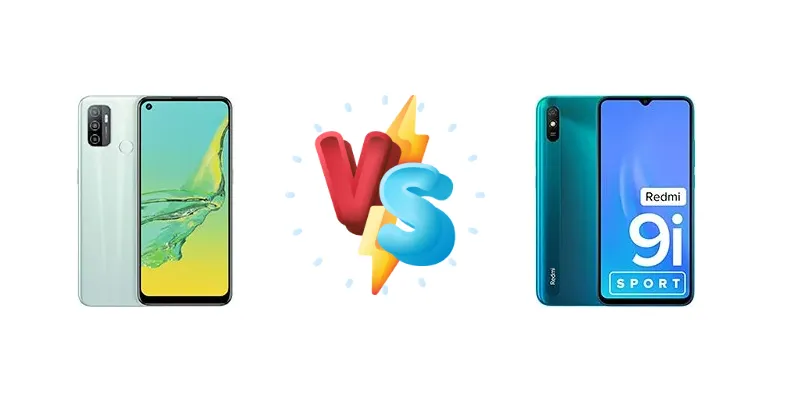
The Oppo A32 and Xiaomi Redmi 9i Sport represent the fiercely competitive sub-$150 smartphone market. Both aim to deliver essential smartphone functionality at an accessible price, but they take different approaches to achieving this. The A32 leverages Qualcomm's Snapdragon 460, while the Redmi 9i Sport opts for MediaTek's Helio G25. This comparison dissects the key differences to help you choose the right device.
🏆 Quick Verdict
For users prioritizing raw processing power and potential for smoother multitasking, the Oppo A32 is the better choice thanks to its Snapdragon 460. However, the Redmi 9i Sport’s more efficient Helio G25 and potentially better battery life make it a compelling option for those focused on longevity and basic usage.
| Network |
|---|
| 2G bands | GSM 850 / 900 / 1800 / 1900 | GSM 850 / 900 / 1800 / 1900 |
| 3G bands | HSDPA 850 / 900 / 2100 | HSDPA 850 / 900 / 2100 |
| 4G bands | 1, 3, 5, 8, 34, 38, 39, 40, 41 | 1, 3, 5, 8, 40, 41 |
| Speed | HSPA, LTE | HSPA, LTE |
| Technology | GSM / CDMA / HSPA / LTE | GSM / HSPA / LTE |
| | CDMA 800 & TD-SCDMA | - |
| Launch |
|---|
| Announced | 2020, September 10. Released 2020, September 10 | 2021, September 28 |
| Status | Discontinued | Available. Released 2021, September 28 |
| Body |
|---|
| Dimensions | 163.9 x 75.1 x 8.4 mm (6.45 x 2.96 x 0.33 in) | 164.9 x 77.1 x 9 mm (6.49 x 3.04 x 0.35 in) |
| SIM | Nano-SIM + Nano-SIM | Nano-SIM + Nano-SIM |
| Weight | 186 g (6.56 oz) | 194 g (6.84 oz) |
| | - | Water-repellent coating |
| Display |
|---|
| Resolution | 720 x 1600 pixels, 20:9 ratio (~270 ppi density) | 720 x 1600 pixels, 20:9 ratio (~269 ppi density) |
| Size | 6.5 inches, 102.0 cm2 (~82.9% screen-to-body ratio) | 6.53 inches, 102.9 cm2 (~81.0% screen-to-body ratio) |
| Type | IPS LCD, 90Hz, 480 nits (typ) | IPS LCD, 400 nits (typ) |
| Platform |
|---|
| CPU | Octa-core (4x1.8 GHz Kryo 240 & 4x1.6 GHz Kryo 240) | Octa-core (4x2.0 GHz Cortex-A53 & 4x1.5 GHz Cortex-A53) |
| Chipset | Qualcomm SM4250 Snapdragon 460 (11 nm) | Mediatek MT6762G Helio G25 (12 nm) |
| GPU | Adreno 610 | PowerVR GE8320 |
| OS | Android 10, ColorOS 7.2 | Android 10, MIUI 12 |
| Memory |
|---|
| Card slot | microSDXC (dedicated slot) | microSDXC (dedicated slot) |
| Internal | 64GB 4GB RAM, 128GB 4GB RAM, 128GB 8GB RAM | 64GB 4GB RAM, 128GB 4GB RAM |
| | UFS 2.1 | eMMC 5.1 |
| Main Camera |
|---|
| Features | LED flash, HDR, panorama | LED flash, HDR |
| Single | - | 13 MP, f/2.2, 28mm (wide), 1.0µm, PDAF |
| Triple | 13 MP, f/2.2, 25mm (wide), 1/3.06", 1.12µm, PDAF
2 MP (macro)
Auxiliary lens | - |
| Video | 1080p@30fps | 1080p@30fps |
| Selfie camera |
|---|
| Features | HDR | HDR |
| Single | 8 MP, f/2.0, (wide) | 5 MP, f/2.2, (wide), 1.12µm |
| Video | 1080p@30fps | 1080p@30fps |
| Sound |
|---|
| 3.5mm jack | Yes | Yes |
| 35mm jack | Yes | Yes |
| Loudspeaker | Yes, with stereo speakers | Yes |
| Comms |
|---|
| Bluetooth | 5.0, A2DP, LE, aptX HD | 5.0, A2DP, LE |
| NFC | No | No |
| Positioning | GPS, GLONASS, GALILEO, BDS | GPS, GLONASS, BDS |
| Radio | No | FM radio |
| USB | USB Type-C 2.0, OTG | microUSB 2.0, OTG |
| WLAN | Wi-Fi 802.11 a/b/g/n/ac, dual-band, Wi-Fi Direct | Wi-Fi 802.11 а/b/g/n, Wi-Fi Direct |
| Features |
|---|
| Sensors | Fingerprint (rear-mounted), accelerometer, proximity, compass | Accelerometer, proximity, compass |
| Battery |
|---|
| Charging | 18W wired | 10W wired |
| Type | Li-Po 5000 mAh | Li-Po 5000 mAh |
| Misc |
|---|
| Colors | Mint Green, Electric Black, Fancy Blue | Carbon Black, Coral Green, Metallic Blue |
| Models | PDVM00 | - |
| Price | About 150 EUR | About 100 EUR |
| SAR | 0.77 W/kg (head) 0.97 W/kg (body) | - |
Oppo A32
- Faster processor for smoother multitasking
- 18W fast charging for quicker top-ups
- Potentially better single-core performance
- Potentially lower battery life due to less efficient chipset
- May run slightly warmer under sustained load
Xiaomi Redmi 9i Sport
- More power-efficient chipset for longer battery life
- Potentially better thermal management
- Lower price point (likely)
- Slower processor for demanding tasks
- Slower 10W charging
Display Comparison
Neither device boasts a standout display. Both likely feature LCD panels, typical for this price bracket. The key difference lies under the hood: display driver efficiency. Without specific display specs, it's difficult to definitively say which is superior, but the focus should be on real-world viewing experience, which will likely be similar. Expect 720p+ resolution on both.
Camera Comparison
Both phones likely feature basic camera setups. Without detailed sensor information, it’s safe to assume both rely on a primary sensor paired with auxiliary lenses (depth, macro) of limited utility. The image processing capabilities of Qualcomm and MediaTek SoCs are generally comparable at this level. The A32’s ISP (Image Signal Processor) within the Snapdragon 460 might offer slightly better noise reduction, but the real-world difference will be minimal. Focusing on the primary sensor megapixel count (if available) is more important than the presence of 2MP macro lenses.
Performance
The core battleground is the chipset. The Oppo A32’s Qualcomm Snapdragon 460, built on an 11nm process, features an octa-core CPU with a split core configuration (4x1.8 GHz Kryo 240 & 4x1.6 GHz Kryo 240). This architecture aims to balance performance and power efficiency. Conversely, the Redmi 9i Sport utilizes the MediaTek Helio G25, fabricated on a more efficient 12nm process, with an octa-core CPU (4x2.0 GHz Cortex-A53 & 4x1.5 GHz Cortex-A53). While the Helio G25 has a slightly higher clock speed on its prime cores, the Snapdragon 460’s Kryo cores are architecturally more advanced, suggesting better single-core performance. This translates to snappier app launches and smoother overall responsiveness on the Oppo A32.
Battery Life
The Redmi 9i Sport’s Helio G25, built on a 12nm process, inherently offers better power efficiency than the Snapdragon 460’s 11nm process. This, combined with the Redmi 9i Sport’s 10W charging, suggests a focus on maximizing battery life. The Oppo A32’s 18W charging is a clear advantage, allowing for faster top-ups, but the Snapdragon 460’s higher power draw may negate some of that benefit. Expect the Redmi 9i Sport to potentially last longer on a single charge, while the A32 will recharge more quickly.
Buying Guide
Buy the Oppo A32 if you frequently switch between apps, enjoy light gaming, or need a phone that feels more responsive overall. Its Snapdragon 460 provides a noticeable performance edge. Buy the Xiaomi Redmi 9i Sport if your primary needs are calls, texts, social media, and occasional web browsing. The Helio G25 prioritizes efficiency, potentially leading to longer battery life between charges, and is ideal for users who don't demand high performance.
Frequently Asked Questions
❓ Will the Redmi 9i Sport struggle with popular apps like WhatsApp and Facebook?
The Helio G25 in the Redmi 9i Sport is capable of running essential apps like WhatsApp and Facebook without significant issues. However, expect some lag when multitasking or using more demanding features within these apps. It's designed for light to moderate usage.
❓ Is the 18W charging on the Oppo A32 a significant advantage in real-world use?
Yes, the 18W charging on the Oppo A32 is a noticeable benefit. While the battery capacity is likely similar between the two devices, the faster charging will significantly reduce the time spent plugged into the wall, offering more convenience.
❓ Can either of these phones handle basic mobile gaming?
Both phones can handle basic mobile gaming, but don't expect high frame rates or graphics settings. The Oppo A32’s Snapdragon 460 will provide a slightly smoother experience for less demanding titles, while the Redmi 9i Sport may struggle with more graphically intensive games.
❓ Which phone is better for someone who primarily uses their phone for calls and texts?
The Xiaomi Redmi 9i Sport is the better choice for users who primarily use their phone for calls and texts. Its power-efficient Helio G25 chipset will maximize battery life, ensuring the phone lasts throughout the day with minimal charging.