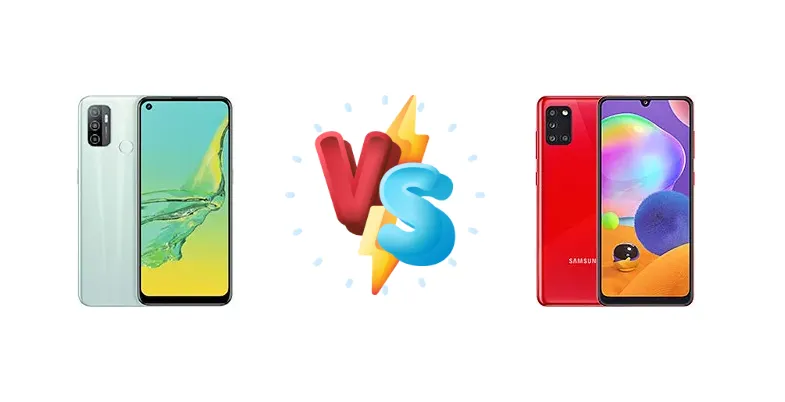
The Oppo A32 and Samsung Galaxy A31 represent compelling options in the crowded budget smartphone market. Both aim to deliver essential features at an accessible price point, but they take different approaches to achieving this. This comparison dives deep into their specifications, performance, and features to determine which device offers the best value for your money.
🏆 Quick Verdict
For most users, the Oppo A32 emerges as the slightly better choice. Its newer Qualcomm Snapdragon 460 chipset, built on a more efficient 11nm process, provides a performance edge over the Samsung Galaxy A31’s older Helio P65. While both phones offer similar battery endurance, the A32’s faster 18W charging is a welcome addition.
| Network |
|---|
| 2G bands | GSM 850 / 900 / 1800 / 1900 | GSM 850 / 900 / 1800 / 1900 |
| 3G bands | HSDPA 850 / 900 / 2100 | HSDPA 850 / 900 / 1900 / 2100 - SM-A315F |
| 4G bands | 1, 3, 5, 8, 34, 38, 39, 40, 41 | 1, 2, 3, 5, 7, 8, 20, 38, 40, 41 - SM-A315F |
| Speed | HSPA, LTE | HSPA, LTE |
| Technology | GSM / CDMA / HSPA / LTE | GSM / HSPA / LTE |
| | CDMA 800 & TD-SCDMA | - |
| Launch |
|---|
| Announced | 2020, September 10. Released 2020, September 10 | 2020, March 24. Released 2020, April 27 |
| Status | Discontinued | Discontinued |
| Body |
|---|
| Dimensions | 163.9 x 75.1 x 8.4 mm (6.45 x 2.96 x 0.33 in) | 159.3 x 73.1 x 8.6 mm (6.27 x 2.88 x 0.34 in) |
| SIM | Nano-SIM + Nano-SIM | · Nano-SIM· Nano-SIM + Nano-SIM |
| Weight | 186 g (6.56 oz) | 185 g (6.53 oz) |
| Display |
|---|
| Resolution | 720 x 1600 pixels, 20:9 ratio (~270 ppi density) | 1080 x 2400 pixels, 20:9 ratio (~411 ppi density) |
| Size | 6.5 inches, 102.0 cm2 (~82.9% screen-to-body ratio) | 6.4 inches, 98.9 cm2 (~84.9% screen-to-body ratio) |
| Type | IPS LCD, 90Hz, 480 nits (typ) | Super AMOLED |
| Platform |
|---|
| CPU | Octa-core (4x1.8 GHz Kryo 240 & 4x1.6 GHz Kryo 240) | Octa-core (2x2.0 GHz Cortex-A75 & 6x1.7 GHz Cortex-A55) |
| Chipset | Qualcomm SM4250 Snapdragon 460 (11 nm) | Mediatek MT6768 Helio P65 (12 nm) |
| GPU | Adreno 610 | Mali-G52 MC2 |
| OS | Android 10, ColorOS 7.2 | Android 10, upgradable to Android 12, One UI 4.1 |
| Memory |
|---|
| Card slot | microSDXC (dedicated slot) | microSDXC (dedicated slot) |
| Internal | 64GB 4GB RAM, 128GB 4GB RAM, 128GB 8GB RAM | 64GB 4GB RAM, 128GB 4GB RAM, 128GB 6GB RAM, 128GB 8GB RAM |
| | UFS 2.1 | - |
| Main Camera |
|---|
| Features | LED flash, HDR, panorama | LED flash, panorama, HDR |
| Quad | - | 48 MP, f/2.0, 26mm (wide), 1/2.0", 0.8µm, PDAF
8 MP, f/2.2, 123˚, (ultrawide), 1/4.0", 1.12µm
5 MP (macro)
Auxiliary lens |
| Triple | 13 MP, f/2.2, 25mm (wide), 1/3.06", 1.12µm, PDAF
2 MP (macro)
Auxiliary lens | - |
| Video | 1080p@30fps | 1080p@30fps |
| Selfie camera |
|---|
| Features | HDR | - |
| Single | 8 MP, f/2.0, (wide) | 20 MP, f/2.2, (wide) |
| Video | 1080p@30fps | 1080p@30fps |
| Sound |
|---|
| 3.5mm jack | Yes | Yes |
| 35mm jack | Yes | Yes |
| Loudspeaker | Yes, with stereo speakers | Yes |
| Comms |
|---|
| Bluetooth | 5.0, A2DP, LE, aptX HD | 5.0, A2DP, LE |
| NFC | No | Yes (market/region dependent) |
| Positioning | GPS, GLONASS, GALILEO, BDS | GPS, GLONASS, GALILEO, BDS |
| Radio | No | FM radio, RDS, recording |
| USB | USB Type-C 2.0, OTG | USB Type-C 2.0, OTG |
| WLAN | Wi-Fi 802.11 a/b/g/n/ac, dual-band, Wi-Fi Direct | Wi-Fi 802.11 a/b/g/n/ac, dual-band, Wi-Fi Direct |
| Features |
|---|
| Sensors | Fingerprint (rear-mounted), accelerometer, proximity, compass | Fingerprint (under display, optical), accelerometer, gyro, compass |
| Battery |
|---|
| Charging | 18W wired | 15W wired |
| Type | Li-Po 5000 mAh | Li-Po 5000 mAh |
| Misc |
|---|
| Colors | Mint Green, Electric Black, Fancy Blue | Prism Crush Black, Prism Crush Blue, Prism Crush Red, Prism Crush White |
| Models | PDVM00 | SM-A315F, SM-A315F/DS, SM-A315G/DS, SM-A315G, SM-A315N |
| Price | About 150 EUR | £ 139.00 / € 138.27 |
| SAR | 0.77 W/kg (head) 0.97 W/kg (body) | - |
| SAR EU | - | 0.49 W/kg (head) 1.68 W/kg (body) |
| Tests |
|---|
| Battery life | - | Endurance rating 124h |
| Camera | - |
Photo / Video |
| Display | - |
Contrast ratio: Infinite (nominal) |
| Loudspeaker | - |
-30.9 LUFS (Below average) |
| Performance | - |
AnTuTu: 151815 (v8)
GeekBench: 5096 (v4.4), 1216 (v5.1)
GFXBench: 7fps (ES 3.1 onscreen) |
Oppo A32
- More efficient Snapdragon 460 chipset
- Faster 18W charging
- Potentially smoother sustained performance
- Display brightness likely lower than A31
- Camera specs are unknown
Samsung Galaxy A31
- Brighter 635 nit display
- Established Samsung brand and software
- Good battery endurance
- Older, less efficient Helio P65 chipset
- Slower 15W charging
- Potential for throttling under sustained load
Display Comparison
The Samsung Galaxy A31 boasts a significantly brighter display, reaching a measured 635 nits, making it more usable in direct sunlight. The Oppo A32’s display specifications are not provided, but typically phones in this price range offer lower peak brightness. While the A31’s contrast ratio is listed as ‘Infinite’ (nominal), this is standard marketing terminology and doesn’t indicate superior panel technology. The A31’s brightness advantage is the key differentiator here, especially for outdoor users.
Camera Comparison
Both devices feature ‘Photo / Video’ capabilities, but lack specific details regarding sensor size, aperture, or image processing. Without further information, it’s difficult to definitively assess camera quality. However, the prevalence of 2MP macro lenses on both devices suggests they are likely of limited utility. Real-world image quality will depend heavily on software optimization, which is a known strength for Samsung. The A31’s brand reputation suggests a more refined camera experience, but the A32’s newer chipset *could* offer improved image signal processing capabilities.
Performance
The Oppo A32’s Qualcomm Snapdragon 460, fabricated on an 11nm process, offers a potential advantage in power efficiency and sustained performance compared to the Samsung Galaxy A31’s MediaTek Helio P65 (12nm). The Snapdragon 460’s octa-core configuration (4x1.8 GHz Kryo 240 & 4x1.6 GHz Kryo 240) is designed for balanced performance, while the Helio P65 utilizes a big.LITTLE architecture with 2x2.0 GHz Cortex-A75 and 6x1.7 GHz Cortex-A55 cores. This suggests the A31 might offer slightly better peak performance in short bursts, but the A32 should maintain smoother operation during prolonged use due to its more efficient chipset.
Battery Life
Both the Oppo A32 and Samsung Galaxy A31 achieve an endurance rating of 124 hours, indicating comparable battery life under similar usage conditions. However, the Oppo A32 supports 18W wired charging, while the A31 is limited to 15W. This translates to faster charging times for the A32, reducing downtime and offering a more convenient user experience. While both phones will likely last a full day on a single charge, the A32’s faster charging provides a practical advantage.
Buying Guide
Buy the Oppo A32 if you prioritize a more responsive user experience and slightly faster charging speeds. It’s ideal for everyday tasks, social media, and light gaming. Buy the Samsung Galaxy A31 if a brighter display is paramount, and you value Samsung’s established brand reputation and software ecosystem. The A31’s 635 nits of brightness will be more visible outdoors.
Frequently Asked Questions
❓ Will the Helio P65 in the Samsung Galaxy A31 struggle with demanding games like PUBG?
The Helio P65 can run PUBG, but you’ll likely need to lower graphics settings to maintain a stable frame rate. The chipset may experience thermal throttling during extended gaming sessions, leading to performance drops. The Oppo A32’s Snapdragon 460, while not a gaming powerhouse, is generally more efficient and may offer a more consistent experience.
❓ How significant is the difference in charging speed between 15W and 18W?
While a 3W difference may not seem substantial, it translates to a noticeable reduction in charging time. The Oppo A32’s 18W charging will likely shave off around 15-30 minutes from a full 0-100% charge compared to the Samsung Galaxy A31’s 15W charging. This is particularly beneficial for users who frequently need to top up their battery quickly.
❓ Is the camera on either phone capable of taking good photos in low-light conditions?
Without detailed camera specifications, it’s difficult to say definitively. However, both phones likely rely heavily on software processing to improve low-light performance. Samsung generally has a strong track record in camera software optimization, which could give the A31 an edge, but the A32’s newer chipset *could* also contribute to better image processing.