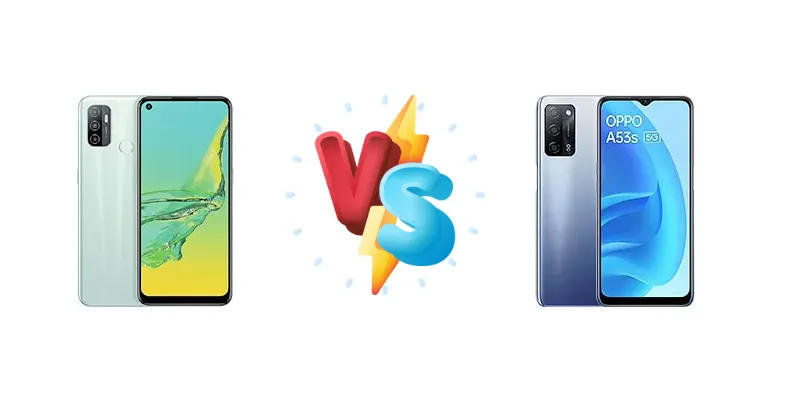
Oppo's A-series consistently targets the value-conscious consumer. The A32 and A53s 5G represent two distinct approaches within this segment: the A32 prioritizes a proven, if older, platform, while the A53s 5G leaps into the 5G era with a Mediatek Dimensity chipset. This comparison dissects the core differences to determine which device delivers the best experience for your needs.
🏆 Quick Verdict
For most users, the Oppo A53s 5G is the superior choice. Its Mediatek Dimensity 700 chipset offers a significant performance uplift over the Snapdragon 460 in the A32, enabling smoother multitasking and 5G connectivity. While charging is slower, the performance benefits outweigh this drawback for all but the most power-user focused.
| Network |
|---|
| 2G bands | GSM 850 / 900 / 1800 / 1900 | GSM 850 / 900 / 1800 / 1900 |
| 3G bands | HSDPA 850 / 900 / 2100 | HSDPA 800 / 850 / 900 / 2100 |
| 4G bands | 1, 3, 5, 8, 34, 38, 39, 40, 41 | 1, 3, 5, 8, 34, 38, 39, 40, 41 |
| 5G bands | - | 1, 28, 41, 77, 78 SA/NSA |
| Speed | HSPA, LTE | HSPA, LTE, 5G |
| Technology | GSM / CDMA / HSPA / LTE | GSM / HSPA / LTE / 5G |
| | CDMA 800 & TD-SCDMA | - |
| Launch |
|---|
| Announced | 2020, September 10. Released 2020, September 10 | 2021, April 27 |
| Status | Discontinued | Available. Released 2021, May 07 |
| Body |
|---|
| Dimensions | 163.9 x 75.1 x 8.4 mm (6.45 x 2.96 x 0.33 in) | 164 x 75.7 x 8.4 mm (6.46 x 2.98 x 0.33 in) |
| SIM | Nano-SIM + Nano-SIM | Nano-SIM + Nano-SIM |
| Weight | 186 g (6.56 oz) | 189.6 g (6.70 oz) |
| Display |
|---|
| Resolution | 720 x 1600 pixels, 20:9 ratio (~270 ppi density) | 720 x 1600 pixels, 20:9 ratio (~269 ppi density) |
| Size | 6.5 inches, 102.0 cm2 (~82.9% screen-to-body ratio) | 6.52 inches, 102.6 cm2 (~82.7% screen-to-body ratio) |
| Type | IPS LCD, 90Hz, 480 nits (typ) | IPS LCD, 480 nits (typ) |
| Platform |
|---|
| CPU | Octa-core (4x1.8 GHz Kryo 240 & 4x1.6 GHz Kryo 240) | Octa-core (2x2.2 GHz Cortex-A76 & 6x2.0 GHz Cortex-A55) |
| Chipset | Qualcomm SM4250 Snapdragon 460 (11 nm) | Mediatek Dimensity 700 (7 nm) |
| GPU | Adreno 610 | Mali-G57 MC2 |
| OS | Android 10, ColorOS 7.2 | Android 11, ColorOS 11.1 |
| Memory |
|---|
| Card slot | microSDXC (dedicated slot) | microSDXC (dedicated slot) |
| Internal | 64GB 4GB RAM, 128GB 4GB RAM, 128GB 8GB RAM | 128GB 6GB RAM, 128GB 8GB RAM |
| | UFS 2.1 | UFS 2.2 |
| Main Camera |
|---|
| Features | LED flash, HDR, panorama | LED flash, HDR, panorama |
| Single | - | 8 MP, f/2.0, 26mm (wide) |
| Triple | 13 MP, f/2.2, 25mm (wide), 1/3.06", 1.12µm, PDAF
2 MP (macro)
Auxiliary lens | 13 MP, f/2.2, 25mm (wide), 1/3.06", 1.12µm, PDAF
2 MP (macro)
Auxiliary lens |
| Video | 1080p@30fps | 1080p@30fps |
| Selfie camera |
|---|
| Features | HDR | HDR |
| Single | 8 MP, f/2.0, (wide) | 8 MP, f/2.0, 26mm (wide) |
| Video | 1080p@30fps | 1080p@30fps |
| Sound |
|---|
| 3.5mm jack | Yes | Yes |
| 35mm jack | Yes | Yes |
| Loudspeaker | Yes, with stereo speakers | Yes |
| Comms |
|---|
| Bluetooth | 5.0, A2DP, LE, aptX HD | 5.0, A2DP, LE, aptX HD |
| NFC | No | No |
| Positioning | GPS, GLONASS, GALILEO, BDS | GPS, GLONASS, GALILEO, BDS, QZSS |
| Radio | No | No |
| USB | USB Type-C 2.0, OTG | USB Type-C 2.0, OTG |
| WLAN | Wi-Fi 802.11 a/b/g/n/ac, dual-band, Wi-Fi Direct | Wi-Fi 802.11 a/b/g/n/ac, dual-band, Wi-Fi Direct |
| Features |
|---|
| Sensors | Fingerprint (rear-mounted), accelerometer, proximity, compass | Fingerprint (side-mounted), accelerometer, gyro, proximity, compass |
| Battery |
|---|
| Charging | 18W wired | 10W wired |
| Type | Li-Po 5000 mAh | Li-Po 5000 mAh |
| Misc |
|---|
| Colors | Mint Green, Electric Black, Fancy Blue | Crystal Blue, Ink Black |
| Models | PDVM00 | CPH2321 |
| Price | About 150 EUR | About 170 EUR |
| SAR | 0.77 W/kg (head) 0.97 W/kg (body) | - |
Oppo A32
- Faster 18W charging
- Potentially more stable software experience (due to simpler chipset)
- Lower price point (likely)
- Significantly weaker performance
- No 5G connectivity
- Less efficient chipset
Oppo A53s 5G
- 5G connectivity
- Much faster processor and GPU
- More responsive user experience
- Slower 10W charging
- Potentially more software bugs (due to newer chipset)
- Higher price point (likely)
Display Comparison
Neither Oppo provides detailed display specifications beyond resolution. However, the A53s 5G's focus on multimedia consumption, implied by its more powerful chipset, suggests a potentially more vibrant panel. Both likely utilize LCD technology common in this price bracket. Bezels are expected to be similar, prioritizing cost-effectiveness over premium aesthetics. Color accuracy is unlikely to be a strong point on either device, geared towards general use rather than professional content creation.
Camera Comparison
Without detailed sensor information, a direct comparison is difficult. However, Oppo’s marketing typically emphasizes megapixel count over sensor size in this segment. It’s reasonable to assume both phones feature a primary camera, an ultrawide, and depth/macro sensors. The A53s 5G’s more powerful ISP (Image Signal Processor) within the Dimensity 700 chipset will likely result in better image processing, particularly in low-light conditions. The A32’s Snapdragon 460 ISP is less capable, potentially leading to softer images and more noise. The inclusion of a 2MP macro lens on both devices is largely a marketing tactic, offering limited practical benefit.
Performance
The core difference lies in the chipsets. The Oppo A53s 5G’s Mediatek Dimensity 700, fabricated on a 7nm process, demonstrably outperforms the Oppo A32’s Qualcomm Snapdragon 460 (11nm). The Dimensity 700’s Cortex-A76 cores provide a substantial CPU performance boost, while its integrated Mali-G57 MC3 GPU offers significantly improved graphics capabilities. This translates to smoother gaming, faster app loading times, and a more responsive overall experience. The Snapdragon 460 is adequate for basic tasks, but will struggle with resource-intensive applications. The A53s 5G also benefits from 5G connectivity, a feature absent in the A32.
Battery Life
Battery capacity is not specified in the provided data, but both phones likely feature batteries in the 4000-5000 mAh range, typical for this price point. The A32’s 18W charging is faster than the A53s 5G’s 10W charging. However, the Dimensity 700’s improved power efficiency may offset some of this difference. Users prioritizing quick top-ups will favor the A32, while those less concerned with charging speed will benefit from the A53s 5G’s longer sustained performance due to its more efficient chipset.
Buying Guide
Buy the Oppo A32 if you prioritize a consistently stable experience for basic tasks like calling, texting, and light social media use, and are less concerned with future-proofing or demanding applications. Buy the Oppo A53s 5G if you want a phone capable of handling more demanding apps, enjoy faster download speeds with 5G, and appreciate a more responsive user interface, even if it means slightly slower charging.
Frequently Asked Questions
❓ Will the Mediatek Dimensity 700 in the A53s 5G overheat during extended gaming sessions?
While the Dimensity 700 is a capable chipset, sustained high loads can generate heat. However, Oppo's thermal management solutions, combined with the 7nm fabrication process, should prevent significant throttling during typical gaming sessions. Expect some performance reduction after prolonged gameplay, but it shouldn't render the phone unusable.
❓ Is the 5G connectivity on the A53s 5G actually useful, or is it just a marketing gimmick?
The usefulness of 5G depends on your location and carrier coverage. If you live in an area with robust 5G infrastructure, you'll experience significantly faster download and upload speeds compared to 4G LTE. Even if 5G coverage is limited, the A53s 5G will fall back to 4G, ensuring continued connectivity. It provides future-proofing and a potential performance boost where available.
❓ How much of a performance difference will I realistically see between the Snapdragon 460 and the Dimensity 700 in everyday tasks?
The difference will be noticeable. The Dimensity 700 will make everyday tasks like opening apps, browsing the web, and switching between applications feel significantly smoother and more responsive. The Snapdragon 460 will handle these tasks, but with more noticeable lag and delays, especially when multitasking.