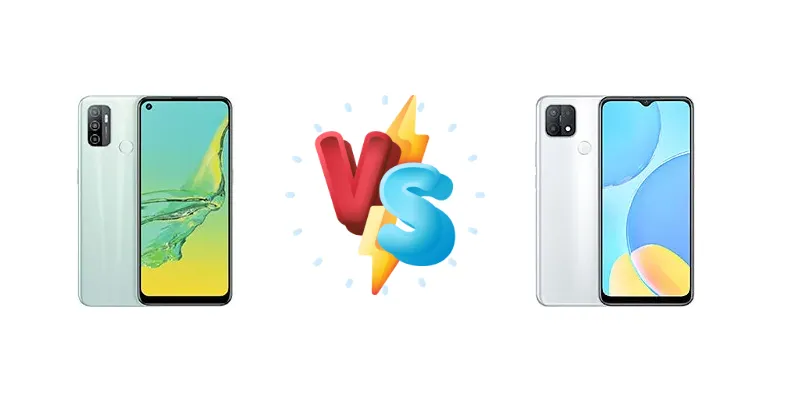
The Oppo A32 and A15s represent Oppo’s commitment to the entry-level smartphone market. While both aim to deliver essential smartphone functionality at an affordable price, they diverge significantly in their core hardware. This comparison will dissect the key differences – specifically the chipset choice – to determine which device offers the best value for budget-conscious consumers.
🏆 Quick Verdict
For most users, the Oppo A32 emerges as the superior choice. Its Qualcomm Snapdragon 460, built on an 11nm process, provides a noticeable performance advantage over the A15s’ MediaTek Helio P35, despite the A15s’ slightly higher CPU clock speeds. The faster 18W charging also adds to the A32’s appeal, making it a more responsive and convenient daily driver.
| Network |
|---|
| 2G bands | GSM 850 / 900 / 1800 / 1900 | GSM 850 / 900 / 1800 / 1900 |
| 3G bands | HSDPA 850 / 900 / 2100 | HSDPA 850 / 900 / 2100 |
| 4G bands | 1, 3, 5, 8, 34, 38, 39, 40, 41 | 1, 3, 5, 8, 38, 40, 41 |
| Speed | HSPA, LTE | HSPA, LTE |
| Technology | GSM / CDMA / HSPA / LTE | GSM / HSPA / LTE |
| | CDMA 800 & TD-SCDMA | - |
| Launch |
|---|
| Announced | 2020, September 10. Released 2020, September 10 | 2020, December 18. Released 2020, December 18 |
| Status | Discontinued | Discontinued |
| Body |
|---|
| Build | - | Glass front, plastic back, plastic frame |
| Dimensions | 163.9 x 75.1 x 8.4 mm (6.45 x 2.96 x 0.33 in) | 164 x 75.4 x 7.9 mm (6.46 x 2.97 x 0.31 in) |
| SIM | Nano-SIM + Nano-SIM | Nano-SIM + Nano-SIM |
| Weight | 186 g (6.56 oz) | 177 g (6.24 oz) |
| Display |
|---|
| Resolution | 720 x 1600 pixels, 20:9 ratio (~270 ppi density) | 720 x 1600 pixels, 20:9 ratio (~269 ppi density) |
| Size | 6.5 inches, 102.0 cm2 (~82.9% screen-to-body ratio) | 6.52 inches, 102.6 cm2 (~83.0% screen-to-body ratio) |
| Type | IPS LCD, 90Hz, 480 nits (typ) | IPS LCD, 480 nits (typ) |
| Platform |
|---|
| CPU | Octa-core (4x1.8 GHz Kryo 240 & 4x1.6 GHz Kryo 240) | Octa-core (4x2.35 GHz Cortex-A53 & 4x1.8 GHz Cortex-A53) |
| Chipset | Qualcomm SM4250 Snapdragon 460 (11 nm) | Mediatek MT6765 Helio P35 (12 nm) |
| GPU | Adreno 610 | PowerVR GE8320 |
| OS | Android 10, ColorOS 7.2 | Android 10, ColorOS 7.2 |
| Memory |
|---|
| Card slot | microSDXC (dedicated slot) | microSDXC |
| Internal | 64GB 4GB RAM, 128GB 4GB RAM, 128GB 8GB RAM | 64GB 4GB RAM, 128GB 4GB RAM |
| | UFS 2.1 | eMMC 5.1 |
| Main Camera |
|---|
| Features | LED flash, HDR, panorama | LED flash, HDR, panorama |
| Triple | 13 MP, f/2.2, 25mm (wide), 1/3.06", 1.12µm, PDAF
2 MP (macro)
Auxiliary lens | 13 MP, f/2.2, (wide), 1/3.1", 1.12µm, PDAF
2 MP (macro)
Auxiliary lens |
| Video | 1080p@30fps | 1080p@30fps |
| Selfie camera |
|---|
| Features | HDR | HDR |
| Single | 8 MP, f/2.0, (wide) | 8 MP, f/2.0, (wide) |
| Video | 1080p@30fps | 1080p@30fps |
| Sound |
|---|
| 3.5mm jack | Yes | Yes |
| 35mm jack | Yes | Yes |
| Loudspeaker | Yes, with stereo speakers | Yes |
| Comms |
|---|
| Bluetooth | 5.0, A2DP, LE, aptX HD | 5.0, A2DP, LE, aptX |
| NFC | No | No |
| Positioning | GPS, GLONASS, GALILEO, BDS | GPS, GLONASS, GALILEO, BDS |
| Radio | No | FM radio |
| USB | USB Type-C 2.0, OTG | microUSB 2.0, OTG |
| WLAN | Wi-Fi 802.11 a/b/g/n/ac, dual-band, Wi-Fi Direct | Wi-Fi 802.11 b/g/n, Wi-Fi Direct |
| Features |
|---|
| Sensors | Fingerprint (rear-mounted), accelerometer, proximity, compass | Fingerprint (rear-mounted), accelerometer, proximity |
| Battery |
|---|
| Charging | 18W wired | 10W wired |
| Type | Li-Po 5000 mAh | Li-Po 4230 mAh |
| Misc |
|---|
| Colors | Mint Green, Electric Black, Fancy Blue | Dynamic Black, Fancy White |
| Models | PDVM00 | CPH2179 |
| Price | About 150 EUR | About 130 EUR |
| SAR | 0.77 W/kg (head) 0.97 W/kg (body) | - |
Oppo A32
- Faster Snapdragon 460 processor
- More efficient 11nm process
- 18W fast charging
- Potentially better image processing
- May be slightly more expensive
- Likely similar display quality to A15s
Oppo A15s
- Potentially lower price point
- Higher CPU clock speeds (on paper)
- Acceptable for basic tasks
- May have slightly longer battery life with minimal use
- Slower Helio P35 processor
- Less efficient 12nm process
- 10W slow charging
- Potential for throttling under load
Display Comparison
Neither Oppo provides detailed display specifications beyond resolution. However, the display is likely the least differentiating factor. Both will likely feature LCD panels, typical of this price bracket. The focus here is on the internal hardware, as display quality is unlikely to be a significant differentiator. Bezels are expected to be substantial on both devices, reflecting their budget positioning.
Camera Comparison
Both phones likely feature similar camera setups, with a primary sensor and potentially a depth sensor. Given the context data, detailed camera analysis is limited. However, the image signal processor (ISP) within the Snapdragon 460 is generally more advanced than that found in the Helio P35, potentially leading to better image processing, particularly in low-light conditions. The A32’s chipset is more likely to support features like faster autofocus and improved dynamic range. We anticipate both phones will include a 2MP macro camera, which offers limited practical benefit due to its low resolution.
Performance
The core difference lies in the chipsets. The Oppo A32’s Qualcomm Snapdragon 460 (11nm) utilizes a more modern architecture and fabrication process than the Oppo A15s’ MediaTek Helio P35 (12nm). While the Helio P35 boasts higher peak CPU clock speeds (2.35 GHz vs 1.8 GHz), the Snapdragon 460’s Kryo cores and more efficient process node translate to better sustained performance and thermal management. The 11nm process allows for greater transistor density and reduced power consumption, meaning the A32 is less likely to throttle under load. This benefits users engaging in even light multitasking or casual gaming.
Battery Life
While battery capacity isn’t specified, the A32’s 18W wired charging is a significant advantage over the A15s’ 10W charging. This translates to a considerably faster 0-100% charge time, reducing downtime. Even with a similar battery capacity, the Snapdragon 460’s greater power efficiency could result in slightly longer battery life for the A32 during moderate usage. The faster charging is a key convenience factor for users who need to quickly top up their phone throughout the day.
Buying Guide
Buy the Oppo A32 if you prioritize smoother multitasking, a more responsive user experience, and faster charging. This phone is ideal for users who frequently switch between apps, enjoy casual gaming, or simply want a phone that feels less sluggish. Buy the Oppo A15s if your primary needs are basic communication – calls, texts, and light social media – and you’re willing to trade performance for potentially lower cost (depending on current market pricing).
Frequently Asked Questions
❓ Will the Oppo A15s struggle with popular apps like Facebook and WhatsApp?
While the Oppo A15s can run these apps, the Helio P35’s limited processing power may result in noticeable lag and slower loading times, especially when multitasking. Users who frequently switch between apps or use resource-intensive features within these platforms may find the experience frustrating.
❓ Is the Snapdragon 460 in the Oppo A32 capable of playing mobile games?
The Snapdragon 460 can handle casual mobile games without issue. However, demanding titles like PUBG Mobile or Call of Duty: Mobile will likely require low graphics settings and may still experience occasional frame drops. It’s not a gaming powerhouse, but it offers a playable experience for less intensive games.
❓ How long does it realistically take to charge the Oppo A15s from 0% to 100%?
With its 10W charging, the Oppo A15s will likely take over 3 hours to fully charge from 0% to 100%. This is significantly slower than the Oppo A32, making it less convenient for users who need a quick power boost.
❓ Does the Oppo A32 support any form of fast charging protocols beyond 18W?
While the Oppo A32 supports 18W charging, it's unlikely to support more advanced fast charging protocols like Qualcomm Quick Charge or USB Power Delivery. It will charge at a slower rate with chargers that don't support 18W.