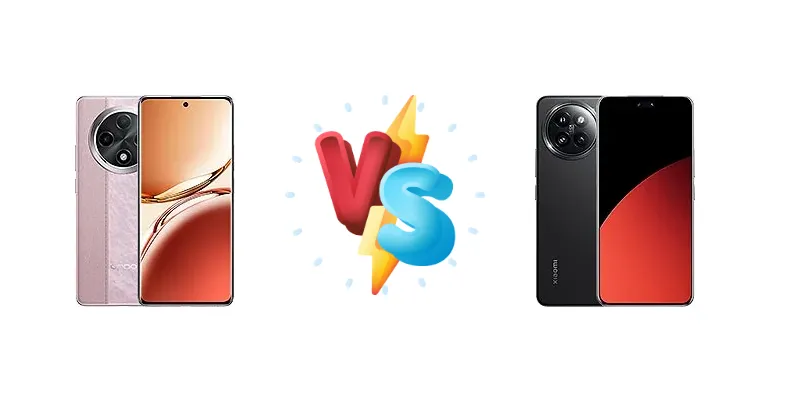
The Oppo A3 Pro and Xiaomi Civi 4 Pro represent compelling options in the increasingly competitive mid-range smartphone market. While both aim for a balance of style and substance, they diverge significantly in their core hardware choices – a Mediatek Dimensity 7050 versus a Qualcomm Snapdragon 8s Gen 3. This comparison dissects these differences to determine which device delivers the best experience for various user profiles.
🏆 Quick Verdict
For the average user prioritizing raw performance and future-proofing, the Xiaomi Civi 4 Pro emerges as the winner. Its Snapdragon 8s Gen 3, built on a more efficient 4nm process, offers a substantial performance advantage over the Oppo A3 Pro’s Dimensity 7050. However, the A3 Pro’s robust build quality and potentially more conservative software approach may appeal to those seeking durability and a less ‘bloated’ experience.
| Network |
|---|
| 2G bands | GSM 850 / 900 / 1800 / 1900 | GSM 850 / 900 / 1800 / 1900 |
| 3G bands | HSDPA 850 / 900 / 2100 | HSDPA 800 / 850 / 900 / 1700(AWS) / 1900 / 2100 |
| 4G bands | 1, 3, 5, 8, 28, 34, 38, 39, 40, 41 | 1, 3, 4, 5, 8, 18, 19, 26, 28, 34, 38, 39, 40, 41, 42, 48, 66 |
| 5G bands | 1, 5, 8, 28, 41, 77, 78 SA/NSA | 1, 3, 5, 8, 28, 38, 40, 41, 48, 66, 77, 78 SA/NSA |
| Speed | HSPA, LTE, 5G | HSPA, LTE, 5G |
| Technology | GSM / CDMA / HSPA / CDMA2000 / LTE / 5G | GSM / CDMA / HSPA / CDMA2000 / LTE / 5G |
| Launch |
|---|
| Announced | 2024, April 12 | 2024, March 21 |
| Status | Available. Released 2024, April 19 | Available. Released 2024, March 21 |
| Body |
|---|
| Build | - | Glass front (Gorilla Glass Victus 2), glass back or silicone polymer back (eco leather), aluminum frame |
| Dimensions | 162.7 x 74.3 x 7.5 mm or 7.9 mm | 157.2 x 72.8 x 7.5 mm or 7.8 mm |
| SIM | Nano-SIM + Nano-SIM | Nano-SIM + Nano-SIM |
| Weight | 177 g or 182 g (6.24 oz) | 177.6 or 179.3 g or 180.9 g (6.28 oz) |
| Display |
|---|
| Protection | - | Corning Gorilla Glass Victus 2 |
| Resolution | 1080 x 2412 pixels, 20:9 ratio (~394 ppi density) | 1236 x 2750 pixels, 20:9 ratio (~460 ppi density) |
| Size | 6.7 inches, 108.0 cm2 (~89.4% screen-to-body ratio) | 6.55 inches, 103.5 cm2 (~90.4% screen-to-body ratio) |
| Type | AMOLED, 1B colors, 120Hz, 500 nits (typ), 800 nits (HBM), 950 nits (peak) | AMOLED, 68B colors, 120Hz, Dolby Vision, HDR10+, 3000 nits (peak) |
| Platform |
|---|
| CPU | Octa-core (2x2.6 GHz Cortex-A78 & 6x2.0 GHz Cortex-A55) | Octa-core (1x3.0 GHz Cortex-X4 & 4x2.8 GHz Cortex-A720 & 3x2.0 GHz Cortex-A520) |
| Chipset | Mediatek Dimensity 7050 (6 nm) | Qualcomm SM8635 Snapdragon 8s Gen 3 (4 nm) |
| GPU | Mali-G68 MC4 | Adreno 735 |
| OS | Android 14, ColorOS 14 | Android 14, HyperOS |
| Memory |
|---|
| Card slot | No | No |
| Internal | 256GB 8GB RAM, 256GB 12GB RAM, 512GB 12GB RAM | 256GB 12GB RAM, 512GB 12GB RAM, 512GB 16GB RAM |
| Main Camera |
|---|
| Dual | 64 MP, f/1.7, 25mm (wide), 1/2.0", 0.7µm, PDAF
Auxiliary lens | - |
| Features | LED flash, HDR, panorama | Color spectrum sensor, Dual-LED flash, HDR, panorama, Leica lenses |
| Triple | - | 50 MP, f/1.6, 25mm (wide), 1/1.55", 1.0µm, PDAF, OIS
50 MP, f/2.0, 50mm (telephoto), 0.64µm, PDAF, 2x optical zoom
12 MP, f/2.2, 15mm, 120˚ (ultrawide), 1.12µm |
| Video | 4K@30fps, 1080p@30/60/120fps, gyro-EIS | 4K@24/30/60fps, 1080p@30/60/120/240/960fps, 720p@1920fps, HDR10+, BT.2020, 10-bit video, gyro-EIS |
| Selfie camera |
|---|
| Dual | - | 32 MP, f/2.0, 26mm (wide), 1/2.8", 0.8µm, AF
32 MP, f/2.4, 100˚ (ultrawide), 1/2.8", 0.8µm |
| Features | - | HDR, panorama |
| Single | 8 MP, f/2.0, (wide) | - |
| Video | 1080p@30fps | 4K@30fps, 1080p@30/60fps; gyro-EIS |
| Sound |
|---|
| 35mm jack | No | No |
| Loudspeaker | Yes | Yes, with stereo speakers |
| Comms |
|---|
| Bluetooth | 5.3, A2DP, LE, aptX HD | 5.4, A2DP, LE, LHDC |
| Infrared port | Yes | Yes |
| NFC | Unspecified | Yes |
| Positioning | GPS, GLONASS, GALILEO, BDS, QZSS | GPS (L1), GLONASS (G1), BDS (B1I+B1c), GALILEO (E1), QZSS (L1) |
| Radio | No | No |
| USB | USB Type-C 2.0, OTG | USB Type-C 2.0, OTG |
| WLAN | Wi-Fi 802.11 a/b/g/n/ac/6, dual-band | Wi-Fi 802.11 a/b/g/n/ac/6, dual-band, Wi-Fi Direct |
| Features |
|---|
| Sensors | Fingerprint (under display, optical), accelerometer, gyro, proximity, compass | Fingerprint (under display, optical), accelerometer, gyro, proximity, compass |
| Battery |
|---|
| Charging | 67W wired, PD, 56% in 20 min
Reverse wired | 67W wired, PD3.0, 100% in 40 minutes |
| Type | Li-Po 5000 mAh | Li-Po 4700 mAh |
| Misc |
|---|
| Colors | Blue, Pink, Mint | Black, Pink, Blue, Green |
| Models | PJY110 | 24053PY09C |
| Price | About 260 EUR | About 380 EUR |
Oppo A3 Pro (China)
- Potentially more durable build quality (based on Oppo’s brand reputation)
- May offer a cleaner software experience with less bloatware
- Fast initial charging speed (56% in 20 minutes)
- Less powerful chipset (Dimensity 7050)
- Less efficient 6nm fabrication process
- Likely lower peak performance in demanding tasks
Xiaomi Civi 4 Pro
- More powerful chipset (Snapdragon 8s Gen 3)
- More efficient 4nm fabrication process
- Superior performance in gaming and multitasking
- Faster full charge time (100% in 40 minutes)
- Potential for more software bloatware (typical of Xiaomi)
- May not be as durable as the Oppo A3 Pro
- Potentially higher price point
Display Comparison
Neither device’s display specifications are provided, so a direct comparison is limited. However, given the Civi 4 Pro’s positioning as a more premium device, it’s reasonable to expect a higher peak brightness and potentially LTPO technology for adaptive refresh rates, leading to improved power efficiency. The A3 Pro, likely targeting a more budget-conscious segment, may utilize a standard AMOLED panel. Bezels and color accuracy will be key differentiators, requiring hands-on testing to determine a clear winner.
Camera Comparison
Without detailed camera specifications, analysis is limited. However, the Civi 4 Pro’s positioning suggests a more sophisticated camera system. The Snapdragon 8s Gen 3’s ISP (Image Signal Processor) is generally more advanced than that found in Dimensity 7050-powered devices, potentially leading to better image processing, dynamic range, and low-light performance. We can assume both phones will feature multiple cameras, but the sensor sizes and lens apertures will be crucial factors. Ignoring typical 2MP macro lenses, the main sensor’s quality and the presence of Optical Image Stabilization (OIS) will be key differentiators.
Performance
The core difference lies in the chipsets. The Xiaomi Civi 4 Pro’s Qualcomm Snapdragon 8s Gen 3 (4nm) boasts a Cortex-X4 prime core clocked at 3.0 GHz, alongside Cortex-A720 and A520 performance cores. This architecture, coupled with the 4nm fabrication process, delivers superior performance and thermal efficiency compared to the Oppo A3 Pro’s Mediatek Dimensity 7050 (6nm). The Dimensity 7050, while capable with its 2x Cortex-A78 and 6x Cortex-A55 cores, is a generation behind and operates on a less efficient node. This translates to potentially more throttling under sustained load and lower overall performance in demanding tasks. The Civi 4 Pro will excel in gaming and resource-intensive applications.
Battery Life
Both devices feature 67W wired charging, supporting PD standards. The Xiaomi Civi 4 Pro claims a full charge in 40 minutes, while the Oppo A3 Pro reaches 56% in 20 minutes. While the A3 Pro’s initial charging speed appears faster, the Civi 4 Pro’s complete charge time suggests more efficient power delivery. Battery capacity isn’t specified, but the Snapdragon 8s Gen 3’s superior efficiency could offset a potentially smaller battery in the Civi 4 Pro, resulting in comparable or even better real-world battery life.
Buying Guide
Buy the Oppo A3 Pro (China) if you need a phone with a focus on durability and a potentially cleaner software experience, and aren't heavily reliant on demanding mobile games or applications. Buy the Xiaomi Civi 4 Pro if you prioritize processing power for gaming, multitasking, and future application compatibility, and appreciate a more modern chipset architecture.
Frequently Asked Questions
❓ Will the Dimensity 7050 in the Oppo A3 Pro struggle with graphically intensive games like Genshin Impact?
The Dimensity 7050 is capable of running Genshin Impact, but you’ll likely need to lower the graphics settings to achieve a consistently smooth frame rate. The Snapdragon 8s Gen 3 in the Civi 4 Pro offers significantly more headroom for gaming at higher settings without experiencing significant throttling.
❓ Does the Xiaomi Civi 4 Pro’s Snapdragon 8s Gen 3 chipset support advanced features like ray tracing?
The Snapdragon 8s Gen 3 does support ray tracing, although its implementation is less advanced than on flagship Snapdragon 8 Gen 3 chips. This means you may see improved visual fidelity in supported games, but don't expect a dramatic difference compared to devices without ray tracing capabilities.
❓ How does Xiaomi’s MIUI software affect the long-term performance of the Civi 4 Pro?
MIUI is known for its customization options but also for potential bloatware and background processes. While Xiaomi has been improving MIUI, it's possible that these factors could slightly impact long-term performance and battery life compared to a cleaner software experience. Regular software updates are crucial for optimizing MIUI’s performance.