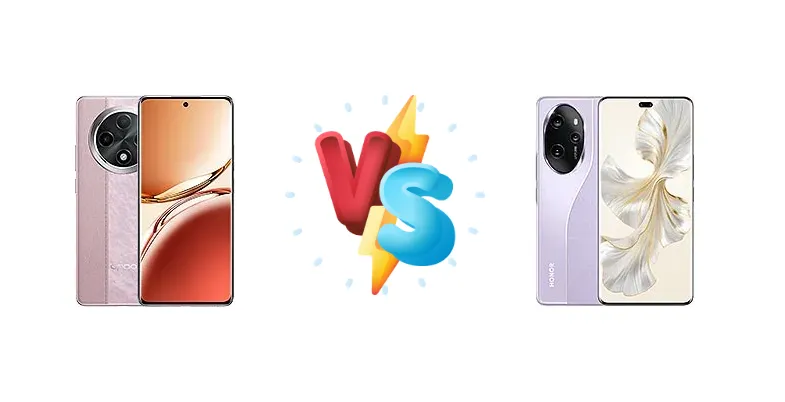
The Oppo A3 Pro (China) and Honor 100 Pro represent compelling options in the increasingly competitive mid-to-high range smartphone market. While both aim to deliver a premium experience, they diverge significantly in their core hardware, particularly in chipset choice and charging capabilities. This comparison dissects these differences to determine which device offers the best value and performance for various user needs.
🏆 Quick Verdict
For users prioritizing raw performance and future-proofing, the Honor 100 Pro, powered by the Snapdragon 8 Gen 2, is the clear winner. However, the Oppo A3 Pro offers a respectable experience for everyday tasks and benefits from a robust build, making it a viable option for budget-conscious buyers.
| Network |
|---|
| 2G bands | GSM 850 / 900 / 1800 / 1900 | GSM 850 / 900 / 1800 / 1900 |
| 3G bands | HSDPA 850 / 900 / 2100 | HSDPA 800 / 850 / 900 / 1700(AWS) / 1900 / 2100 |
| 4G bands | 1, 3, 5, 8, 28, 34, 38, 39, 40, 41 | LTE |
| 5G bands | 1, 5, 8, 28, 41, 77, 78 SA/NSA | SA/NSA |
| Speed | HSPA, LTE, 5G | HSPA, LTE, 5G |
| Technology | GSM / CDMA / HSPA / CDMA2000 / LTE / 5G | GSM / CDMA / HSPA / CDMA2000 / LTE / 5G |
| Launch |
|---|
| Announced | 2024, April 12 | 2023, November 23 |
| Status | Available. Released 2024, April 19 | Available. Released 2023, November 23 |
| Body |
|---|
| Dimensions | 162.7 x 74.3 x 7.5 mm or 7.9 mm | 163.7 x 74.7 x 8.2 mm or 8.5 mm |
| SIM | Nano-SIM + Nano-SIM | Nano-SIM + Nano-SIM |
| Weight | 177 g or 182 g (6.24 oz) | 195 g (6.88 oz) |
| Display |
|---|
| Resolution | 1080 x 2412 pixels, 20:9 ratio (~394 ppi density) | 1224 x 2700 pixels (~437 ppi density) |
| Size | 6.7 inches, 108.0 cm2 (~89.4% screen-to-body ratio) | 6.78 inches, 111.5 cm2 (~91.2% screen-to-body ratio) |
| Type | AMOLED, 1B colors, 120Hz, 500 nits (typ), 800 nits (HBM), 950 nits (peak) | OLED, 1B colors, 120Hz, HDR, 2600 nits (peak) |
| Platform |
|---|
| CPU | Octa-core (2x2.6 GHz Cortex-A78 & 6x2.0 GHz Cortex-A55) | Octa-core (1x3.2 GHz Cortex-X3 & 2x2.8 GHz Cortex-A715 & 2x2.8 GHz Cortex-A710 & 3x2.0 GHz Cortex-A510) |
| Chipset | Mediatek Dimensity 7050 (6 nm) | Qualcomm SM8550-AB Snapdragon 8 Gen 2 (4 nm) |
| GPU | Mali-G68 MC4 | Adreno 740 |
| OS | Android 14, ColorOS 14 | Android 13, MagicOS 7.2 |
| Memory |
|---|
| Card slot | No | No |
| Internal | 256GB 8GB RAM, 256GB 12GB RAM, 512GB 12GB RAM | 256GB 12GB RAM, 256GB 16GB RAM, 512GB 16GB RAM, 1TB 16GB RAM |
| Main Camera |
|---|
| Dual | 64 MP, f/1.7, 25mm (wide), 1/2.0", 0.7µm, PDAF
Auxiliary lens | - |
| Features | LED flash, HDR, panorama | LED flash, HDR, panorama |
| Triple | - | 50 MP, f/2.0, 27mm (wide), 1/1.56", 1.0µm, PDAF, OIS
32 MP, f/2.4, (telephoto), PDAF, OIS, 2.5x optical zoom
12 MP, f/2.2, 112˚ (ultrawide), AF |
| Video | 4K@30fps, 1080p@30/60/120fps, gyro-EIS | 4K@30fps, 1080p@30/60fps, gyro-EIS, OIS |
| Selfie camera |
|---|
| Dual | - | 50 MP, f/2.0
2 MP, f/2.4, (depth) |
| Features | - | HDR |
| Single | 8 MP, f/2.0, (wide) | - |
| Video | 1080p@30fps | 4K@30fps, 1080p@30fps, gyro-EIS |
| Sound |
|---|
| 35mm jack | No | No |
| Loudspeaker | Yes | Yes, with stereo speakers |
| Comms |
|---|
| Bluetooth | 5.3, A2DP, LE, aptX HD | 5.3, A2DP, LE, aptX HD |
| Infrared port | Yes | - |
| NFC | Unspecified | Yes |
| Positioning | GPS, GLONASS, GALILEO, BDS, QZSS | GPS, GALILEO, GLONASS, BDS, QZSS |
| Radio | No | No |
| USB | USB Type-C 2.0, OTG | USB Type-C 2.0, OTG |
| WLAN | Wi-Fi 802.11 a/b/g/n/ac/6, dual-band | Wi-Fi 802.11 a/b/g/n/ac/6, dual-band, Wi-Fi Direct |
| Features |
|---|
| Sensors | Fingerprint (under display, optical), accelerometer, gyro, proximity, compass | Fingerprint (under display, optical), accelerometer, gyro, compass, ultrasound proximity |
| Battery |
|---|
| Charging | 67W wired, PD, 56% in 20 min
Reverse wired | 100W wired, 50% in 10 min
66W wireless, 100% in 42 min
5W reverse wired
Reverse wireless |
| Type | Li-Po 5000 mAh | Li-Po 5000 mAh |
| Misc |
|---|
| Colors | Blue, Pink, Mint | Black, Silver, Blue, Violet |
| Models | PJY110 | MAA-AN10 |
| Price | About 260 EUR | About 440 EUR |
Oppo A3 Pro (China)
- More affordable price point
- Robust build quality (likely)
- Decent performance for everyday tasks
- Inferior chipset compared to Snapdragon 8 Gen 2
- Slower charging speeds
- Less future-proof
Honor 100 Pro
- Flagship-level Snapdragon 8 Gen 2 performance
- Ultra-fast 100W wired and 66W wireless charging
- Likely superior camera system
- Higher price tag
- Potential for higher heat output under sustained load (though mitigated by 4nm process)
- May be overkill for basic users
Display Comparison
While display specifications aren't provided, both phones likely feature OLED panels common in this price bracket. However, the Honor 100 Pro, positioned as a more premium device, may benefit from a higher peak brightness and potentially LTPO technology for adaptive refresh rates, leading to improved power efficiency. The Oppo A3 Pro will likely offer a standard OLED experience, prioritizing cost-effectiveness. Bezels and color accuracy will be key differentiators requiring further testing.
Camera Comparison
Without detailed camera specs, it's difficult to make a definitive judgment. However, the Honor 100 Pro, being the higher-end device, is likely to feature a larger main sensor with optical image stabilization (OIS), resulting in better low-light performance and sharper images. Lens apertures will also play a role; wider apertures (lower f-number) allow more light to reach the sensor. Image processing algorithms will further differentiate the two, with the Honor 100 Pro potentially offering more advanced features and dynamic range. We can assume both phones will include standard wide and ultrawide lenses, but the quality and capabilities will likely favor the Honor 100 Pro.
Performance
The core difference lies in the chipsets. The Honor 100 Pro’s Snapdragon 8 Gen 2 (4nm) is a significant leap ahead of the Oppo A3 Pro’s Mediatek Dimensity 7050 (6nm). The Snapdragon 8 Gen 2’s Cortex-X3 prime core, clocked at 3.2 GHz, provides substantially higher single-core performance, crucial for responsive UI and demanding applications. The 4nm process node also translates to superior thermal efficiency, minimizing throttling during sustained workloads like gaming. The Dimensity 7050, while capable, relies on older Cortex-A78 cores and a less efficient 6nm process, resulting in lower peak performance and potentially more heat generation. The Honor 100 Pro will excel in graphically intensive games and multitasking.
Battery Life
The Honor 100 Pro’s charging capabilities are a standout feature. Its 100W wired charging can replenish 50% of the battery in just 10 minutes, a significant advantage over the Oppo A3 Pro’s 67W charging, which takes 20 minutes to reach 56%. Furthermore, the Honor 100 Pro adds 66W wireless charging, a feature absent on the Oppo A3 Pro. While battery capacity isn’t specified, the faster charging speeds of the Honor 100 Pro effectively mitigate any potential capacity differences, providing a more convenient and rapid charging experience. The inclusion of reverse wireless charging on the Honor 100 Pro adds further versatility.
Buying Guide
Buy the Oppo A3 Pro (China) if you need a durable, reliable phone for daily use and prioritize a balance between performance and affordability. You'll appreciate its 67W charging and solid Mediatek Dimensity 7050 performance for typical tasks. Buy the Honor 100 Pro if you demand top-tier performance for gaming, demanding applications, and content creation, and value the significantly faster 100W wired and 66W wireless charging capabilities.
Frequently Asked Questions
❓ Will the Dimensity 7050 in the Oppo A3 Pro struggle with demanding games like Genshin Impact?
The Dimensity 7050 can run Genshin Impact, but you'll likely need to lower graphics settings to maintain a stable frame rate. The Snapdragon 8 Gen 2 in the Honor 100 Pro will provide a significantly smoother and more consistent gaming experience at higher settings.
❓ How much faster is the 100W charging on the Honor 100 Pro compared to the 67W charging on the Oppo A3 Pro in real-world use?
The Honor 100 Pro's 100W charging can take a phone from 0% to 50% in approximately 10 minutes, while the Oppo A3 Pro's 67W charging takes around 20 minutes to reach 56%. This translates to a substantial time saving, especially for users who frequently need to quickly top up their battery.
❓ Does the Snapdragon 8 Gen 2 in the Honor 100 Pro get noticeably hot during extended gaming sessions?
While the Snapdragon 8 Gen 2 is a powerful chip, the 4nm process helps manage heat effectively. However, prolonged gaming will inevitably generate some heat. The Honor 100 Pro likely incorporates thermal management solutions to mitigate throttling and maintain performance, but some warmth is expected.
❓ Is the reverse wireless charging on the Honor 100 Pro useful for charging accessories like earbuds?
Yes, the 5W reverse wireless charging on the Honor 100 Pro is convenient for topping up accessories like wireless earbuds or smartwatches. While it's not a fast charging solution, it provides a handy way to share power on the go.