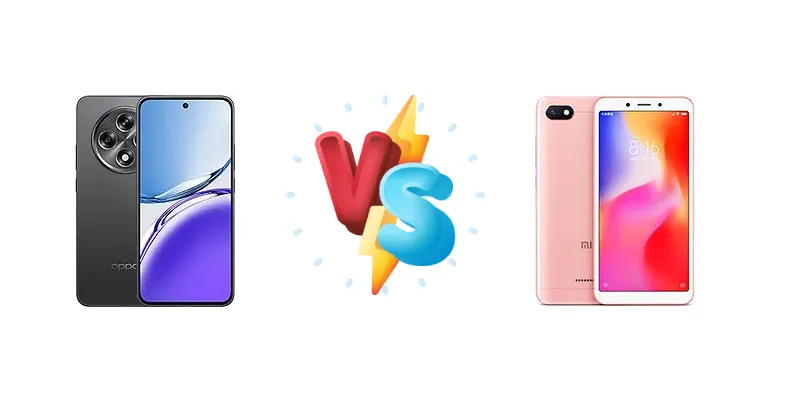
The smartphone landscape is crowded with options, particularly in the budget segment. We're pitting the Oppo A3 (China variant) – a relatively recent entrant boasting 5G connectivity – against the established Xiaomi Redmi 6A, a mainstay for users prioritizing affordability. This comparison isn't about raw power alone; it's about understanding where each phone excels and who benefits most from its strengths.
🏆 Quick Verdict
For the average user seeking future-proof connectivity and a smoother overall experience, the Oppo A3 (China) is the clear winner. Its Snapdragon 695 5G chipset delivers significantly improved performance and 5G capabilities. However, the Redmi 6A remains a viable option for those on the absolute tightest budget and with very basic smartphone needs.
| Network |
|---|
| 2G bands | GSM 850 / 900 / 1800 / 1900 | GSM 850 / 900 / 1800 / 1900 |
| 3G bands | HSDPA 850 / 900 / 2100 | HSDPA 850 / 900 / 1900 / 2100 |
| 4G bands | 1, 3, 5, 8, 28, 34, 38, 39, 40, 41 | 1, 2, 3, 4, 5, 7, 8, 20, 38, 40 - Global |
| 5G bands | 1, 5, 8, 28, 41, 77, 78 SA/NSA | - |
| Speed | HSPA, LTE, 5G | HSPA 21.1/5.76 Mbps, LTE (2CA) Cat7 300/150 Mbps |
| Technology | GSM / CDMA / HSPA / CDMA2000 / LTE / 5G | GSM / CDMA / HSPA / LTE |
| | - | 1, 3, 5, 7, 8, 34, 38, 39, 40, 41 |
| Launch |
|---|
| Announced | 2024, July 02 | 2018, June. Released 2018, June |
| Status | Available. Released 2024, July 05 | Discontinued |
| Body |
|---|
| Build | Glass front (Gorilla Glass 7i), plastic frame, glass back | Glass front, plastic back, plastic frame |
| Dimensions | 162.5 x 75.4 x 7.2 mm (6.40 x 2.97 x 0.28 in) | 147.5 x 71.5 x 8.3 mm (5.81 x 2.81 x 0.33 in) |
| SIM | Nano-SIM + Nano-SIM | Nano-SIM + Nano-SIM |
| Weight | 178 g (6.28 oz) | 145 g (5.11 oz) |
| Display |
|---|
| Protection | Corning Gorilla Glass 7i | - |
| Resolution | 1080 x 2412 pixels, 20:9 ratio (~394 ppi density) | 720 x 1440 pixels, 18:9 ratio (~295 ppi density) |
| Size | 6.7 inches, 108.0 cm2 (~88.2% screen-to-body ratio) | 5.45 inches, 76.7 cm2 (~72.7% screen-to-body ratio) |
| Type | AMOLED, 1B colors, 120Hz, 600 nits (typ), 1200 nits (peak) | IPS LCD |
| Platform |
|---|
| CPU | Octa-core (2x2.2 GHz Kryo 660 Gold & 6x1.7 GHz Kryo 660 Silver) | Quad-core 2.0 GHz Cortex-A53 |
| Chipset | Qualcomm SM6375 Snapdragon 695 5G (6 nm) | Mediatek MT6761 Helio A22 (12 nm) |
| GPU | Adreno 619 | PowerVR GE8320 |
| OS | Android 14, ColorOS 14 | Android 8.1 (Oreo), planned upgrade to Android 10, MIUI 12 |
| Memory |
|---|
| Card slot | microSDXC | microSDXC (dedicated slot) |
| Internal | 256GB 8GB RAM, 256GB 12GB RAM, 512GB 12GB RAM | 16GB 2GB RAM, 32GB 2GB RAM, 32GB 3GB RAM |
| | - | eMMC 5.1 |
| Main Camera |
|---|
| Dual | 50 MP, f/1.8, (wide), PDAF
Auxiliary lens | - |
| Features | LED flash, HDR, panorama | LED flash, HDR, panorama |
| Single | - | 13 MP, f/2.2, PDAF |
| Video | 1080p@30fps | 1080p@30fps |
| Selfie camera |
|---|
| Features | Panorama | - |
| Single | 8 MP, f/2.0, (wide) | 5 MP, f/2.2 |
| Video | 1080p@30fps | - |
| Sound |
|---|
| 3.5mm jack | - | Yes |
| 35mm jack | No | Yes |
| Loudspeaker | Yes | Yes |
| Comms |
|---|
| Bluetooth | 5.1, A2DP, LE, aptX HD | 4.2, A2DP, LE |
| NFC | No | No |
| Positioning | GPS, GLONASS, GALILEO, BDS, QZSS | GPS, GLONASS, BDS |
| Radio | No | FM radio |
| USB | USB Type-C 2.0, OTG | microUSB 2.0 |
| WLAN | Wi-Fi 802.11 a/b/g/n/ac, dual-band | Wi-Fi 802.11 b/g/n, Wi-Fi Direct |
| Features |
|---|
| Sensors | Fingerprint (under display, optical), accelerometer, gyro, proximity, compass | Accelerometer, proximity, compass |
| Battery |
|---|
| Charging | 45W wired, PD, 50% in 30 min
Reverse wired | - |
| Type | 5000 mAh | Li-Ion 3000 mAh, non-removable |
| Misc |
|---|
| Colors | Black, Purple, Green | Black, Grey, Blue, Gold, Rose Gold |
| Models | PKA110 | M1804C3CG, M1804C3CH, M1804C3CI |
| Price | About 210 EUR | About 110 EUR |
| SAR | - | 0.78 W/kg (head) 1.17 W/kg (body) |
| SAR EU | - | 0.66 W/kg (head) 1.52 W/kg (body) |
| Tests |
|---|
| Performance | - |
AnTuTu: 61660 (v7)
GeekBench: 2450 (v4.4)
GFXBench: 3.1fps (ES 3.1 onscreen) |
Oppo A3 (China)
- Significantly faster processor with 5G connectivity
- 45W fast charging with PD support
- Likely a higher-resolution and more vibrant display
- More future-proof for software updates and app compatibility
- Potentially higher price point
- China-specific model may have software limitations for some users
Xiaomi Redmi 6A
- Extremely affordable price
- Simple and easy-to-use interface
- Compact and lightweight design
- Widely available and well-supported
- Outdated processor with limited performance
- Slow charging speeds
- Lower-quality display
- Limited 5G support
Display Comparison
The context data lacks display specifics for both devices. However, given the Redmi 6A's age and market positioning, it likely features a standard 720p LCD panel. The Oppo A3, being a more recent device, likely has a higher resolution display, potentially 1080p, and may incorporate features like higher brightness for outdoor visibility. The Redmi 6A's older panel technology will likely exhibit narrower viewing angles and less accurate color reproduction compared to what we'd expect from the A3.
Camera Comparison
Without detailed camera specifications, a direct comparison is limited. However, it's reasonable to assume the Oppo A3 benefits from more advanced image processing capabilities thanks to its newer chipset. The Redmi 6A likely features a basic camera setup focused on capturing acceptable images in good lighting conditions. The Oppo A3, while not necessarily a camera powerhouse, will likely offer better low-light performance and more features, such as improved HDR and potentially more sophisticated scene detection. The prevalence of 2MP macro lenses on budget phones is a concern; their utility is often minimal.
Performance
The performance gap between these two devices is substantial. The Oppo A3's Qualcomm Snapdragon 695 5G (6nm) is a modern, octa-core processor designed for efficiency and 5G connectivity. Its Kryo 660 Gold and Silver cores provide a balanced approach to performance, handling demanding tasks with relative ease. In contrast, the Xiaomi Redmi 6A's MediaTek Helio A22 (12nm) is a quad-core Cortex-A53 processor, representing an older generation of mobile technology. The 6nm process node of the Snapdragon 695 offers significantly improved power efficiency, translating to better battery life and reduced thermal throttling under sustained load. Users who intend to play games, edit photos, or run multiple apps simultaneously will find the Oppo A3 far more capable.
Battery Life
Again, specific battery capacities are missing. However, the Oppo A3's 45W wired charging with PD support is a significant advantage. The ability to reach 50% charge in just 30 minutes is a game-changer for users who need a quick power boost. The Redmi 6A likely supports slower charging speeds, requiring considerably more time to fully recharge. While the Redmi 6A might have a slightly larger battery capacity, the Oppo A3's more efficient chipset and faster charging will likely result in a more convenient user experience.
Buying Guide
Buy the Oppo A3 (China) if you need 5G connectivity, smoother multitasking, and a more responsive user experience, even if it means spending a bit more. It's ideal for users who stream video, play casual games, or want a phone that will remain usable for longer. Buy the Xiaomi Redmi 6A if you prioritize extreme affordability and only require basic functionality like calls, texts, and light social media use. It's a good choice for first-time smartphone owners or as a secondary device.
Frequently Asked Questions
❓ Is the Snapdragon 695 5G in the Oppo A3 powerful enough for modern mobile games?
The Snapdragon 695 5G is capable of running many popular mobile games at medium settings. While it won't deliver flagship-level performance, it provides a significantly smoother gaming experience than the Helio A22 in the Redmi 6A, especially in titles that benefit from 5G connectivity for cloud gaming or faster downloads.
❓ Does the Oppo A3 (China) support Google Mobile Services (GMS)?
As a China-specific model, the Oppo A3 may not come with Google Mobile Services pre-installed. It likely uses Oppo's ColorOS based on Android, with access to alternative app stores like the Oppo App Market. Users may need to sideload GMS if desired, which can be a complex process.
❓ How much faster is 5G on the Oppo A3 compared to 4G on the Redmi 6A?
5G speeds on the Oppo A3 can be significantly faster than 4G on the Redmi 6A, potentially offering download speeds 10-100 times faster depending on network conditions and carrier support. This translates to quicker app downloads, smoother streaming, and lower latency for online gaming.