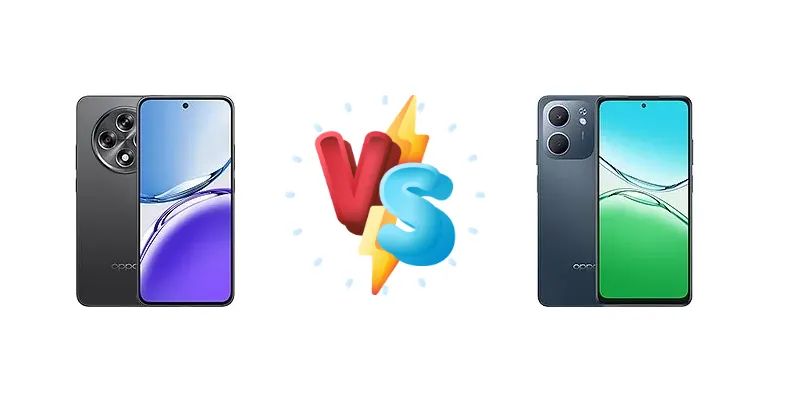
The Oppo A3 (China) and A5x represent Oppo’s strategy for delivering 5G connectivity at accessible price points. While both devices share a similar aesthetic and 45W charging, they diverge significantly under the hood with different chipsets – Qualcomm’s Snapdragon 695 5G versus MediaTek’s Dimensity 6300. This comparison dissects these core differences to determine which phone offers the best performance and value for your money.
🏆 Quick Verdict
For the average user prioritizing consistent performance and established 5G reliability, the Oppo A5x emerges as the better choice. The Dimensity 6300’s Cortex-A76 cores provide a noticeable CPU performance advantage over the Snapdragon 695’s Kryo 660 Gold cores, translating to smoother multitasking and app loading. While charging is comparable, the A5x’s slightly slower rate is a minor trade-off.
| Network |
|---|
| 2G bands | GSM 850 / 900 / 1800 / 1900 | GSM 850 / 900 / 1800 / 1900 |
| 3G bands | HSDPA 850 / 900 / 2100 | HSDPA 850 / 900 / 2100 |
| 4G bands | 1, 3, 5, 8, 28, 34, 38, 39, 40, 41 | LTE |
| 5G bands | 1, 5, 8, 28, 41, 77, 78 SA/NSA | SA/NSA |
| Speed | HSPA, LTE, 5G | HSPA, LTE, 5G |
| Technology | GSM / CDMA / HSPA / CDMA2000 / LTE / 5G | GSM / HSPA / LTE / 5G |
| Launch |
|---|
| Announced | 2024, July 02 | 2025, May 23 |
| Status | Available. Released 2024, July 05 | Available. Released 2025, May 25 |
| Body |
|---|
| Build | Glass front (Gorilla Glass 7i), plastic frame, glass back | - |
| Dimensions | 162.5 x 75.4 x 7.2 mm (6.40 x 2.97 x 0.28 in) | 165.7 x 76.2 x 8 mm (6.52 x 3.00 x 0.31 in) |
| SIM | Nano-SIM + Nano-SIM | Nano-SIM + Nano-SIM |
| Weight | 178 g (6.28 oz) | 193 g (6.81 oz) |
| Display |
|---|
| Protection | Corning Gorilla Glass 7i | Unspecified |
| Resolution | 1080 x 2412 pixels, 20:9 ratio (~394 ppi density) | 720 x 1604 pixels, 20:9 ratio (~264 ppi density) |
| Size | 6.7 inches, 108.0 cm2 (~88.2% screen-to-body ratio) | 6.67 inches, 107.2 cm2 (~84.9% screen-to-body ratio) |
| Type | AMOLED, 1B colors, 120Hz, 600 nits (typ), 1200 nits (peak) | IPS LCD, 120Hz, 1000 nits (HBM) |
| Platform |
|---|
| CPU | Octa-core (2x2.2 GHz Kryo 660 Gold & 6x1.7 GHz Kryo 660 Silver) | Octa-core (2x2.4 GHz Cortex-A76 & 6x2.0 GHz Cortex-A55) |
| Chipset | Qualcomm SM6375 Snapdragon 695 5G (6 nm) | Mediatek Dimensity 6300 (6 nm) |
| GPU | Adreno 619 | Mali-G57 MC2 |
| OS | Android 14, ColorOS 14 | Android 15, ColorOS 15 |
| Memory |
|---|
| Card slot | microSDXC | microSDXC |
| Internal | 256GB 8GB RAM, 256GB 12GB RAM, 512GB 12GB RAM | 64GB 4GB RAM, 128GB 4GB RAM, 128GB 6GB RAM |
| Main Camera |
|---|
| Dual | 50 MP, f/1.8, (wide), PDAF
Auxiliary lens | - |
| Features | LED flash, HDR, panorama | LED flash, HDR, panorama |
| Single | - | 32 MP, f/1.9, (wide), AF |
| Video | 1080p@30fps | Yes |
| Selfie camera |
|---|
| Features | Panorama | - |
| Single | 8 MP, f/2.0, (wide) | 5 MP, f/2.2, (wide) |
| Video | 1080p@30fps | Yes |
| Sound |
|---|
| 35mm jack | No | Yes |
| Loudspeaker | Yes | Yes |
| Comms |
|---|
| Bluetooth | 5.1, A2DP, LE, aptX HD | 5.1, A2DP, LE |
| NFC | No | No |
| Positioning | GPS, GLONASS, GALILEO, BDS, QZSS | GPS, GALILEO, GLONASS, BDS, QZSS |
| Radio | No | Unspecified |
| USB | USB Type-C 2.0, OTG | USB Type-C 2.0, OTG |
| WLAN | Wi-Fi 802.11 a/b/g/n/ac, dual-band | Wi-Fi 802.11 a/b/g/n/ac, dual-band |
| Features |
|---|
| Sensors | Fingerprint (under display, optical), accelerometer, gyro, proximity, compass | Fingerprint (side-mounted), accelerometer, proximity, compass |
| Battery |
|---|
| Charging | 45W wired, PD, 50% in 30 min
Reverse wired | 45W wired, 33W PPS, 13.5W PD, 50% in 37 min |
| Type | 5000 mAh | 6000 mAh |
| Misc |
|---|
| Colors | Black, Purple, Green | Tranquil Lake Green, Laser White |
| Models | PKA110 | - |
| Price | About 210 EUR | ₹ 11,499 |
Oppo A3 (China)
- Qualcomm Snapdragon 695 5G offers established 5G connectivity.
- 45W fast charging with PD support.
- Potentially wider software optimization within the Qualcomm ecosystem.
- CPU performance lags behind the Dimensity 6300.
- Kryo 660 Gold cores are less efficient than Cortex-A76.
Oppo A5x
- MediaTek Dimensity 6300 provides superior CPU performance.
- Cortex-A76 cores offer better efficiency.
- Supports 33W PPS and 13.5W PD for broader charger compatibility.
- Slightly slower charging time (37 minutes to 50%).
- MediaTek chipset may have less software optimization compared to Qualcomm.
Display Comparison
Both devices are expected to feature similar LCD panels, typical for this price bracket. However, detailed display specs (resolution, refresh rate, peak brightness) are unavailable. The focus here is on internal components. Without specific display data, it’s difficult to assess visual quality differences, but we anticipate both will offer adequate viewing experiences for everyday use. Bezels are likely comparable, reflecting cost-saving measures in the mid-range segment.
Camera Comparison
Camera specifications are not detailed enough to draw firm conclusions. Both phones likely feature a multi-camera setup, but the quality will heavily depend on the primary sensor and image processing algorithms. Without knowing sensor sizes or apertures, it’s difficult to assess low-light performance. The inclusion of a 2MP macro camera on either device is largely a marketing tactic, offering limited practical benefit. Image processing style will likely differ between Oppo’s software implementations, potentially favoring different color profiles or levels of sharpening.
Performance
The core difference lies in the chipsets. The Oppo A3 utilizes the Qualcomm Snapdragon 695 5G (6nm), featuring an octa-core CPU with 2x2.2 GHz Kryo 660 Gold and 6x1.7 GHz Kryo 660 Silver cores. The Oppo A5x, conversely, employs the MediaTek Dimensity 6300 (6nm) with 2x2.4 GHz Cortex-A76 and 6x2.0 GHz Cortex-A55 cores. The Dimensity 6300’s Cortex-A76 cores represent a significant architectural upgrade over the Snapdragon 695’s Kryo 660 Gold, offering superior single-core performance. This translates to snappier app launches and a more responsive user interface. While both are 6nm chips, the Cortex-A76’s efficiency gains are notable. RAM configurations are unknown, but LPDDR4X is likely on both, limiting memory bandwidth.
Battery Life
Both devices support 45W wired charging, a significant advantage in this price range. The Oppo A3 claims 50% charge in 30 minutes, while the A5x takes 37 minutes. The A5x also supports 33W PPS and 13.5W PD, offering broader compatibility with chargers. Battery capacity is unknown for both devices, but a 5000mAh battery is a reasonable expectation. The A5x’s PPS support provides a slight edge in charging efficiency with compatible chargers, but the difference in 0-100% charge times is minimal.
Buying Guide
Buy the Oppo A3 (China) if you prioritize Qualcomm’s established 5G modem and a potentially wider range of software optimizations within the Qualcomm ecosystem. Buy the Oppo A5x if you prefer a more powerful CPU for everyday tasks and light gaming, benefiting from MediaTek’s Cortex-A76 based architecture, and are comfortable with a slightly different software experience.
Frequently Asked Questions
❓ Will the Dimensity 6300 in the Oppo A5x struggle with demanding games like PUBG Mobile?
While the Dimensity 6300 isn't a flagship gaming chip, it's capable of running PUBG Mobile at medium settings with stable frame rates. The Cortex-A76 cores provide enough processing power for a smooth experience, but you may need to lower graphics settings for extended gaming sessions to avoid overheating.
❓ Does the Oppo A3 (China) benefit from carrier aggregation for faster 5G speeds?
The Snapdragon 695 5G supports carrier aggregation, which can improve 5G speeds in areas with good network coverage. However, the actual speeds will depend on your carrier and location. The A5x’s Dimensity 6300 also supports carrier aggregation, so this isn’t a differentiating factor.
❓ Is the 45W charging on both phones compatible with all USB-PD chargers?
While both support USB-PD, full 45W charging requires a charger specifically rated for that wattage. The Oppo A5x’s additional support for 33W PPS offers wider compatibility with chargers that adhere to that standard, potentially providing faster charging with those devices.