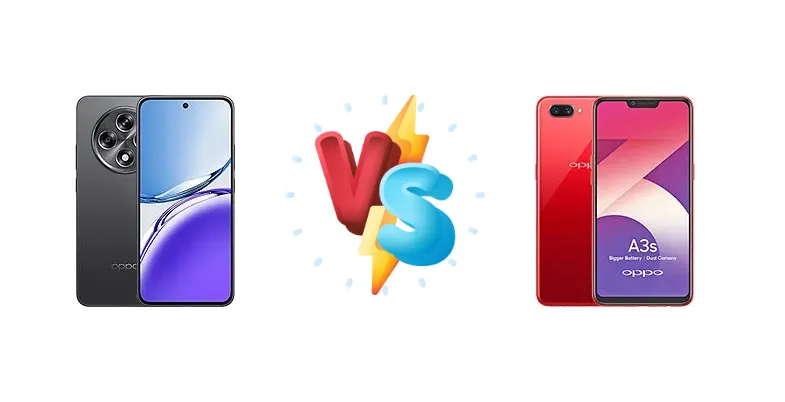
The Oppo A3 and A3s represent distinct approaches to the budget smartphone market. The A3, exclusive to China, prioritizes 5G connectivity and faster charging, while the A3s focuses on affordability. This comparison dissects the core differences between these two devices, helping you determine which best suits your needs and budget.
🏆 Quick Verdict
For users prioritizing 5G access and significantly faster charging, the Oppo A3 (China) is the clear winner. Its Snapdragon 695 offers a substantial performance uplift over the A3s' Snapdragon 450. However, if budget is the primary concern and 5G isn't essential, the A3s remains a viable, cost-effective option.
| Network |
|---|
| 2G bands | GSM 850 / 900 / 1800 / 1900 | GSM 850 / 900 / 1800 / 1900 |
| 3G bands | HSDPA 850 / 900 / 2100 | HSDPA 850 / 900 / 2100 |
| 4G bands | 1, 3, 5, 8, 28, 34, 38, 39, 40, 41 | 1, 3, 5, 8, 38, 40, 41 |
| 5G bands | 1, 5, 8, 28, 41, 77, 78 SA/NSA | - |
| Speed | HSPA, LTE, 5G | HSPA 42.2/5.76 Mbps, LTE (2CA) Cat6 300/50 Mbps |
| Technology | GSM / CDMA / HSPA / CDMA2000 / LTE / 5G | GSM / HSPA / LTE |
| Launch |
|---|
| Announced | 2024, July 02 | 2018, July 13. Released 2018, July |
| Status | Available. Released 2024, July 05 | Discontinued |
| Body |
|---|
| Build | Glass front (Gorilla Glass 7i), plastic frame, glass back | Glass front (Gorilla Glass 3), plastic back, plastic frame |
| Dimensions | 162.5 x 75.4 x 7.2 mm (6.40 x 2.97 x 0.28 in) | 156.2 x 75.6 x 8.2 mm (6.15 x 2.98 x 0.32 in) |
| SIM | Nano-SIM + Nano-SIM | Nano-SIM + Nano-SIM |
| Weight | 178 g (6.28 oz) | 168 g (5.93 oz) |
| Display |
|---|
| Protection | Corning Gorilla Glass 7i | Corning Gorilla Glass 3 |
| Resolution | 1080 x 2412 pixels, 20:9 ratio (~394 ppi density) | 720 x 1520 pixels, 19:9 ratio (~271 ppi density) |
| Size | 6.7 inches, 108.0 cm2 (~88.2% screen-to-body ratio) | 6.2 inches, 95.9 cm2 (~81.2% screen-to-body ratio) |
| Type | AMOLED, 1B colors, 120Hz, 600 nits (typ), 1200 nits (peak) | IPS LCD |
| Platform |
|---|
| CPU | Octa-core (2x2.2 GHz Kryo 660 Gold & 6x1.7 GHz Kryo 660 Silver) | Octa-core 1.8 GHz Cortex-A53 |
| Chipset | Qualcomm SM6375 Snapdragon 695 5G (6 nm) | Qualcomm SDM450 Snapdragon 450 (14 nm) |
| GPU | Adreno 619 | Adreno 506 |
| OS | Android 14, ColorOS 14 | Android 8.1 (Oreo), ColorOS 5.1 |
| Memory |
|---|
| Card slot | microSDXC | microSDXC (dedicated slot) |
| Internal | 256GB 8GB RAM, 256GB 12GB RAM, 512GB 12GB RAM | 16GB 2GB RAM, 32GB 3GB RAM, 64GB 4GB RAM |
| | - | eMMC 5.1 |
| Main Camera |
|---|
| Dual | 50 MP, f/1.8, (wide), PDAF
Auxiliary lens | 13 MP, f/2.2, AF
Auxiliary lens |
| Features | LED flash, HDR, panorama | LED flash, HDR, panorama |
| Video | 1080p@30fps | 1080p@30fps |
| Selfie camera |
|---|
| Features | Panorama | - |
| Single | 8 MP, f/2.0, (wide) | 8 MP, f/2.2 |
| Video | 1080p@30fps | 1080p@30fps |
| Sound |
|---|
| 3.5mm jack | - | Yes |
| 35mm jack | No | Yes |
| Loudspeaker | Yes | Yes |
| Comms |
|---|
| Bluetooth | 5.1, A2DP, LE, aptX HD | 4.2, A2DP, LE |
| NFC | No | No |
| Positioning | GPS, GLONASS, GALILEO, BDS, QZSS | GPS |
| Radio | No | FM radio |
| USB | USB Type-C 2.0, OTG | microUSB 2.0, OTG |
| WLAN | Wi-Fi 802.11 a/b/g/n/ac, dual-band | Wi-Fi 802.11 b/g/n, Wi-Fi Direct |
| Features |
|---|
| Sensors | Fingerprint (under display, optical), accelerometer, gyro, proximity, compass | Accelerometer, gyro, proximity, compass |
| Battery |
|---|
| Charging | 45W wired, PD, 50% in 30 min
Reverse wired | 20W wired |
| Type | 5000 mAh | Li-Ion 4230 mAh, non-removable |
| Misc |
|---|
| Colors | Black, Purple, Green | Red, Dark Purple |
| Models | PKA110 | CPH1803, CPH1853, CPH1805 |
| Price | About 210 EUR | About 11000 INR |
Oppo A3 (China)
- Significantly faster 5G performance with Snapdragon 695
- 45W fast charging with PD support (50% in 30 mins)
- Reverse wired charging capability
- Higher price point
- Availability limited to China
Oppo A3s
- More affordable price
- Decent performance for basic tasks
- Widely available
- Slow 20W charging
- Outdated Snapdragon 450 chipset
- No 5G connectivity
Display Comparison
Neither Oppo provides display specifications beyond size, so a direct comparison is limited. However, given the A3's positioning as a more premium device, it's reasonable to expect a slightly better panel in terms of color accuracy and brightness. The A3s, targeting a lower price point, likely utilizes a more basic LCD panel. Bezels are expected to be similar on both, reflecting their budget nature.
Camera Comparison
Without detailed camera specifications, a precise comparison is difficult. However, it's safe to assume the A3 benefits from a more advanced image signal processor (ISP) within the Snapdragon 695, leading to better image processing and low-light performance. While both phones likely feature a multi-camera setup, the A3 is expected to have a higher-resolution main sensor and potentially optical image stabilization (OIS), resulting in sharper and more detailed photos. The A3s likely relies on software enhancements to compensate for its less capable hardware.
Performance
The performance gap between the Oppo A3 and A3s is substantial. The A3's Qualcomm Snapdragon 695 5G (6nm) boasts a modern octa-core CPU with Kryo 660 Gold and Silver cores clocked at 2.2 GHz and 1.7 GHz respectively. This contrasts sharply with the A3s' Snapdragon 450 (14nm) and its Cortex-A53 cores running at 1.8 GHz. The 6nm process node of the Snapdragon 695 translates to improved power efficiency and reduced thermal throttling compared to the older 14nm Snapdragon 450. This means the A3 will handle multitasking, demanding apps, and even light gaming significantly better. The A3 also benefits from potentially faster RAM speeds (though not specified), further enhancing responsiveness.
Battery Life
The Oppo A3's 45W wired charging with PD support is a game-changer compared to the A3s' 20W charging. Oppo claims a 50% charge in just 30 minutes for the A3, significantly reducing downtime. While battery capacity isn't specified for either device, the A3's faster charging effectively mitigates any potential capacity disadvantage. The A3 also offers reverse wired charging, a feature absent on the A3s, adding to its versatility.
Buying Guide
Buy the Oppo A3 (China) if you need future-proof 5G connectivity, faster app loading times, and the convenience of 45W fast charging. This phone is ideal for users who stream a lot of video, play mobile games occasionally, and want a device that will remain relevant for longer. Buy the Oppo A3s if you prefer a more affordable device for basic tasks like calling, texting, and light social media use. It's a good choice for first-time smartphone users or those on a very tight budget.
Frequently Asked Questions
❓ Is the Snapdragon 695 in the Oppo A3 powerful enough for demanding mobile games like Genshin Impact?
The Snapdragon 695 is capable of running Genshin Impact, but you'll likely need to lower the graphics settings to medium or low to achieve a smooth frame rate. It's not a flagship-level gaming chip, but it's a significant step up from the Snapdragon 450 in the A3s and provides a playable experience.
❓ Does the Oppo A3 support VoLTE and VoWiFi for improved call quality?
Given the A3's 5G capabilities, it almost certainly supports VoLTE (Voice over LTE) for higher-quality calls on 4G networks. VoWiFi (Voice over Wi-Fi) support is likely, but depends on carrier compatibility. The A3s supports VoLTE, but VoWiFi support is less certain.
❓ How does the 6nm process of the Snapdragon 695 impact battery life compared to the 14nm Snapdragon 450?
The 6nm process is significantly more power-efficient than the 14nm process. This means the Snapdragon 695 consumes less power for the same level of performance, resulting in longer battery life, especially during sustained use like gaming or video streaming. While battery capacity isn't specified, the A3 will likely offer better real-world battery endurance.