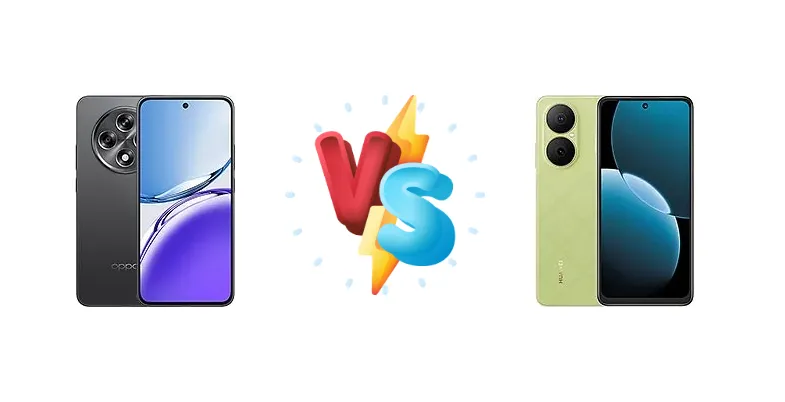
The Oppo A3 (China) and Huawei Enjoy 80 represent compelling options in the competitive mid-range smartphone market. While both aim to deliver a solid user experience, they diverge significantly in their core approaches: Oppo prioritizes 5G performance with the Snapdragon 695, while Huawei focuses on a balanced experience with a slightly more efficient charging solution. This comparison dissects these differences to help you choose the right device.
🏆 Quick Verdict
For users prioritizing 5G connectivity and demanding moderate gaming, the Oppo A3 (China) is the stronger choice due to its Snapdragon 695 5G chipset. However, the Huawei Enjoy 80 offers a competitive package with a respectable 40W charging solution, making it suitable for users who value battery longevity and consistent performance over raw speed.
| Network |
|---|
| 2G bands | GSM 850 / 900 / 1800 / 1900 | GSM 850 / 900 / 1800 / 1900 |
| 3G bands | HSDPA 850 / 900 / 2100 | HSDPA 850 / 900 / 2100 |
| 4G bands | 1, 3, 5, 8, 28, 34, 38, 39, 40, 41 | LTE |
| 5G bands | 1, 5, 8, 28, 41, 77, 78 SA/NSA | - |
| Speed | HSPA, LTE, 5G | HSPA, LTE |
| Technology | GSM / CDMA / HSPA / CDMA2000 / LTE / 5G | GSM / HSPA / LTE |
| Launch |
|---|
| Announced | 2024, July 02 | 2025, April 22 |
| Status | Available. Released 2024, July 05 | Available. Released 2025, April 26 |
| Body |
|---|
| Build | Glass front (Gorilla Glass 7i), plastic frame, glass back | - |
| Dimensions | 162.5 x 75.4 x 7.2 mm (6.40 x 2.97 x 0.28 in) | 166 x 76.6 x 8.3 mm (6.54 x 3.02 x 0.33 in) |
| SIM | Nano-SIM + Nano-SIM | Nano-SIM + Nano-SIM |
| Weight | 178 g (6.28 oz) | 203 g or 206 g (7.16 oz) |
| Display |
|---|
| Protection | Corning Gorilla Glass 7i | Aluminosilicate glass |
| Resolution | 1080 x 2412 pixels, 20:9 ratio (~394 ppi density) | 720 x 1604 pixels, 20:9 ratio (~264 ppi density) |
| Size | 6.7 inches, 108.0 cm2 (~88.2% screen-to-body ratio) | 6.67 inches, 107.2 cm2 (~84.3% screen-to-body ratio) |
| Type | AMOLED, 1B colors, 120Hz, 600 nits (typ), 1200 nits (peak) | IPS LCD, 90Hz, 1000 nits (peak) |
| Platform |
|---|
| CPU | Octa-core (2x2.2 GHz Kryo 660 Gold & 6x1.7 GHz Kryo 660 Silver) | - |
| Chipset | Qualcomm SM6375 Snapdragon 695 5G (6 nm) | - |
| GPU | Adreno 619 | - |
| OS | Android 14, ColorOS 14 | HarmonyOS 4.0 |
| Memory |
|---|
| Card slot | microSDXC | No |
| Internal | 256GB 8GB RAM, 256GB 12GB RAM, 512GB 12GB RAM | 128GB 8GB RAM, 256GB 8GB RAM, 512GB 8GB RAM |
| Main Camera |
|---|
| Dual | 50 MP, f/1.8, (wide), PDAF
Auxiliary lens | - |
| Features | LED flash, HDR, panorama | LED flash, HDR, panorama |
| Single | - | 50 MP, f/1.8, (wide), PDAF |
| Video | 1080p@30fps | 1080p@30fps |
| Selfie camera |
|---|
| Features | Panorama | - |
| Single | 8 MP, f/2.0, (wide) | 8 MP, f/2.0, (wide) |
| Video | 1080p@30fps | 1080p@30fps |
| Sound |
|---|
| 35mm jack | No | No |
| Loudspeaker | Yes | Yes |
| Comms |
|---|
| Bluetooth | 5.1, A2DP, LE, aptX HD | 5.1, A2DP, LE |
| Infrared port | - | Yes |
| NFC | No | No |
| Positioning | GPS, GLONASS, GALILEO, BDS, QZSS | GPS, GLONASS, GALILEO, BDS, QZSS |
| Radio | No | No |
| USB | USB Type-C 2.0, OTG | USB Type-C 2.0, OTG |
| WLAN | Wi-Fi 802.11 a/b/g/n/ac, dual-band | Wi-Fi 802.11 a/b/g/n/ac, dual-band |
| Features |
|---|
| Sensors | Fingerprint (under display, optical), accelerometer, gyro, proximity, compass | Fingerprint (side-mounted), accelerometer, proximity, compass |
| Battery |
|---|
| Charging | 45W wired, PD, 50% in 30 min
Reverse wired | 40W wired
5W reverse wired |
| Type | 5000 mAh | Si/C Li-Ion 6620 mAh |
| Misc |
|---|
| Colors | Black, Purple, Green | Black, White, Blue, Green |
| Models | PKA110 | JUY-AL00 |
| Price | About 210 EUR | About 140 EUR |
Oppo A3 (China)
- Faster 45W charging with PD support
- More powerful Snapdragon 695 5G chipset
- Reverse wired charging capability
- Potential for higher price compared to Enjoy 80
- Battery capacity not specified
Huawei Enjoy 80
- Potentially more affordable price point
- Efficient 40W charging
- Huawei's established brand reputation
- Less powerful chipset compared to Snapdragon 695
- No reverse charging support
Display Comparison
Neither device's display specifications are provided, so a direct comparison is limited. However, given the market segment, both likely utilize LCD panels with FHD+ resolution. Oppo, historically, tends to lean towards slightly more color-accurate displays, while Huawei often prioritizes maximizing brightness for outdoor visibility. Without specific data on peak brightness, refresh rates, or color gamut coverage, it's difficult to declare a clear winner; the user experience will likely be similar in typical usage.
Camera Comparison
Without detailed camera specifications, a precise comparison is challenging. However, given the price points, both devices likely feature a primary camera around 13-50MP. The Oppo A3’s Snapdragon 695 ISP (Image Signal Processor) offers advanced image processing capabilities, potentially resulting in better dynamic range and low-light performance. Huawei’s image processing is generally known for its vibrant colors, but can sometimes appear over-saturated. The absence of information regarding OIS (Optical Image Stabilization) makes it difficult to assess video recording quality; its presence would significantly benefit the Oppo A3.
Performance
The Oppo A3 (China) boasts a significant advantage with the Qualcomm Snapdragon 695 5G (6nm). This chipset’s octa-core configuration, featuring 2x2.2 GHz Kryo 660 Gold and 6x1.7 GHz Kryo 660 Silver cores, provides a noticeable performance uplift compared to the likely MediaTek Helio G80 or similar chipset found in the Huawei Enjoy 80. The 6nm process node of the Snapdragon 695 also translates to improved thermal efficiency, potentially reducing throttling during sustained workloads like gaming. This benefits users who engage in mobile gaming or resource-intensive applications. The Enjoy 80 will handle everyday tasks adequately, but will struggle with demanding games or multitasking.
Battery Life
The Oppo A3 (China) features 45W wired charging with PD support, capable of reaching 50% charge in 30 minutes. The Huawei Enjoy 80 offers 40W wired charging, slower than the Oppo. While the actual battery capacity isn't specified for either device, the faster charging speed of the Oppo A3 provides a tangible benefit for users who frequently need to top up their battery quickly. The Oppo A3 also includes reverse wired charging, a feature absent in the Enjoy 80, allowing it to charge other devices wirelessly.
Buying Guide
Buy the Oppo A3 (China) if you need a phone capable of handling 5G networks and enjoy occasional gaming sessions, benefiting from the Snapdragon 695's processing power. Buy the Huawei Enjoy 80 if you prefer a device with a focus on efficient power management and reliable, albeit slightly slower, charging, prioritizing consistent daily use over peak performance.
Frequently Asked Questions
❓ Will the Oppo A3 (China) overheat during prolonged gaming sessions?
The Snapdragon 695 5G's 6nm process node and Oppo's thermal management solutions should mitigate overheating during gaming. While some throttling is possible, it's likely to be less severe than on devices with less efficient chipsets. However, sustained high-resolution gaming will still generate heat.
❓ How effective is the 40W charging on the Huawei Enjoy 80 in real-world use?
The 40W charging on the Huawei Enjoy 80 is respectable and will provide a noticeable charging speed boost compared to older 15W or 18W chargers. Expect a full charge to take around 60-90 minutes, depending on battery capacity and usage patterns. It's sufficient for overnight charging or topping up during short breaks.
❓ Does the Oppo A3 (China) support carrier aggregation for improved 5G speeds?
While not explicitly stated, the Snapdragon 695 5G generally supports carrier aggregation, which combines multiple frequency bands for faster and more stable 5G connections. However, the specific bands supported will depend on the carrier and region.