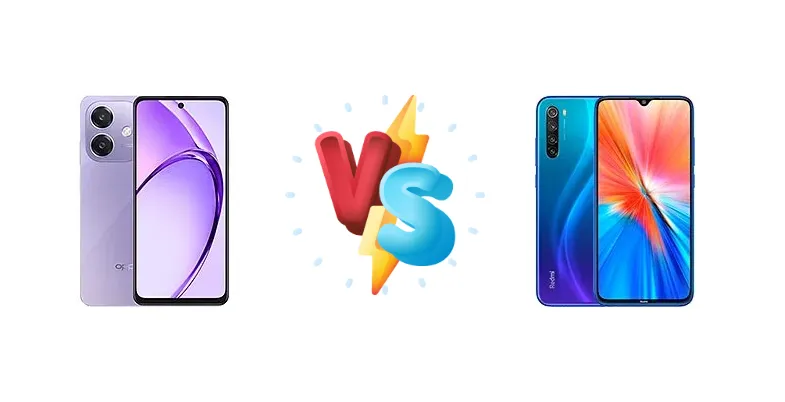
The Oppo A3 4G and Xiaomi Redmi Note 8 2021 represent compelling options in the crowded budget smartphone market. While both aim to deliver essential features at an accessible price, they take different approaches to achieving this. The A3 4G prioritizes faster charging and a newer chipset, while the Redmi Note 8 2021 focuses on established reliability and a proven endurance rating. This comparison dissects their key differences to determine which device offers the best value.
🏆 Quick Verdict
For the average user prioritizing quick top-ups and slightly better processing power, the Oppo A3 4G emerges as the winner. Its 45W charging significantly outperforms the Redmi Note 8 2021’s 18W, and the Snapdragon 6s Gen 1 offers a modest performance edge. However, the Redmi Note 8 2021 remains a solid choice for those valuing long-term battery endurance.
| Network |
|---|
| 2G bands | GSM 850 / 900 / 1800 / 1900 | GSM 850 / 900 / 1800 / 1900 |
| 3G bands | HSDPA 800 / 850 / 900 / 1700(AWS) / 1900 / 2100 - version 1 | HSDPA 850 / 900 / 1700(AWS) / 1900 / 2100 |
| 4G bands | 1, 2, 3, 4, 5, 7, 8, 12, 13, 17, 18, 19, 26, 28, 38, 40, 41, 66 - version 1 | 1, 2, 3, 4, 5, 7, 8, 20, 28, 38, 40 |
| Speed | HSPA, LTE | HSPA, LTE |
| Technology | GSM / HSPA / LTE | GSM / HSPA / LTE |
| Launch |
|---|
| Announced | 2024, August 20 | 2021, May 25 |
| Status | Available. Released 2024, August 20 | Available. Released 2021, May 27 |
| Body |
|---|
| Build | - | Glass front (Gorilla Glass 5), glass back (Gorilla Glass 5), plastic frame |
| Dimensions | 165.8 x 76.1 x 7.7 mm (6.53 x 3.00 x 0.30 in) | 158.3 x 75.3 x 8.4 mm (6.23 x 2.96 x 0.33 in) |
| SIM | Nano-SIM + Nano-SIM | Nano-SIM + Nano-SIM |
| Weight | 186 g (6.56 oz) | 190 g (6.70 oz) |
| Display |
|---|
| Protection | Panda glass | Corning Gorilla Glass 5 |
| Resolution | 720 x 1604 pixels, 20:9 ratio (~264 ppi density) | 1080 x 2340 pixels, 19.5:9 ratio (~409 ppi density) |
| Size | 6.67 inches, 107.2 cm2 (~85.0% screen-to-body ratio) | 6.3 inches, 97.4 cm2 (~81.7% screen-to-body ratio) |
| Type | IPS LCD, 90Hz, 1000 nits (HBM) | IPS LCD, 500 nits (typ) |
| Platform |
|---|
| CPU | Octa-core (4x2.1 GHz Cortex-A73 & 4x1.8 GHz Cortex-A53) | Octa-core (2x2.0 GHz Cortex-A75 & 6x1.8 GHz Cortex-A55) |
| Chipset | Qualcomm SM-6115 Snapdragon 6s 4G Gen1 (11 nm) | Mediatek MT6769Z Helio G85 (12 nm) |
| GPU | Adreno 610 | Mali-G52 MC2 |
| OS | Android 14, ColorOS 14 | Android 11, MIUI 12.5 |
| Memory |
|---|
| Card slot | microSDXC | microSDXC (dedicated slot) |
| Internal | 128GB 4GB RAM, 128GB 6GB RAM, 128GB 8GB RAM, 256GB 4GB RAM, 256GB 6GB RAM, 256GB 8GB RAM | 64GB 3GB RAM, 64GB 4GB RAM, 128GB 4GB RAM |
| | - | eMMC 5.1 |
| Main Camera |
|---|
| Dual | 50 MP, f/1.8, (wide), PDAF
Auxiliary lens | - |
| Features | LED flash, HDR, panorama | LED flash, HDR, panorama |
| Quad | - | 48 MP, f/1.8, 26mm (wide), 1/2.0", 0.8µm, PDAF
8 MP, f/2.2, 120˚ (ultrawide), 1/4.0", 1.12µm
2 MP (macro)
Auxiliary lens |
| Single | - | 13 MP, f/2.0, (wide), 1/3.1", 1.12µm |
| Video | 1080p@30/60fps | 1080p@30/120fps; gyro-EIS |
| Selfie camera |
|---|
| Features | - | HDR, panorama |
| Single | 5 MP, f/2.2, (wide) | 13 MP, f/2.0, (wide), 1/3.1", 1.12µm |
| Video | 1080p@30fps | 1080p@30fps |
| Sound |
|---|
| 3.5mm jack | - | Yes |
| 35mm jack | Yes | Yes |
| Loudspeaker | Yes | Yes |
| Comms |
|---|
| Bluetooth | 5.0, A2DP, LE | 5.2, A2DP, LE |
| Infrared port | - | Yes |
| NFC | Yes, 360˚ (market/region dependent) | No |
| Positioning | GPS, GALILEO, GLONASS, BDS, QZSS | GPS, GLONASS, GALILEO, BDS |
| Radio | Unspecified | FM radio |
| USB | USB Type-C 2.0, OTG | USB Type-C 2.0, OTG |
| WLAN | Wi-Fi 802.11 a/b/g/n/ac, dual-band | Wi-Fi 802.11 a/b/g/n/ac, dual-band, Wi-Fi Direct |
| Features |
|---|
| Sensors | Fingerprint (side-mounted), accelerometer, proximity, compass | Fingerprint (rear-mounted), accelerometer, gyro, proximity, compass |
| Battery |
|---|
| Charging | 45W wired, PD2.0, PPS, 50% in 30 min | 18W wired |
| Type | 5100 mAh | Li-Po 4000 mAh |
| Misc |
|---|
| Colors | Sparkle Black, Starry Purple, Starlight White | Neptune Blue, Moonlight White, Space Black |
| Models | CPH2669, CPH3669 | M1908C3JGG |
| Price | About 150 EUR | About 160 EUR |
| SAR | - | 0.97 W/kg (head) 0.75 W/kg (body) |
| SAR EU | - | 0.57 W/kg (head) 0.94 W/kg (body) |
| Tests |
|---|
| Battery life | - |
Endurance rating 102h
|
| Camera | - |
Photo / Video |
| Display | - |
Contrast ratio: 1487:1 (nominal) |
| Loudspeaker | - |
-28.6 LUFS (Average)
|
| Performance | - |
AnTuTu: 180195 (v8), 165779 (v9)
GeekBench: 5259 (v4.4), 1314 (v5.1)
GFXBench: 8.7fps (ES 3.1 onscreen) |
Oppo A3 4G
- 45W Fast Charging with PD/PPS
- More Efficient Snapdragon 6s Gen 1 Chipset
- Potentially better thermal management
- Battery capacity not specified
- Camera specifications are unknown
Xiaomi Redmi Note 8 2021
- Excellent 102-hour Endurance Rating
- 620 nits Peak Brightness
- Proven Reliability
- Slow 18W Charging
- Less Powerful Helio G85 Chipset
- Older Processor
Display Comparison
Both devices share a contrast ratio of 1487:1, suggesting similar visual depth. However, the Redmi Note 8 2021 boasts a measured peak brightness of 620 nits, providing better visibility in direct sunlight. While the Oppo A3 4G’s display specifications are not provided, it’s reasonable to assume it falls within a similar range given its market positioning. The lack of high refresh rate panels on either device is typical for this price segment, focusing instead on maximizing battery efficiency.
Camera Comparison
Both phones offer 'Photo / Video' capabilities, but detailed camera specifications are limited. Without information on sensor size, aperture, or image processing algorithms, a direct comparison is difficult. It’s likely both devices rely on multi-camera setups with a primary sensor and supporting lenses. The absence of details suggests neither phone is positioned as a photography powerhouse, focusing instead on providing adequate image capture for social media and casual use. We can assume the Redmi Note 8 2021's camera is well-established and has a known software profile.
Performance
The Oppo A3 4G’s Qualcomm Snapdragon 6s Gen 1 (11nm) and the Redmi Note 8 2021’s MediaTek Helio G85 (12nm) represent different approaches to mobile processing. The Snapdragon 6s Gen 1 utilizes a more efficient 11nm process, potentially leading to better thermal management during sustained workloads. Its CPU configuration – 4x2.1 GHz Cortex-A73 & 4x1.8 GHz Cortex-A53 – is paired with an Adreno 615 GPU. The Helio G85, with its 2x2.0 GHz Cortex-A75 & 6x1.8 GHz Cortex-A55 configuration and Mali-G52 MC2 GPU, prioritizes raw CPU power in its prime cores, but the larger 12nm process may result in higher power consumption. This translates to a slight edge for the Oppo A3 4G in sustained performance and efficiency.
Battery Life
The Redmi Note 8 2021 boasts an impressive endurance rating of 102 hours, indicating excellent battery life under typical usage. However, the Oppo A3 4G compensates with significantly faster 45W wired charging, supporting PD2.0 and PPS for optimized charging speeds – capable of reaching 50% charge in just 30 minutes. The Redmi Note 8 2021’s 18W charging is considerably slower. While the A3 4G’s battery capacity isn’t specified, the faster charging mitigates concerns about a potentially smaller battery, allowing for quick top-ups throughout the day.
Buying Guide
Buy the Oppo A3 4G if you frequently find yourself needing to quickly recharge your phone and appreciate a slightly more modern processor for smoother multitasking. Buy the Xiaomi Redmi Note 8 2021 if you prioritize all-day battery life and a proven track record of reliability, even if it means slower charging and a less powerful chipset. Consider the Redmi Note 8 2021 if you are a very light user who doesn't need fast processing.
Frequently Asked Questions
❓ How much faster is the Oppo A3 4G's charging compared to the Redmi Note 8 2021 in real-world use?
The Oppo A3 4G's 45W charging can take a phone from 0% to 50% in approximately 30 minutes, while the Redmi Note 8 2021's 18W charging will take significantly longer – likely over 1.5 to 2 hours to reach the same level. This difference is crucial for users who frequently need to quickly top up their battery.
❓ Will the Snapdragon 6s Gen 1 in the Oppo A3 4G handle demanding games like PUBG or Call of Duty?
The Snapdragon 6s Gen 1 is capable of running PUBG and Call of Duty, but likely at medium graphics settings to maintain a stable frame rate. The Helio G85 in the Redmi Note 8 2021 offers similar gaming performance, but the A3 4G's more efficient chipset may result in slightly less thermal throttling during extended gaming sessions.
❓ Is the Redmi Note 8 2021 still a good option in 2024, considering its age?
Yes, the Redmi Note 8 2021 remains a viable option for users prioritizing battery life and a reliable, well-established device. Its 102-hour endurance rating is still impressive, and it offers a solid overall experience for basic smartphone tasks. However, it lacks the faster charging and newer processor of the Oppo A3 4G.