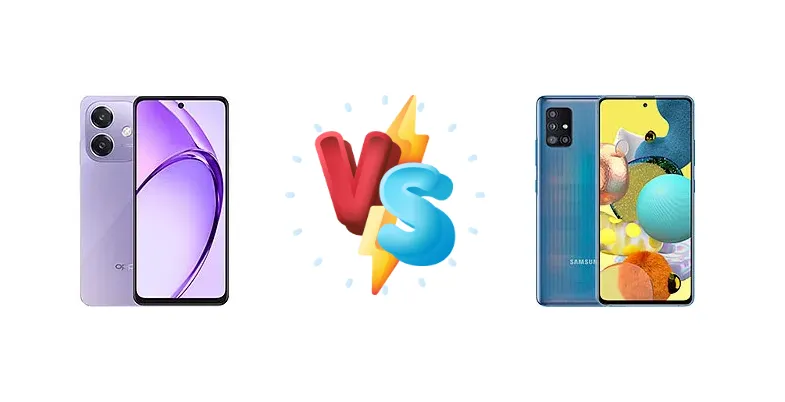
The Oppo A3 4G and Samsung Galaxy A51 5G UW represent different approaches to the mid-range smartphone market. The A3 prioritizes rapid charging and a streamlined experience, while the A51 5G UW aims for future-proofing with 5G connectivity and a more powerful chipset. This comparison dissects their key differences to determine which device delivers the best value.
🏆 Quick Verdict
For the average user prioritizing future-proofing and overall performance, the Samsung Galaxy A51 5G UW is the better choice. Its Snapdragon 765G chipset, built on a 7nm process, offers a significant performance advantage over the Oppo A3 4G’s Snapdragon 6s Gen 1, despite the A3’s faster charging.
| Network |
|---|
| 2G bands | GSM 850 / 900 / 1800 / 1900 | GSM 850 / 900 / 1800 / 1900 |
| 3G bands | HSDPA 800 / 850 / 900 / 1700(AWS) / 1900 / 2100 - version 1 | HSDPA 850 / 900 / 1900 / 2100 |
| 4G bands | 1, 2, 3, 4, 5, 7, 8, 12, 13, 17, 18, 19, 26, 28, 38, 40, 41, 66 - version 1 | 2, 4, 5, 13, 66 |
| 5G bands | - | 260, 261 mmWave |
| Speed | HSPA, LTE | HSPA, LTE, 5G |
| Technology | GSM / HSPA / LTE | GSM / HSPA / LTE / 5G |
| Launch |
|---|
| Announced | 2024, August 20 | 2020, August 14 |
| Status | Available. Released 2024, August 20 | Available. Released 2020, August 14 |
| Body |
|---|
| Build | - | Glass front (Gorilla Glass 3), plastic back, aluminum frame |
| Dimensions | 165.8 x 76.1 x 7.7 mm (6.53 x 3.00 x 0.30 in) | 158.8 x 73.4 x 8.6 mm (6.25 x 2.89 x 0.34 in) |
| SIM | Nano-SIM + Nano-SIM | Nano-SIM (pre-installed) |
| Weight | 186 g (6.56 oz) | 188.8 g (6.67 oz) |
| Display |
|---|
| Protection | Panda glass | Corning Gorilla Glass 3 |
| Resolution | 720 x 1604 pixels, 20:9 ratio (~264 ppi density) | 1080 x 2400 pixels, 20:9 ratio (~405 ppi density) |
| Size | 6.67 inches, 107.2 cm2 (~85.0% screen-to-body ratio) | 6.5 inches, 102.0 cm2 (~87.5% screen-to-body ratio) |
| Type | IPS LCD, 90Hz, 1000 nits (HBM) | Super AMOLED |
| Platform |
|---|
| CPU | Octa-core (4x2.1 GHz Cortex-A73 & 4x1.8 GHz Cortex-A53) | Octa-core (1x2.4 GHz Kryo 475 Prime & 1x2.2 GHz Kryo 475 Gold & 6x1.8 GHz Kryo 475 Silver) |
| Chipset | Qualcomm SM-6115 Snapdragon 6s 4G Gen1 (11 nm) | Qualcomm SM7250 Snapdragon 765G 5G (7 nm) |
| GPU | Adreno 610 | Adreno 620 |
| OS | Android 14, ColorOS 14 | Android 10, One UI 2 |
| Memory |
|---|
| Card slot | microSDXC | microSDXC (uses shared SIM slot) |
| Internal | 128GB 4GB RAM, 128GB 6GB RAM, 128GB 8GB RAM, 256GB 4GB RAM, 256GB 6GB RAM, 256GB 8GB RAM | 128GB 6GB RAM |
| | - | UFS 2.1 |
| Main Camera |
|---|
| Dual | 50 MP, f/1.8, (wide), PDAF
Auxiliary lens | - |
| Features | LED flash, HDR, panorama | LED flash, panorama, HDR |
| Quad | - | 48 MP, f/2.0, 26mm (wide), 1/2.0", 0.8µm, PDAF
12 MP, f/2.2, 123˚ (ultrawide)
5 MP (macro)
Auxiliary lens |
| Single | - | 5 MP, AF |
| Video | 1080p@30/60fps | 4K@30fps, 1080p@30/120fps; gyro-EIS |
| Selfie camera |
|---|
| Features | - | HDR |
| Single | 5 MP, f/2.2, (wide) | 32 MP, f/2.2, 26mm (wide), 1/2.8", 0.8µm |
| Video | 1080p@30fps | 4K@30fps, 1080p@30fps |
| Sound |
|---|
| 3.5mm jack | - | Yes |
| 35mm jack | Yes | Yes |
| Loudspeaker | Yes | Yes |
| Comms |
|---|
| Bluetooth | 5.0, A2DP, LE | 5.0, A2DP, LE |
| NFC | Yes, 360˚ (market/region dependent) | Yes |
| Positioning | GPS, GALILEO, GLONASS, BDS, QZSS | GPS, GLONASS, GALILEO, BDS |
| Radio | Unspecified | FM radio, RDS, recording |
| USB | USB Type-C 2.0, OTG | USB Type-C 2.0, OTG |
| WLAN | Wi-Fi 802.11 a/b/g/n/ac, dual-band | Wi-Fi 802.11 a/b/g/n/ac, dual-band, Wi-Fi Direct |
| Features |
|---|
| Sensors | Fingerprint (side-mounted), accelerometer, proximity, compass | Fingerprint (under display, optical), accelerometer, gyro, proximity, compass |
| | - | ANT+ |
| Battery |
|---|
| Charging | 45W wired, PD2.0, PPS, 50% in 30 min | 15W wired |
| Stand-by | - | Up to 672 h |
| Talk time | - | Up to 5 h |
| Type | 5100 mAh | Li-Po 4500 mAh |
| Misc |
|---|
| Colors | Sparkle Black, Starry Purple, Starlight White | Prism Bricks Blue |
| Models | CPH2669, CPH3669 | SM-A516V |
| Price | About 150 EUR | About 470 EUR |
| SAR | - | 0.70 W/kg (head) 1.25 W/kg (body) |
| SAR EU | - | 0.59 W/kg (head) 1.32 W/kg (body) |
Oppo A3 4G
- Blazing-fast 45W charging
- Potentially more affordable price point
- Sufficient performance for basic tasks
- Less powerful Snapdragon 6s Gen 1 chipset
- Lacks 5G connectivity
- Potentially lower-quality display
Samsung Galaxy A51 5G UW
- More powerful Snapdragon 765G chipset
- 5G connectivity for future-proofing
- Superior image processing capabilities
- Significantly slower 15W charging
- Potentially higher price
- May experience more throttling under sustained load
Display Comparison
Neither device’s display specifications are provided, so a direct comparison is limited. However, given the A51 5G UW’s positioning as a slightly more premium device, it likely features a higher-quality panel with potentially better color accuracy and brightness. The A3 4G, focusing on cost-effectiveness, may utilize a more basic LCD panel. Bezels are likely comparable, typical of this price segment.
Camera Comparison
Without detailed camera specifications, a definitive comparison is difficult. However, the A51 5G UW’s positioning suggests a more capable camera system. The Snapdragon 765G’s image signal processor (ISP) is more advanced than the one found in the Snapdragon 6s Gen 1, enabling better image processing and potentially superior low-light performance. It’s reasonable to assume the A51 5G UW has a larger main sensor and potentially optical image stabilization (OIS), features that would significantly improve image quality. The prevalence of low-resolution macro lenses on both devices suggests they are primarily for marketing purposes and offer limited real-world benefit.
Performance
The Samsung Galaxy A51 5G UW’s Qualcomm Snapdragon 765G (7nm) represents a substantial leap in processing power over the Oppo A3 4G’s Snapdragon 6s Gen 1 (11nm). The 7nm fabrication process inherently offers better power efficiency and thermal performance. The 765G’s CPU configuration – a 1x2.4 GHz Kryo 475 Prime core, 1x2.2 GHz Kryo 475 Gold core, and 6x1.8 GHz Kryo 475 Silver cores – is architecturally more advanced than the A3’s Octa-core (4x2.1 GHz Cortex-A73 & 4x1.8 GHz Cortex-A53). This translates to faster app loading times, smoother multitasking, and improved gaming performance on the Samsung device. The 765G also includes an integrated 5G modem, a feature absent in the A3 4G.
Battery Life
While battery capacities are not specified, the Oppo A3 4G’s 45W wired charging is a clear advantage. This allows for a 50% charge in just 30 minutes, significantly reducing downtime. The Samsung Galaxy A51 5G UW’s 15W charging is considerably slower. However, the Snapdragon 765G’s superior power efficiency may partially offset the slower charging, potentially resulting in comparable real-world battery life despite a potentially smaller battery capacity on the Samsung device. The faster charging of the Oppo A3 4G will be particularly beneficial for users who frequently need to top up their battery quickly.
Buying Guide
Buy the Oppo A3 4G if you absolutely need the fastest possible charging speeds and primarily use your phone for basic tasks like calling, texting, and social media. Buy the Samsung Galaxy A51 5G UW if you want a phone capable of handling more demanding applications, benefit from 5G connectivity, and appreciate a more robust processor for future software updates and app compatibility.
Frequently Asked Questions
❓ Will the Snapdragon 765G in the A51 5G UW handle demanding games like Genshin Impact?
The Snapdragon 765G is capable of running Genshin Impact, but you’ll likely need to lower the graphics settings to medium or low to maintain a stable frame rate. The 765G’s Adreno 620 GPU is a significant step up from the A3’s GPU, but it’s not a flagship-level performer.
❓ How much faster is the 45W charging on the Oppo A3 4G compared to the 15W charging on the A51 5G UW?
The 45W charging on the A3 4G is dramatically faster. Oppo claims a 50% charge in 30 minutes. The A51 5G UW’s 15W charging will take considerably longer – likely over 1.5 to 2 hours for a full charge, depending on battery capacity. This makes the A3 ideal for users who need quick top-ups.
❓ Does the Samsung Galaxy A51 5G UW support sub-6GHz 5G, or is it limited to mmWave?
The 'UW' designation in the Samsung Galaxy A51 5G UW indicates support for Ultra Wideband (mmWave) 5G, in addition to sub-6GHz 5G. However, mmWave coverage is currently limited to specific areas, so the benefit depends on your location and carrier.