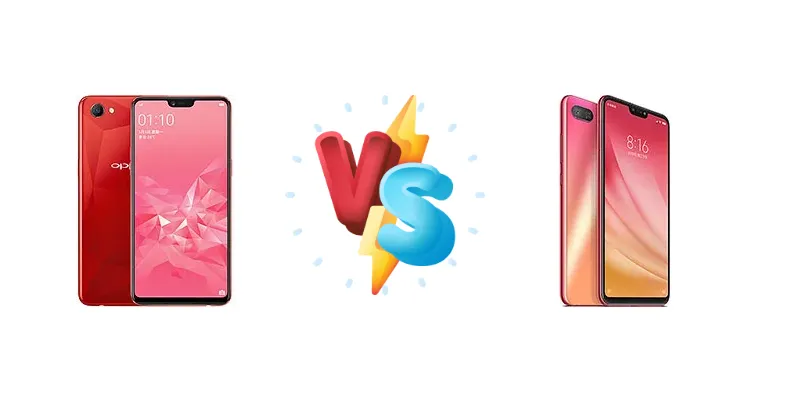
Released in 2018, the Oppo A3 and Xiaomi Mi 8 Lite represented compelling options in the increasingly competitive mid-range smartphone market. Both aimed to deliver a balance of features and performance without breaking the bank. This comparison dissects their key differences, focusing on chipset architecture, display characteristics, and battery endurance to determine which device offers the best value today.
🏆 Quick Verdict
For the average user prioritizing sustained performance and slightly faster charging, the Xiaomi Mi 8 Lite emerges as the better choice. Its Snapdragon 660, built on a 14nm process, generally offers more consistent performance under load compared to the Oppo A3’s Helio P60, despite the latter’s newer architecture.
| Network |
|---|
| 2G bands | GSM 850 / 900 / 1800 / 1900 | GSM 850 / 900 / 1800 / 1900 |
| 3G bands | HSDPA 850 / 900 / 1900 / 2100 | HSDPA 850 / 900 / 1700(AWS) / 1900 / 2100 - Global |
| 4G bands | 1, 3, 5, 7, 8, 34, 38, 39, 40, 41 | 1, 2, 3, 4, 5, 7, 8, 20, 28, 38, 40 - Global |
| Speed | HSPA 42.2/5.76 Mbps, LTE (2CA) Cat13 600/100 Mbps | HSPA 42.2/5.76 Mbps, LTE (2CA) Cat6 300/50 Mbps |
| Technology | GSM / CDMA / HSPA / LTE | GSM / CDMA / HSPA / LTE |
| | - | 1, 3, 5, 7, 8, 34, 38, 39, 40, 41 - China |
| Launch |
|---|
| Announced | 2018, April. Released 2018, May | 2018, September. Released 2018, September |
| Status | Discontinued | Discontinued |
| Body |
|---|
| Build | - | Glass front, glass back, aluminum frame |
| Dimensions | 156 x 75.3 x 7.8 mm (6.14 x 2.96 x 0.31 in) | 156.4 x 75.8 x 7.5 mm (6.16 x 2.98 x 0.30 in) |
| SIM | Nano-SIM + Nano-SIM | Nano-SIM + Nano-SIM |
| Weight | 159 g (5.61 oz) | 169 g (5.96 oz) |
| Display |
|---|
| Resolution | 1080 x 2280 pixels, 19:9 ratio (~405 ppi density) | 1080 x 2280 pixels, 19:9 ratio (~403 ppi density) |
| Size | 6.2 inches, 96.9 cm2 (~82.5% screen-to-body ratio) | 6.26 inches, 97.8 cm2 (~82.5% screen-to-body ratio) |
| Type | IPS LCD | IPS LCD |
| Platform |
|---|
| CPU | Octa-core (4x2.0 GHz Cortex-A73 & 4x2.0 GHz Cortex-A53) | Octa-core (4x2.2 GHz Kryo 260 Gold & 4x1.8 GHz Kryo 260 Silver) |
| Chipset | Mediatek MT6771 Helio P60 (12 nm) | Qualcomm SDM660 Snapdragon 660 (14 nm) |
| GPU | Mali-G72 MP3 | Adreno 512 |
| OS | Android 8.1 (Oreo), ColorOS 5 | Android 8.1 (Oreo), upgradable to Android 10, MIUI 11 |
| Memory |
|---|
| Card slot | microSDXC (dedicated slot) | microSDXC (uses shared SIM slot) |
| Internal | 128GB 4GB RAM | 64GB 4GB RAM, 64GB 6GB RAM, 128GB 4GB RAM, 128GB 6GB RAM |
| | - | eMMC 5.1 |
| Main Camera |
|---|
| Dual | - | 12 MP, f/1.9, 1/2.55", 1.4µm, dual pixel PDAF
Auxiliary lens |
| Features | LED flash, HDR, panorama | LED flash, HDR, panorama |
| Single | 16 MP, f/1.8, PDAF | - |
| Video | 1080p@30fps | 4K@30fps, 1080p@60/120fps, 1080p@30fps (gyro-EIS) |
| Selfie camera |
|---|
| Features | - | Auto HDR |
| Single | 8 MP, f/2.2 | 24 MP, f/2.0, 26mm (wide), 1/2.8", 0.9µm |
| Video | - | 1080p@30fps |
| Sound |
|---|
| 3.5mm jack | - | No |
| 35mm jack | Yes | No |
| Loudspeaker | Yes | Yes |
| Comms |
|---|
| Bluetooth | 4.2, A2DP, LE | 5.0, A2DP, LE |
| NFC | No | No |
| Positioning | GPS | GPS, GLONASS, BDS |
| Radio | FM radio | No |
| USB | microUSB 2.0, OTG | USB Type-C |
| WLAN | Wi-Fi 802.11 b/g/n/ac, dual-band, Wi-Fi Direct | Wi-Fi 802.11 a/b/g/n/ac, dual-band, Wi-Fi Direct |
| Features |
|---|
| Sensors | Accelerometer, gyro, proximity, compass | Fingerprint (rear-mounted), accelerometer, gyro, proximity, compass |
| Battery |
|---|
| Charging | - | 18W wired, QC3 |
| Type | Li-Ion 3400 mAh, non-removable | Li-Po 3350 mAh, non-removable |
| Misc |
|---|
| Colors | Knight Black, Soybean Meal, Stardust Silver, Garnet Red | Midnight Black, Aurora Blue, Twilight Gold |
| Models | PADM00, CPH1837, PADT00 | M1808D2TG |
| Price | About 330 EUR | About 360 EUR |
| SAR | - | 0.75 W/kg (head) 1.58 W/kg (body) |
| Tests |
|---|
| Audio quality | - |
Noise -93.5dB / Crosstalk -35.4dB |
| Battery life | - |
Endurance rating 77h
|
| Camera | - |
Photo / Video |
| Display | - |
Contrast ratio: 1453 (nominal), 2.862 (sunlight) |
| Loudspeaker | - |
Voice 67dB / Noise 77dB / Ring 77dB
|
| Performance | - |
AnTuTu: 143257 (v7)
GeekBench: 5894 (v4.4)
GFXBench: 8fps (ES 3.1 onscreen) |
Oppo A3 (2018)
- Sleek design (based on market perception)
- Potentially better power efficiency due to 12nm process (theoretical)
- Competitive price point (at launch)
- Helio P60 chipset may throttle under sustained load
- Charging specifications are unknown
- Limited information on camera capabilities
Xiaomi Mi 8 Lite
- Snapdragon 660 offers better sustained performance
- 18W Quick Charge 3.0 support for faster charging
- Likely more refined camera software
- 14nm process is less efficient than 12nm (theoretical)
- Display specifications are limited
- May be slightly more expensive than the Oppo A3
Display Comparison
Both the Oppo A3 and Xiaomi Mi 8 Lite feature displays with a nominal contrast ratio of 1453 and a sunlight contrast ratio of 2.862, suggesting similar visibility in bright outdoor conditions. However, detailed panel specifications like resolution and refresh rate are missing. Given the market positioning, both likely utilized IPS LCD panels. The lack of information prevents a definitive judgment on color accuracy or viewing angles, but the comparable contrast ratios indicate a similar viewing experience in most lighting scenarios.
Camera Comparison
Both phones are listed as having 'Photo / Video' capabilities, but specific details are absent. Without sensor size, aperture, or image processing details, a direct comparison is impossible. However, given Xiaomi’s historical emphasis on camera features, the Mi 8 Lite likely benefits from more refined software algorithms. The absence of any mention of OIS (Optical Image Stabilization) suggests neither phone features this technology, potentially resulting in less stable video recording and lower-quality low-light photos.
Performance
The core difference lies in the chipsets: the Oppo A3 utilizes the MediaTek Helio P60 (MT6771), a 12nm processor, while the Xiaomi Mi 8 Lite features the Qualcomm Snapdragon 660 (SDM660) built on a 14nm process. While the Helio P60’s newer 12nm node *should* theoretically offer better power efficiency, the Snapdragon 660’s Kryo 260 cores (4x2.2 GHz Gold & 4x1.8 GHz Silver) generally outperform the Helio P60’s Cortex-A73/A53 configuration (4x2.0 GHz each). The Snapdragon 660’s architecture is optimized for sustained performance, meaning less throttling during prolonged use. This translates to a smoother experience in demanding apps and games.
Battery Life
Interestingly, both the Oppo A3 and Xiaomi Mi 8 Lite share an endurance rating of 77 hours. However, the Xiaomi Mi 8 Lite supports 18W wired charging with Quick Charge 3.0 (QC3), while the Oppo A3’s charging capabilities are unspecified. QC3 allows for faster charging speeds, reducing the time needed to replenish the battery. This faster charging capability, combined with the Snapdragon 660’s potentially more efficient power management, gives the Mi 8 Lite a slight edge in real-world usability.
Buying Guide
Buy the Oppo A3 (2018) if you prioritize a sleek design and are primarily focused on everyday tasks like social media and light browsing. Buy the Xiaomi Mi 8 Lite if you prefer a phone capable of handling more demanding applications, enjoy occasional gaming, and appreciate the convenience of Quick Charge 3.0 support.
Frequently Asked Questions
❓ Will the Helio P60 in the Oppo A3 struggle with graphically intensive games like PUBG Mobile?
The Helio P60 can run PUBG Mobile, but you may experience frame drops and stuttering, especially on higher graphics settings. The Snapdragon 660 in the Mi 8 Lite offers a smoother gaming experience due to its more powerful GPU and better thermal management.
❓ Does the Xiaomi Mi 8 Lite's Quick Charge 3.0 require a special charger, or will any USB charger work?
While any USB charger will *work*, to take full advantage of the 18W Quick Charge 3.0 capabilities, you'll need a charger that specifically supports the Quick Charge protocol. Using a standard charger will result in significantly slower charging times.
❓ Given both phones have similar battery endurance ratings, does that mean they'll last the same amount of time on a single charge?
Not necessarily. The endurance rating is a standardized test, but real-world usage varies. The Snapdragon 660’s potentially more efficient power management, combined with the faster charging, means the Mi 8 Lite may feel more usable throughout the day, even with similar overall battery life.