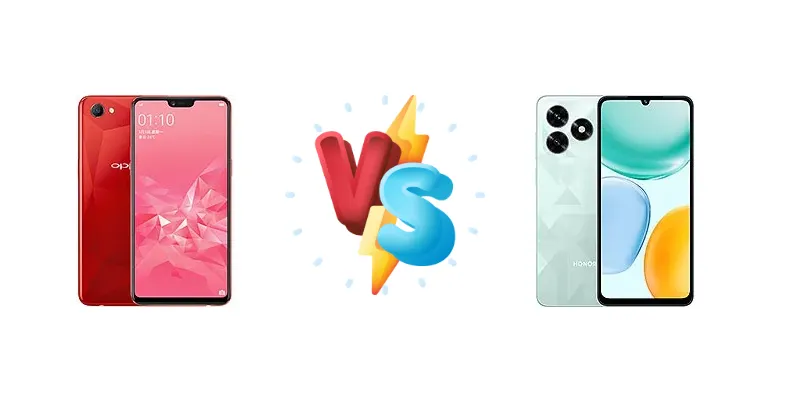
The Oppo A3 (2018) and Honor Play10A represent different approaches to the budget smartphone market. The A3, released in 2018, offers a proven platform, while the Play10A, a more recent device, leverages newer Mediatek silicon. This comparison dissects the key differences between the Mediatek Helio P60 and Helio G81 chipsets to determine which phone delivers the best experience for everyday users.
🏆 Quick Verdict
For most users, the Honor Play10A is the better choice. While the Oppo A3 (2018) remains a capable device, the Helio G81 in the Play10A provides a noticeable performance uplift, particularly in gaming and multitasking, and benefits from the inclusion of 15W charging, making it a more modern and versatile option.
| Network |
|---|
| 2G bands | GSM 850 / 900 / 1800 / 1900 | GSM 850 / 900 / 1800 / 1900 |
| 3G bands | HSDPA 850 / 900 / 1900 / 2100 | HSDPA 850 / 900 / 1900 / 2100 |
| 4G bands | 1, 3, 5, 7, 8, 34, 38, 39, 40, 41 | LTE |
| Speed | HSPA 42.2/5.76 Mbps, LTE (2CA) Cat13 600/100 Mbps | HSPA, LTE |
| Technology | GSM / CDMA / HSPA / LTE | GSM / HSPA / LTE |
| Launch |
|---|
| Announced | 2018, April. Released 2018, May | 2025, October 23 |
| Status | Discontinued | Available. Released 2025, October 23 |
| Body |
|---|
| Dimensions | 156 x 75.3 x 7.8 mm (6.14 x 2.96 x 0.31 in) | 167 x 77 x 7.9 mm (6.57 x 3.03 x 0.31 in) |
| SIM | Nano-SIM + Nano-SIM | Nano-SIM + Nano-SIM |
| Weight | 159 g (5.61 oz) | 186 g (6.56 oz) |
| Display |
|---|
| Resolution | 1080 x 2280 pixels, 19:9 ratio (~405 ppi density) | 720 x 1600 pixels, 20:9 ratio (~260 ppi density) |
| Size | 6.2 inches, 96.9 cm2 (~82.5% screen-to-body ratio) | 6.74 inches, 109.7 cm2 (~85.3% screen-to-body ratio) |
| Type | IPS LCD | TFT LCD, 90Hz |
| Platform |
|---|
| CPU | Octa-core (4x2.0 GHz Cortex-A73 & 4x2.0 GHz Cortex-A53) | Octa-core (2x2.0 GHz Cortex-A75 & 6x1.7 GHz Cortex-A55) |
| Chipset | Mediatek MT6771 Helio P60 (12 nm) | Mediatek Helio G81 (12 nm) |
| GPU | Mali-G72 MP3 | Mali-G52 MC2 |
| OS | Android 8.1 (Oreo), ColorOS 5 | Android 15, MagicOS 9 |
| Memory |
|---|
| Card slot | microSDXC (dedicated slot) | microSDXC (uses shared SIM slot) |
| Internal | 128GB 4GB RAM | 128GB 4GB RAM |
| Main Camera |
|---|
| Features | LED flash, HDR, panorama | LED flash, HDR, panorama |
| Single | 16 MP, f/1.8, PDAF | 50 MP, f/1.8, (wide), PDAF
Auxiliary lens |
| Video | 1080p@30fps | 1080p@30fps |
| Selfie camera |
|---|
| Single | 8 MP, f/2.2 | 5 MP, f/2.2, (wide) |
| Video | - | 1080p@30fps |
| Sound |
|---|
| 35mm jack | Yes | Yes |
| Loudspeaker | Yes | Yes |
| Comms |
|---|
| Bluetooth | 4.2, A2DP, LE | 5.1, A2DP, LE, aptX HD |
| NFC | No | No |
| Positioning | GPS | GPS, GLONASS, GALILEO, BDS |
| Radio | FM radio | FM radio |
| USB | microUSB 2.0, OTG | USB Type-C 2.0, OTG |
| WLAN | Wi-Fi 802.11 b/g/n/ac, dual-band, Wi-Fi Direct | Wi-Fi 802.11 a/b/g/n/ac, dual-band, Wi-Fi Direct |
| Features |
|---|
| Sensors | Accelerometer, gyro, proximity, compass | Fingerprint (side-mounted), accelerometer, proximity |
| Battery |
|---|
| Charging | - | 15W wired |
| Type | Li-Ion 3400 mAh, non-removable | Li-Po 5260 mAh |
| Misc |
|---|
| Colors | Knight Black, Soybean Meal, Stardust Silver, Garnet Red | Ocean Cyan |
| Models | PADM00, CPH1837, PADT00 | NLA-LX3 |
| Price | About 330 EUR | About 80 EUR |
Oppo A3 (2018)
- Established platform with a known track record.
- Potentially lower price point due to age.
- Reliable performance for basic tasks.
- Older chipset with lower performance.
- Likely slower charging speeds.
- Potentially limited software support.
Honor Play10A
- More powerful Helio G81 chipset.
- Faster 15W wired charging.
- More modern software experience.
- Improved gaming performance.
- May be slightly more expensive.
- Brand recognition may be lower than Oppo in some markets.
- Potential for bloatware (typical of Honor).
Display Comparison
Neither device boasts a standout display. Both utilize 12nm chipsets, suggesting a focus on efficiency over high-end display features. Without specific display specs for the Oppo A3, we can assume it features a standard LCD panel common for its price point at launch. The Honor Play10A’s display details are also missing, but given its market segment, it likely features a similar LCD panel. The absence of information regarding refresh rates or peak brightness suggests neither phone is geared towards media consumption or gaming with visually demanding graphics.
Camera Comparison
Without detailed camera specifications for either device, a direct comparison is difficult. However, it’s reasonable to assume both phones feature basic camera setups geared towards casual photography. The market segment suggests both will likely include a primary sensor, a depth sensor, and potentially a macro lens. The image processing capabilities of the Helio G81 may offer a slight advantage to the Honor Play10A, potentially resulting in better dynamic range and noise reduction, but this is speculative without sample images and detailed sensor information. The inclusion of Optical Image Stabilization (OIS) on either device is unlikely given their price points.
Performance
The core difference lies in the chipsets. The Oppo A3’s Mediatek Helio P60 utilizes a combination of Cortex-A73 and A53 cores, offering a balanced approach to performance. However, the Honor Play10A’s Helio G81 represents a generational leap. Its Cortex-A75 cores, while still clocked at 2.0 GHz, offer significantly improved single-core performance compared to the A73. The G81’s six Cortex-A55 cores, while more numerous than the A3’s four, are designed for efficiency, contributing to better sustained performance. This translates to snappier app launches, smoother multitasking, and a more responsive user experience on the Play10A, especially for users who frequently switch between applications. The G81 also benefits from improved GPU performance, making it the better choice for mobile gaming.
Battery Life
Battery capacity details are missing for the Oppo A3. The Honor Play10A includes 15W wired charging, a significant advantage over the Oppo A3, which likely supports slower charging speeds. While battery life ultimately depends on usage patterns, the more efficient Helio G81 in the Play10A, combined with faster charging, provides a more convenient and user-friendly experience. The 15W charging on the Play10A will allow for quicker top-ups throughout the day, reducing downtime.
Buying Guide
Buy the Oppo A3 (2018) if you prioritize a device with a known track record and are comfortable with potentially limited software support. It's a solid option for basic smartphone tasks. Buy the Honor Play10A if you value improved performance for gaming and demanding apps, faster charging, and a more current software experience, even if it means sacrificing the established reputation of the Oppo A3.
Frequently Asked Questions
❓ Will the Honor Play10A handle demanding games like PUBG Mobile smoothly?
The Helio G81 in the Honor Play10A is specifically designed for gaming. While it won't deliver flagship-level performance, it should handle PUBG Mobile at medium settings with a stable frame rate. The Oppo A3’s Helio P60 will struggle with consistent performance in demanding titles.
❓ How much of a difference will I notice in everyday tasks between the two phones?
You'll likely notice a difference in app launch speeds and multitasking. The Honor Play10A’s Helio G81 offers a more responsive experience, especially when switching between multiple apps. The Oppo A3 will feel adequate for basic tasks, but may exhibit slight lag when pushed.
❓ Is the software experience significantly different between Oppo and Honor?
Yes. Oppo’s ColorOS is known for its customization options, while Honor’s Magic UI (based on EMUI) has historically included more pre-installed apps (bloatware). Both offer a similar Android experience at their core, but the user interface and included features differ.
❓ Does the Honor Play10A support fast charging protocols beyond 15W?
The Honor Play10A officially supports 15W charging. While it may be compatible with some PD (Power Delivery) chargers, it won't necessarily charge faster than 15W. Using a higher wattage charger won't damage the device, but it won't provide a significant speed boost.