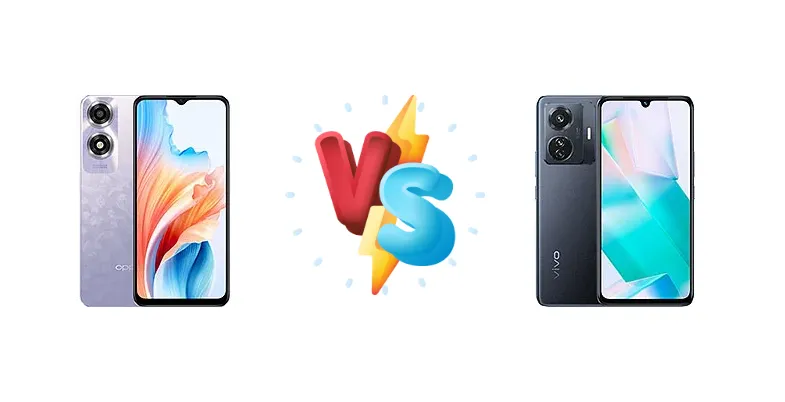
The mid-range smartphone market is fiercely competitive, and the Oppo A2x and vivo T1 Pro represent compelling options for budget-conscious buyers. While both aim to deliver a solid experience, they take different approaches to achieving it. The A2x focuses on a streamlined experience with a Mediatek Dimensity 6020, while the T1 Pro leverages the Qualcomm Snapdragon 778G 5G for a performance boost and significantly faster charging.
🏆 Quick Verdict
For most users, the vivo T1 Pro emerges as the stronger choice. Its Snapdragon 778G chipset offers a noticeable performance advantage over the Dimensity 6020 in the Oppo A2x, and the 66W charging is a game-changer, reducing downtime considerably. While the A2x is a capable device, the T1 Pro provides a more premium experience.
| Network |
|---|
| 2G bands | GSM 850 / 900 / 1800 / 1900 | GSM 850 / 900 / 1800 / 1900 |
| 3G bands | HSDPA 850 / 900 / 2100 | HSDPA 850 / 900 / 2100 |
| 4G bands | 1, 3, 5, 8, 28, 34, 38, 39, 40, 41 | 1, 3, 5, 8, 38, 40, 41 |
| 5G bands | 1, 5, 8, 28, 41, 77, 78 SA/NSA | 1, 3, 5, 8, 41, 77, 78 SA/NSA |
| Speed | HSPA, LTE, 5G | HSPA, LTE, 5G |
| Technology | GSM / HSPA / LTE / 5G | GSM / HSPA / LTE / 5G |
| Launch |
|---|
| Announced | 2023, October 12 | 2022, May 04 |
| Status | Available. Released 2023, October 16 | Available. Released 2022, May 07 |
| Body |
|---|
| Build | - | Glass front, plastic frame, plastic back |
| Dimensions | 163.8 x 75.1 x 8.1 mm (6.45 x 2.96 x 0.32 in) | 159.7 x 73.6 x 8.5 mm (6.29 x 2.90 x 0.33 in) |
| SIM | Nano-SIM + Nano-SIM | Nano-SIM + Nano-SIM |
| Weight | 185 g (6.53 oz) | 180.3 g (6.35 oz) |
| Display |
|---|
| Resolution | 720 x 1612 pixels, 20:9 ratio (~269 ppi density) | 1080 x 2404 pixels, 20:9 ratio (~409 ppi density) |
| Size | 6.56 inches, 103.4 cm2 (~84.0% screen-to-body ratio) | 6.44 inches, 100.0 cm2 (~85.1% screen-to-body ratio) |
| Type | IPS LCD, 90Hz, 720 nits (peak) | AMOLED, HDR10+, 1300 nits (peak) |
| Platform |
|---|
| CPU | Octa-core (2x2.2 GHz Cortex-A76 & 6x2.0 GHz Cortex-A55) | Octa-core (1x2.4 GHz Cortex-A78 & 3x2.2 GHz Cortex-A78 & 4x1.9 GHz Cortex-A55) |
| Chipset | Mediatek Dimensity 6020 (7 nm) | Qualcomm SM7325 Snapdragon 778G 5G (6 nm) |
| GPU | Mali-G57 MC2 | Adreno 642L |
| OS | Android 13, ColorOS 13.1 | Android 12, Funtouch 12 |
| Memory |
|---|
| Card slot | microSDXC | No |
| Internal | 128GB 6GB RAM, 256GB 8GB RAM, 256GB 12GB RAM | 128GB 6GB RAM, 128GB 8GB RAM |
| Main Camera |
|---|
| Dual | 13 MP, f/2.2, (wide), AF
Auxiliary lens | - |
| Features | LED flash, panorama | Dual-LED dual-tone flash, HDR, panorama |
| Single | - | 16 MP, f/2.0, (wide) |
| Triple | - | 64 MP, f/1.8, 26mm (wide), PDAF
8 MP, f/2.2, 117˚ (ultrawide)
2 MP (macro) |
| Video | 1080p@30fps | 1080p@30fps, gyro-EIS |
| Selfie camera |
|---|
| Features | Panorama | - |
| Single | 5 MP, f/2.2, (wide) | 16 MP, f/2.0, (wide) |
| Video | 1080p@30fps | 1080p@30fps |
| Sound |
|---|
| 3.5mm jack | - | No |
| 35mm jack | Yes | No |
| Loudspeaker | Yes | Yes |
| | - | 24-bit/192kHz audio |
| Comms |
|---|
| Bluetooth | 5.3, A2DP, LE, aptX HD | 5.2, A2DP, LE |
| NFC | No | No |
| Positioning | GPS, GALILEO, GLONASS, BDS, QZSS | GPS, GLONASS, GALILEO, BDS |
| Radio | No | No |
| USB | USB Type-C 2.0, OTG | USB Type-C 2.0, OTG |
| WLAN | Wi-Fi 802.11 a/b/g/n/ac, dual-band, Wi-Fi Direct | Wi-Fi 802.11 a/b/g/n/ac, dual-band, Wi-Fi Direct |
| Features |
|---|
| Sensors | Fingerprint (side-mounted), accelerometer, proximity, compass | Fingerprint (under display, optical), accelerometer, gyro, proximity, compass |
| Battery |
|---|
| Charging | 10W wired | 66W wired, 50% in 18 min |
| Type | Li-Po 5000 mAh | 4700 mAh |
| Misc |
|---|
| Colors | Black, Gold, Purple | Turbo Black, Turbo Cyan |
| Models | PJU110, PJS110 | V2151 |
| Price | About 150 EUR | About 300 EUR |
Oppo A2x
- Potentially more affordable price point.
- Clean and streamlined software experience (typical of Oppo).
- Efficient processor for basic tasks.
- Significantly slower 10W charging.
- Less powerful processor for gaming and demanding apps.
- Likely inferior camera performance.
vivo T1 Pro
- Faster and more powerful Snapdragon 778G 5G chipset.
- Ultra-fast 66W charging (50% in 18 minutes).
- Superior gaming performance and image processing.
- Potentially higher price.
- May have more pre-installed bloatware (typical of vivo).
- Potentially less efficient battery life due to higher performance.
Display Comparison
Neither device's display specifications are provided, so a direct comparison is limited. However, given the market positioning, we can infer both likely utilize LCD panels. The T1 Pro, being positioned slightly higher, may benefit from a higher peak brightness and potentially better color calibration. Bezels are likely comparable, and without knowing refresh rates, it's difficult to assess smoothness. The absence of LTPO technology on either device suggests standard refresh rate implementations.
Camera Comparison
Without detailed camera specs, a precise comparison is challenging. However, the chipset difference suggests the T1 Pro will have a more capable image signal processor (ISP), resulting in better image processing and potentially improved low-light performance. The Snapdragon 778G’s ISP is known for its excellent dynamic range and detail preservation. We can assume both phones will feature a multi-camera setup, but the T1 Pro is more likely to have a larger main sensor and potentially optical image stabilization (OIS), enhancing image quality and reducing blur.
Performance
The core difference lies in the chipsets. The vivo T1 Pro’s Qualcomm Snapdragon 778G 5G (6nm) is a significant step up from the Oppo A2x’s Mediatek Dimensity 6020 (7nm). The 778G features a more powerful Cortex-A78 prime core clocked at 2.4 GHz, compared to the A2x’s 2.2 GHz Cortex-A76. The T1 Pro also benefits from a more efficient 6nm process, leading to better thermal management and sustained performance during demanding tasks. The A2x’s CPU configuration (2x2.2 GHz Cortex-A76 & 6x2.0 GHz Cortex-A55) is adequate for daily use, but will struggle with graphically intensive games compared to the T1 Pro. The T1 Pro's Adreno 642L GPU will provide a smoother gaming experience.
Battery Life
The Oppo A2x is limited to 10W wired charging, a significant drawback in today’s market. This translates to a much longer charging time – likely several hours for a full charge. The vivo T1 Pro, with its 66W wired charging, can reach 50% charge in just 18 minutes. While battery capacity isn’t specified for either device, the T1 Pro’s charging speed effectively mitigates any potential capacity disadvantage. Users who frequently need to quickly top up their phone will overwhelmingly prefer the T1 Pro.
Buying Guide
Buy the Oppo A2x if you prioritize a simple, efficient smartphone experience and are less concerned with demanding gaming or rapid charging. It's ideal for everyday tasks and users who value a clean software experience. Buy the vivo T1 Pro if you want a phone that can handle more intensive tasks like gaming and video editing, and if you value the convenience of incredibly fast 66W charging. This is the better option for power users and those who frequently find themselves needing to top up their battery quickly.
Frequently Asked Questions
❓ Will the Snapdragon 778G in the vivo T1 Pro handle demanding games like Genshin Impact or Call of Duty Mobile?
Yes, the Snapdragon 778G is a capable chipset for gaming. While it won't deliver flagship-level performance, it can comfortably run most popular titles at medium to high settings with stable frame rates. The Adreno 642L GPU provides a significant advantage over the Dimensity 6020's GPU.
❓ How much faster is the 66W charging on the vivo T1 Pro compared to the 10W charging on the Oppo A2x in real-world use?
The difference is substantial. The T1 Pro can charge from 0% to 50% in just 18 minutes, while the A2x will take several hours to reach a full charge. This means you can quickly top up the T1 Pro during a short break, whereas the A2x requires overnight charging for a full battery.
❓ Does the Oppo A2x's Dimensity 6020 chipset support 5G connectivity?
Yes, the Mediatek Dimensity 6020 does support 5G connectivity, allowing you to take advantage of faster mobile data speeds where available. However, the Snapdragon 778G in the T1 Pro is generally considered to have a more robust 5G modem.
❓ Is the camera on the vivo T1 Pro significantly better for low-light photography?
Likely, yes. The Snapdragon 778G's image signal processor (ISP) is known for its excellent low-light performance, capturing more detail and reducing noise. The T1 Pro may also feature a larger sensor and potentially OIS, further enhancing low-light image quality.