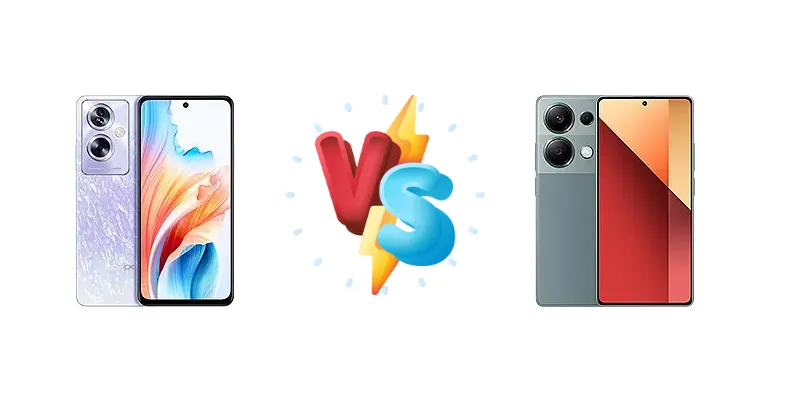
The Oppo A2 and Xiaomi Redmi Note 13 Pro 4G represent compelling options in the competitive sub-$300 4G smartphone market. While both devices share a similar CPU core configuration, key differences in charging technology, display brightness, and battery performance dictate which phone best suits different user needs. This comparison dives deep into the specifics to reveal the optimal choice.
🏆 Quick Verdict
For the average user prioritizing convenience and speed, the Xiaomi Redmi Note 13 Pro 4G is the better buy. Its 67W charging, reaching 50% in just 16 minutes, significantly outperforms the Oppo A2’s 33W charging. While performance is comparable, the Redmi Note 13 Pro 4G’s brighter display also adds to its overall value.
| Network |
|---|
| 2G bands | GSM 850 / 900 / 1800 / 1900 | GSM 850 / 900 / 1800 / 1900 |
| 3G bands | HSDPA 850 / 900 / 2100 | HSDPA 850 / 900 / 1700(AWS) / 1900 / 2100 |
| 4G bands | 1, 3, 5, 8, 28, 34, 38, 39, 40, 41 | 1, 2, 3, 4, 5, 7, 8, 12, 13, 17, 18, 19, 20, 26, 28, 38, 40, 41, 66 |
| 5G bands | 1, 5, 8, 28, 41, 77, 78 SA/NSA | - |
| Speed | HSPA, LTE, 5G | HSPA, LTE |
| Technology | GSM / HSPA / LTE / 5G | GSM / HSPA / LTE |
| Launch |
|---|
| Announced | 2023, November 03 | 2024, January 15 |
| Status | Available. Released 2023, November 06 | Available. Released 2024, January 15 |
| Body |
|---|
| Build | - | Glass front (Gorilla Glass 5), plastic frame, plastic back |
| Dimensions | 165.6 x 76 x 8 mm (6.52 x 2.99 x 0.31 in) | 161.1 x 75 x 8 mm (6.34 x 2.95 x 0.31 in) |
| SIM | Nano-SIM + Nano-SIM | Nano-SIM + Nano-SIM |
| Weight | 193 g (6.81 oz) | 188 g (6.63 oz) |
| Display |
|---|
| Protection | Panda glass | Corning Gorilla Glass 5 |
| Resolution | 1080 x 2400 pixels, 20:9 ratio (~392 ppi density) | 1080 x 2400 pixels, 20:9 ratio (~395 ppi density) |
| Size | 6.72 inches, 109.0 cm2 (~86.6% screen-to-body ratio) | 6.67 inches, 107.4 cm2 (~88.9% screen-to-body ratio) |
| Type | IPS LCD, 90Hz, 680 nits (peak) | AMOLED, 1B colors, 120Hz, 500 nits (typ), 1000 nits (HBM), 1300 nits (peak) |
| Platform |
|---|
| CPU | Octa-core (2x2.2 GHz Cortex-A76 & 6x2.0 GHz Cortex-A55) | Octa-core (2x2.2 GHz Cortex-A76 & 6x2.0 GHz Cortex-A55) |
| Chipset | Mediatek Dimensity 6020 (7 nm) | Mediatek Helio G99 Ultra |
| GPU | Mali-G57 MC2 | Mali-G57 MC2 |
| OS | Android 13, ColorOS 13.1 | Android 13, up to 3 major Android upgrades, HyperOS |
| Memory |
|---|
| Card slot | microSDXC | microSDXC (uses shared SIM slot) |
| Internal | 256GB 12GB RAM, 512GB 12GB RAM | 128GB 8GB RAM, 256GB 8GB RAM, 256GB 12GB RAM, 512GB 8GB RAM, 512GB 12GB RAM |
| Main Camera |
|---|
| Dual | 50 MP, f/1.8, (wide), PDAF
Auxiliary lens | - |
| Features | LED flash, HDR, panorama | LED flash, HDR, panorama |
| Triple | - | 200 MP, f/1.7, 23mm (wide), 1/1.4", 0.56µm, multi-directional PDAF, OIS
8 MP, f/2.2, 15mm, 120˚ (ultrawide), 1/4.4", 1.0µm
2 MP (macro) |
| Video | 1080p@30fps | 1080p@30/60fps |
| Selfie camera |
|---|
| Features | HDR | - |
| Single | 8 MP, f/2.0, (wide) | 16 MP, f/2.4, (wide), 1/3.0", 1.0µm |
| Video | 1080p@30fps | 1080p@30/60fps |
| Sound |
|---|
| 35mm jack | Yes | Yes |
| Loudspeaker | Yes, with stereo speakers | Yes, with dual speakers |
| Comms |
|---|
| Bluetooth | 5.3, A2DP, LE, aptX HD | 5.2, A2DP, LE |
| Infrared port | - | Yes |
| NFC | No | Yes (market/region dependent) |
| Positioning | GPS, GALILEO, GLONASS, BDS, QZSS | GPS, GLONASS, GALILEO, BDS |
| Radio | No | FM radio |
| USB | USB Type-C 2.0, OTG | USB Type-C 2.0, OTG |
| WLAN | Wi-Fi 802.11 a/b/g/n/ac, dual-band | Wi-Fi 802.11 a/b/g/n/ac, dual-band |
| Features |
|---|
| Sensors | Fingerprint (side-mounted), accelerometer, proximity, compass | Fingerprint (under display, optical), accelerometer, gyro, compass |
| Battery |
|---|
| Charging | 33W wired, 51% in 30 min | 67W wired, 50% in 16 min, 100% in 46 min |
| Type | Li-Po 5000 mAh | 5000 mAh |
| Misc |
|---|
| Colors | Mystery Black, Glowing Green, Violet | Midnight Black, Lavender Purple, Forest Green |
| Models | PJB110 | 23117RA68G, 2312FPCA6G |
| Price | About 220 EUR | € 92.00 / $ 269.99 / £ 299.99 |
| SAR | - | 1.09 W/kg (head) 1.09 W/kg (body) |
| SAR EU | - | 0.99 W/kg (head) 0.99 W/kg (body) |
Oppo A2
- Potentially slightly better power efficiency due to 7nm Dimensity 6020.
- Clean and streamlined software experience (typical of Oppo).
- Competitive price point.
- Slower 33W charging.
- Likely lower peak display brightness.
Xiaomi Redmi Note 13 Pro 4G
- Significantly faster 67W charging.
- Brighter 1047 nit display for better outdoor visibility.
- Longer battery life during active use (11:36h).
- Helio G99 Ultra optimized for gaming.
- Xiaomi’s MIUI software can be feature-rich but also bloated.
- Potentially slightly less power efficient than the Dimensity 6020.
Display Comparison
The Xiaomi Redmi Note 13 Pro 4G boasts a significantly brighter display, reaching a measured peak brightness of 1047 nits. This is a crucial advantage for outdoor use, where the Oppo A2’s unspecified brightness will likely struggle in direct sunlight. While both phones likely utilize AMOLED panels (based on market segment), the Redmi Note 13 Pro 4G’s higher peak brightness provides a superior viewing experience. Bezels are expected to be similar on both devices, given their price points, and color accuracy will likely be adequate for general consumption, though professional color work would benefit from calibration.
Camera Comparison
Detailed camera specifications are limited, but the Redmi Note 13 Pro 4G is expected to feature a more sophisticated camera system. While both phones likely include a primary camera, the Redmi Note 13 Pro 4G’s sensor size and aperture are likely larger, resulting in better low-light performance. The Oppo A2’s camera is likely focused on providing adequate image quality for social media sharing, while the Redmi Note 13 Pro 4G aims for a more versatile photography experience. We can expect both phones to include standard features like HDR and portrait modes, but the Redmi Note 13 Pro 4G’s image processing algorithms are likely more refined.
Performance
Both the Oppo A2 and Xiaomi Redmi Note 13 Pro 4G are powered by octa-core CPUs featuring the same core configuration: 2x2.2 GHz Cortex-A76 and 6x2.0 GHz Cortex-A55. However, the chipset differs – the Oppo A2 uses the Mediatek Dimensity 6020 (7nm) while the Redmi Note 13 Pro 4G utilizes the Mediatek Helio G99 Ultra. The 7nm process of the Dimensity 6020 *could* offer slightly better power efficiency, but the Helio G99 Ultra is optimized for gaming. Real-world performance will be very similar for everyday tasks, but the G99 Ultra may exhibit a slight edge in sustained gaming scenarios. Both phones will likely pair this with 8GB of RAM, and LPDDR4X is the expected RAM type, limiting bandwidth compared to LPDDR5x found in higher-end devices.
Battery Life
The Xiaomi Redmi Note 13 Pro 4G shines in the battery and charging department. It achieves a 100% charge in just 46 minutes with its 67W wired charging, and reaches 50% in a mere 16 minutes. This is a significant advantage over the Oppo A2’s 33W charging, which takes 30 minutes to reach 51%. Furthermore, the Redmi Note 13 Pro 4G boasts an active use score of 11:36h, indicating superior battery endurance. While the Oppo A2’s battery capacity is not specified, the faster charging and longer active use time of the Redmi Note 13 Pro 4G make it the clear winner for users who prioritize battery life.
Buying Guide
Buy the Oppo A2 if you prioritize a clean software experience and are less concerned with rapid charging. It’s a solid all-rounder for everyday tasks. Buy the Xiaomi Redmi Note 13 Pro 4G if you value fast charging, a brighter display for outdoor visibility, and longer battery life during active use. It’s ideal for users who are frequently on the go and need a phone that can keep up.
Frequently Asked Questions
❓ Does the Helio G99 Ultra in the Redmi Note 13 Pro 4G get hot during prolonged gaming sessions?
While the Helio G99 Ultra is a capable gaming chip, it's not a flagship processor. Expect some thermal throttling during extended, graphically intensive gaming. However, the Redmi Note 13 Pro 4G likely incorporates thermal management solutions to mitigate overheating, and performance will remain acceptable for most mobile games.
❓ Is the 33W charging on the Oppo A2 slow compared to other phones in this price range?
Yes, 33W charging is relatively slow compared to the 67W charging offered by the Redmi Note 13 Pro 4G and increasingly common in this price segment. It will take significantly longer to fully charge the Oppo A2, which may be inconvenient for users who frequently need a quick power boost.
❓ How does the software experience differ between Oppo's ColorOS and Xiaomi's MIUI?
Oppo's ColorOS is generally considered to be cleaner and more streamlined than Xiaomi's MIUI. MIUI is known for its extensive customization options and feature set, but it can also feel bloated with pre-installed apps and unnecessary features. ColorOS prioritizes simplicity and ease of use.
❓ Will either phone receive significant software update support in the future?
Both Oppo and Xiaomi typically provide at least two major Android updates and several years of security patches for their devices. However, update support can vary depending on the specific model and region. Check the manufacturers' websites for detailed information on software update policies.